

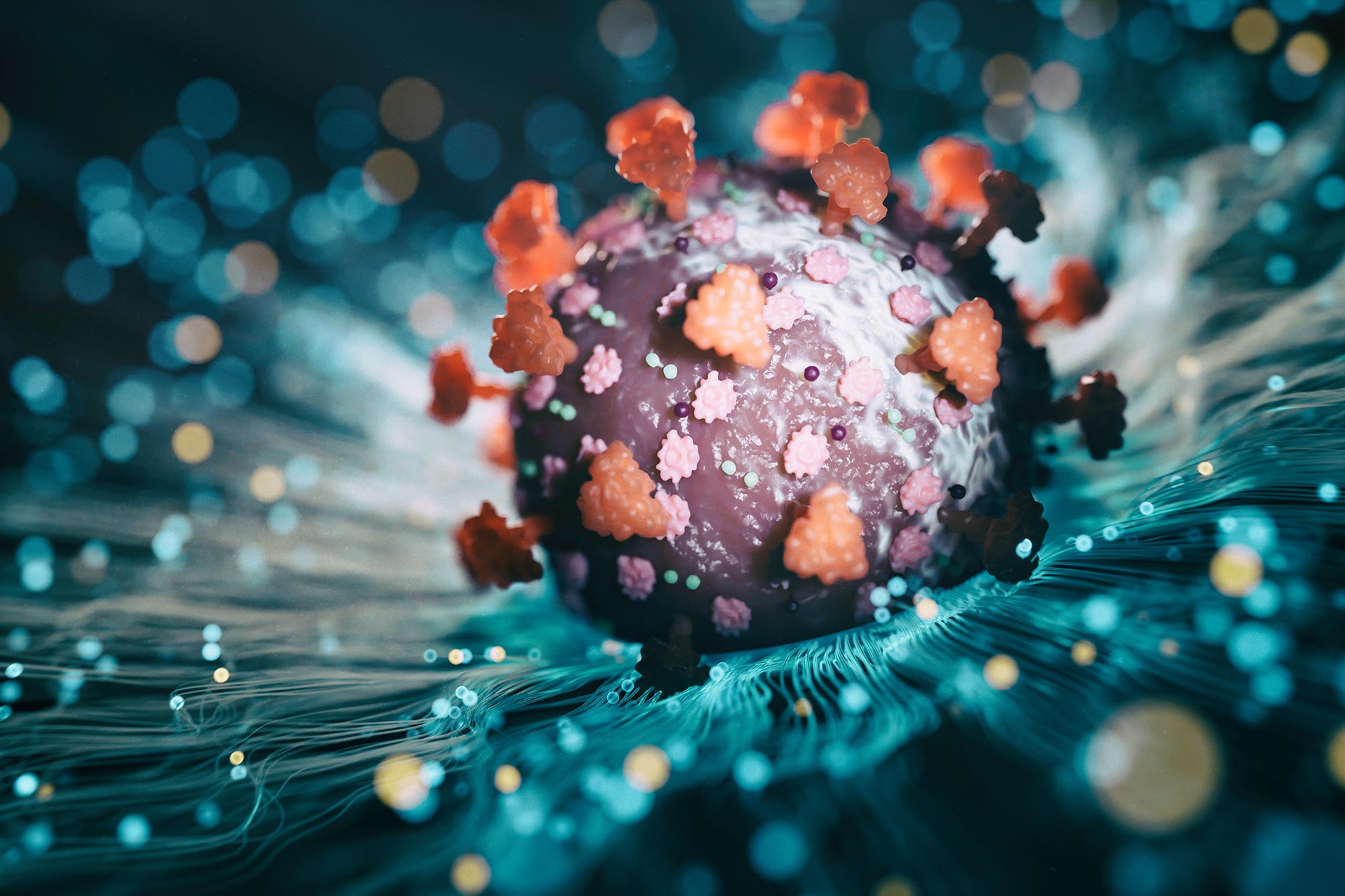
The Antiviral Drug Discovery (AViDD) Center at UCSF is pioneering the development of potent drug candidates aimed at preventing future coronavirus pandemics.
Researchers at UC San Francisco and the Gladstone Institutes have developed new drug candidates that show strong potential against the molecular docking program, a virtual system to test how different molecules interact with proteins, helped the team identify a few dozen molecular structures, out of millions, that mildly blocked MPro – a starting point for developing real-world drug candidates.
The Renslo lab then synthesized hundreds of new molecules based on the virtual molecules, which the Craik lab tested against MPro in the laboratory.
“We spent 18 months going back and forth with different molecules that fit reasonably well inside of MPro, but were still mediocre at blocking it,” Craik said. “Our progress stalled. Something had to give.”
Jamming the viral scissors
Two of Renslo’s post-doctoral researchers, Gilles DeGotte, PhD, and Luca Lizzadro, PhD, were responsible for designing and then making the new molecules in the lab. They were given a task “that in the pharmaceutical industry would have been assigned to a much larger team of medicinal chemists,” according to Renslo, who is a co-corresponding author of the paper.
Lizzadro improved the synthesis (like a recipe) for making the molecules and found a way to make them fit more snugly into the “active site” of MPro, blocking its ability to cut proteins, like jamming open a pair of scissors.
DeGotte, meanwhile, used “click chemistry” to improve the molecules’ fit in MPro even further. This involved introducing a molecular adapter that would make it easier to swap different chemical shapes onto each new drug candidate.
Tyler Detomasi, PhD, a post-doctoral researcher in the Craik Lab, showed that in two such molecules, named AVI-4516 and AVI-4773, the molecular adapter had, itself, bonded to the MPro active site. These molecules weren’t just a perfect fit for MPro – they were glued within the jaws of the scissors.
Fortunately, AVI-4516 and AVI-4773 didn’t block any human proteases, which are important for human health. Verba’s lab generated atomic-scale images of the compounds bound to MPro, helping the team to optimize the fit and prove that they were permanently stuck inside the viral enzyme.
“This was our lucky break and gave us some very special molecules,” Craik said. “They only react when they’re already inside this viral protease, but not to any of our own human proteases, giving us hope that they could have minimal side effects in people.”
A new generation of effective antivirals
With rising confidence that AVI-4516 and AVI-4773 effectively blocked MPro, Ott, a virologist, tested them against live SARS-CoV-2, first in petri dishes and then in mice.
Ott had tested hundreds of drug candidates against SARS-CoV-2 by this point.
“It’s very challenging to fight viruses in general, let alone SARS-CoV-2, but these new compounds were some of the best, if not the best, we had ever seen, in terms of eliminating infection,” said Ott, who is a co-corresponding author of the paper.
The two drug candidates looked promising as disease therapies. They potently blocked their target; they traveled efficiently through the body, ensuring they reached their target; and at least in mice, they appeared safe.
In a tantalizing follow-up experiment, a further-optimized version of the molecules effectively blocked variants of SARS-CoV-2 like Delta, as well as MERS, a less prevalent but much more deadly coronavirus.
The team believes their drug candidates, once shepherded through clinical trials to demonstrate safety in humans, could be kept “on the shelf” ready to fight the next pandemic caused by a coronavirus.
“These compounds are easy to modify and should be easy to manufacture,” Renslo said. “AViDD enabled us to discover important new counter measures for an important class of viral pathogens. It’s critical that we see this project through to clinical studies to ensure we’re better prepared for the next pandemic.”
Reference: “Structure-based discovery of highly bioavailable, covalent, broad-spectrum coronavirus MPro inhibitors with potent in vivo efficacy” by Tyler C. Detomasi, Gilles Degotte, Sijie Huang, Rahul K. Suryawanshi, Amy Diallo, Luca Lizzadro, Francisco J. Zaptero-Belinchón, Taha Y. Taha, Jiapeng Li, Alicia L. Richards, Eric R. Hantz, Zain Alam, Mauricio Montano, Maria McCavitt-Malvido, Rajesh Gumpena, James R. Partridge, Galen J. Correy, Yusuke Matsui, Annemarie F. Charvat, Isabella S. Glenn, Julia Rosecrans, Jezrael L. Revalde, Dashiell Anderson, Judd F. Hultquist, Michelle R. Arkin, R. Jeffrey Neitz, Danielle L. Swaney, Nevan J. Krogan, Brian K. Shoichet, Kliment A. Verba, Melanie Ott, Adam R. Renslo and Charles S. Craik, 23 April 2025, Science Advances.
DOI: 10.1126/sciadv.adt7836
This work was supported by the National Insitute of Allergy and Infectious Diseases (NIAID) Antiviral Drug Discovery (AViDD) grant U19AI171110, other NIAID contracts (75N93019D00021, 75N93023F00001, HHSN272201800007I), the NIH Division of Intramural research, the Roddenberry Foundation, P. and E. Taft, and Gladstone Institutes.
Never miss a breakthrough: Join the SciTechDaily newsletter.
University of California – San Francisco
Read More