

Entertainment
While Caesars Entertainment’s brick-and-mortar business posted softer results, another excellent performance from the digital segment buoyed the operator in Q1.
In its results for the three months ended 31 March, published Tuesday, Caesars posted $2.8 billion (£2 billion/€2.5 billion) in group net revenue, up 2% YoY.
Adjusted EBITDA grew 4% from $853 million in the prior quarter to $884 million this year. On its balance sheet, the company had $884 million in cash as of 31 March and $12.3 billion in total debt. Those were both up slightly from $866 million and $12.29 billion as of 31 December respectively.
Caesars’ Las Vegas net revenue for the quarter was just over $1 billion, down 2% from last year. However, as officials noted several times on the investor call, this was a “tough comparison” given that the city hosted the Super Bowl last February. Adjusted EBITDA for Las Vegas was flat at $433 million.
Regional revenue came in at $1.38 billion, a YoY increase of 1.7%, with adjusted EBITDA of $440 million (+1.6%). Unfavourable regional weather patterns were noted by officials, as well as the terrorist attack in New Orleans on 1 January that killed 14 and subsequently muted performance in that market.
But the star of the show was again Caesars Digital, which has been the company’s primary growth driver for several quarters. The segment posted a 19% increase in net revenue to $335 million, and $43 million in adjusted EBITDA compared to $5 million the prior year. Eric Hession, who leads the division, said players are “responding favourably” to recent updates and game content.
Rumours of digital spin-off swirling
The performance of Caesars Digital has led many to speculate whether it could be spun off into a separate business. Adding to those rumours were the 18 March appointments of two new directors to Caesars’ board, both from Carl Icahn’s Icahn Enterprises.
Icahn has a long history with Caesars, having spearheaded the company’s sale to Reno-based Eldorado Resorts in 2020. The billionaire activist investor sold his position after the sale but generated buzz by again increasing his stake last spring. He said in a statement following the board appointments that he looked forward to “exploring strategic alternatives for the Company’s underappreciated digital business”.
CEO Tom Reeg, in response, told iGB at the East Coast Gaming Congress that Icahn “sees the same thing we see in an undervalued equity and an opportunity to change that through digital”. Asked again Tuesday by Truist analyst Barry Jonas about these rumours, Reeg seemed open to exploring all possibilities.
“Our job is to deliver the numbers we have laid out starting in [2021],” he asserted. “We are well on that path, our goals are in our windshield. … We will look at any and all options to create value for shareholders. But we are mindful that the first thing we need to do is deliver the numbers.”
Caesars Digital is now live in some form in 32 North American jurisdictions, according to an investor presentation.
Macro trends front of mind for Caesars
Given that Caesars operates both destination and regional casinos throughout the US, macroeconomic trends were front and centre from both the company and analysts. Global economic markets have swung in recent weeks in response to US tariffs, and fears of a recession are growing.
In the midst of Covid, Caesars was lauded perhaps more than any casino operator for its effective cost-cutting measures. Officials downplayed current economic fears but referenced those experiences in response to questions.
“If we were to start to see softness, we have levers that we can pull that you saw as we came out of the pandemic, where we were able to outperform peers in the market by tapping into our database,” Reeg said. He later added that “we still do not see any of the consumer softness investors seem to be worried about”.
Reeg pointed multiple times to future bookings, which he said were strong. He also noted that unlike during Covid, the company now has a strong digital component to fall back on. “We have never had, in a prior downturn, a segment that is growing for us like digital,” he told analysts.
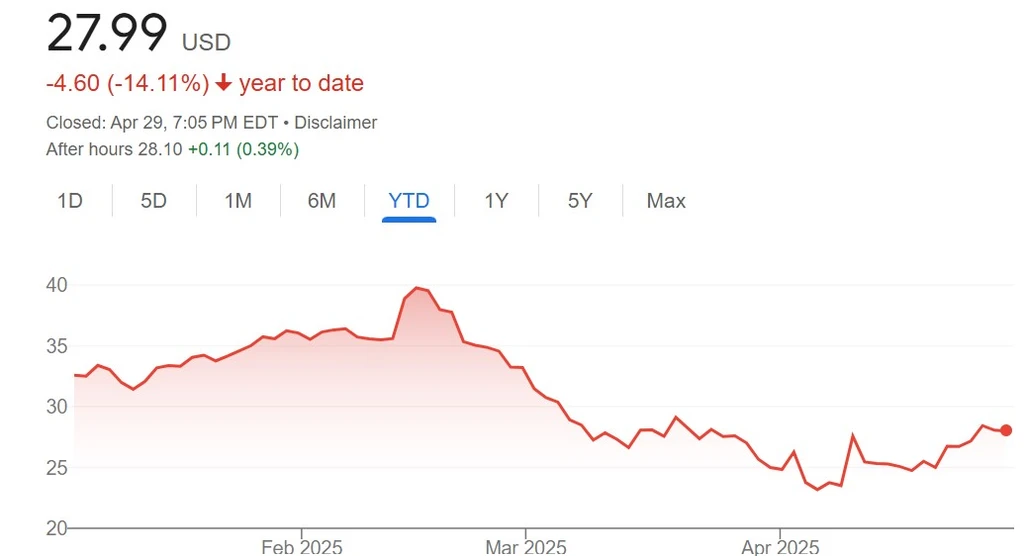
Stock repurchases were also a topic of interest. Reeg said Caesars would be “opportunistic”, especially “if the stock dislocates like it did in early April”. On the heels of the tariff announcements, Caesars shares fell to about $23 before climbing back to the high $20s in recent weeks.
Other happenings in the industry
In addition to Caesars’ developments, Reeg offered comment on several other industry trends Tuesday. One of those trends was tax increases. Since the start of 2024 numerous states have either imposed or discussed imposing significant tax raises for online gambling. Even states that are typically seen as pro-gaming, most notably New Jersey, are pushing to raise rates.
Reeg said this was “symptomatic” of states facing budget shortfalls now that federal Covid funds are drying up. “I’m not surprised at all [state lawmakers] are looking at gaming,” he lamented.
Conversely, he viewed this sentiment in a positive light with regards to legalisation efforts. Now that efforts in Nebraska and Hawaii have largely fallen through, 2025 could be the first post-PASPA calendar year with no new sports betting or igaming markets. If budgets are stretched tight enough, Reeg said, legalisation becomes a lot more palatable.
“[The online gaming industry] will be a popular place to be,” he surmised.
The Caesars CEO also touched on prediction markets, the financial exchanges that allow users to trade contracts on sporting events. Kalshi, the most prominent prediction market, was sent cease-and-desist orders from a bevy of state regulators but has been granted preliminary injunctions in Nevada and New Jersey. A hearing organised by the Commodity Futures Trading Commission was scheduled for 30 April but was canceled last week.
Caesars has seen “zero impact” from prediction markets thus far, Reeg told analysts.
Read More
Jess Marquez