


The legalization of sports betting has fueled a nationwide addiction crisis.
With billions wagered and online sportsbooks making betting effortless, help-seeking for gambling addiction has hit record highs. Yet, public health efforts remain dangerously inadequate. Without urgent reforms—stricter advertising, stronger betting safeguards, and expanded treatment services—the crisis will only worsen.
Surge in Gambling Addiction Following Legalization of Sports Betting
A new study published today (February 17) in JAMA Internal Medicine by researchers at the University of California San Diego Qualcomm Institute and School of Medicine highlights a sharp rise in sports betting and gambling addiction help-seeking. This increase has followed the 2018 Murphy v. NCAA Supreme Court decision, which allowed states to legalize sports betting.
“When the Supreme Court legalized sportsbooks — a venue where people can wager on various sports competitions — in Murphy v. NCAA, public health experts paid little attention,” said the study’s senior author John W. Ayers, Ph.D., who is vice chief of innovation in the Division of Infectious Disease and Global Public Health, deputy director of informatics at UC San Diego Altman Clinical and Translational Research Institute (ACTRI), and Qualcomm Institute scientist. “Now, sportsbooks have expanded from a single state to 38 states, with hundreds of billions of wagers, mostly online, coinciding with record-breaking demand for help with gambling addiction as millions seek help.”
Unprecedented Growth in Sports Betting
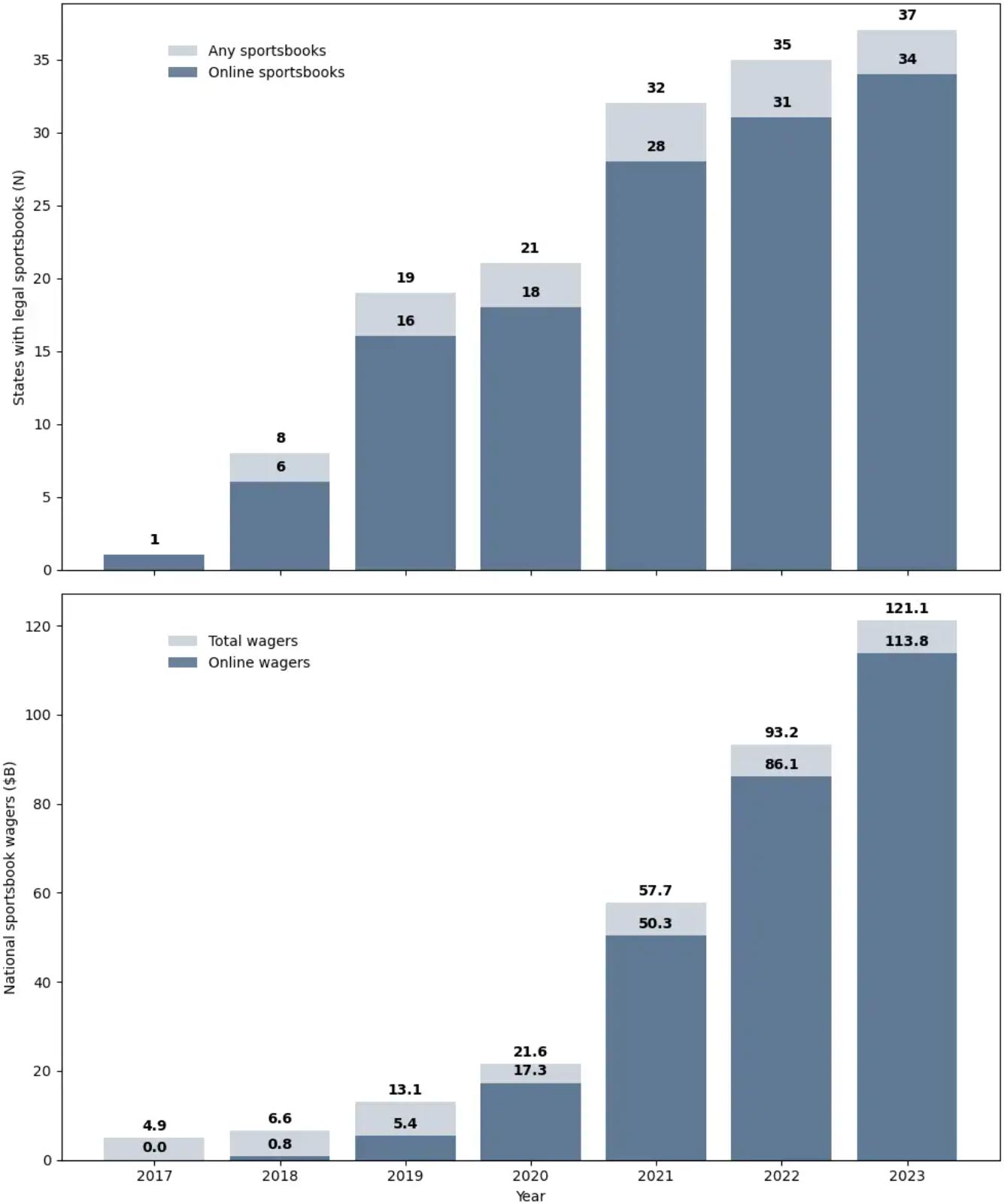
Since the 2018 Supreme Court ruling, the study documents staggering growth in the sportsbook industry:
- The number of states with operational sportsbooks grew from 1 in 2017 to 38 in 2024.
- Total sports wagers skyrocketed from $4.9 billion in 2017 to $121.1 billion in 2023, with 94% of wagers during 2023 placed online.
“Sports betting has become deeply embedded in our culture,” said Matthew Allen, a third-year medical student. “From relentless advertising to social media feeds and in-game commentary, sportsbooks are now everywhere. What was once a taboo activity, confined to the fringes of society, has been completely normalized.”
The researchers note these trends are projected to grow, in no small part due to the industry’s investment in sportsbooks as the future of gambling, as evidenced by Caesars Entertainment’s rebranding to Caesars Sportsbook and Casino.
A Public Health Blind Spot
“Despite gambling addiction as a recognized disorder in the Diagnostic and Statistical Manual of Mental Disorders, it remains largely overlooked in healthcare and public health with no formal ongoing surveillance,” said Kevin Yang, M.D., a third-year resident physician in the Department of Psychiatry. “Without systematic surveillance, we are flying blind while millions bet on sports.”
To fill this gap, the research team analyzed aggregate Google search trends for queries that mentioned gambling, addiction, addict, anonymous or hotline, from January 1, 2016, through June 30, 2024.
“Many people struggling with addiction don’t openly discuss it, but they do turn to the internet for answers,” said Davey Smith, M.D., professor of medicine and director of ACTRI. “By analyzing search trends, we can gain real-time insight into the true scale of gambling addiction in the U.S.”
Record Levels of Gambling Addiction Help Seeking
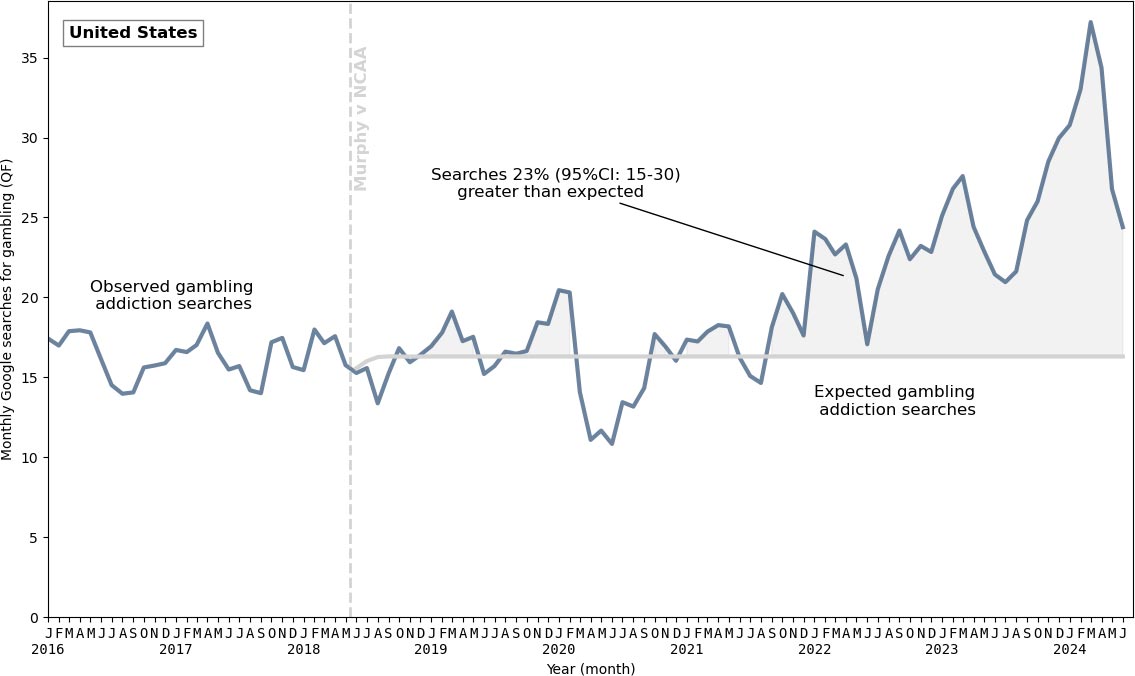
Parallel with the growth in sportsbooks, internet searches for help with gambling addiction, such as “am I addicted to gambling,” have cumulatively increased 23% nationally since Murphy v. NCAA through June 2024. This corresponds with approximately 6.5 to 7.3 million searches for gambling addiction help-seeking nationally, with 180,000 monthly searches at its peak.
By state, the opening of sportsbooks consistently corresponded with increased demand for gambling addiction help seeking. Illinois (35%), Massachusetts (47%), Michigan (37%), New Jersey (34%), New York (37%), Ohio (67%), Pennsylvania (50%) and Virginia (30%) all experienced significant increases in gambling addiction-related searches following the opening of any sportsbooks in their state.
“The significantly higher search volumes observed in all eight states make it virtually impossible that our findings occurred by chance,” said Atharva Yeola, a student researcher in the UC San Diego Qualcomm Institute. “Statistically speaking, the probability of these results happening randomly is less than one in 25.6 billion.”
Online Sportsbooks Drive Even Greater Risk
The study found that online sportsbooks had a substantially greater impact on gambling addiction help-seeking than traditional brick-and-mortar sportsbooks. For example, in Pennsylvania:
- The introduction of retail sportsbooks led to a 33% increase in gambling addiction help seeking searches during the five months before online sportsbooks launched.
- When online sportsbooks became available, searches surged 61%—a significantly greater and more sustained increase that persisted for years
“This pattern highlights the amplified risks associated with the accessibility and convenience of online sports betting,” added Adam Poliak, Ph.D., assistant professor of computer science at Bryn Mawr College.
Policy and Public Health Reforms Needed
“The expansion of legalized sports betting to always be at arm’s reach has outpaced our ability to understand and address its public health consequences,” said Nimit Desai, a third-year medical student. “Our findings are a wake-up call for policymakers, healthcare professionals and public health advocates to act now.”
To mitigate the risks posed by the expansion of sports betting, the researchers recommend the following interventions be explored:
- Increased funding for gambling addiction services using sportsbook tax revenues to ensure accessible, evidence-based treatment programs.
- Enhanced advertising regulations similar to those implemented for tobacco and alcohol to restrict where products can be advertised and who can be targeted.
- Clinical training programs for healthcare professionals to improve gambling addiction diagnosis and treatment.
- Stronger safeguards for online sportsbooks, including betting limits, age limits, enforced breaks and restrictions on credit card use for gambling.
- Expanded public awareness campaigns highlighting the risks and warning signs of gambling, reducing stigma and encouraging early intervention.
- Ongoing data sharing and research collaborations, uniting regulatory bodies, healthcare providers and regulators to assess the effectiveness of interventions and refine policies in real time.
“Sportsbook regulations are lacking because the Supreme Court, not legislators, legalized them,” concluded Ayers. “Congress must act now by passing commonsense safeguards. History has shown that unchecked industries—whether tobacco or opioids—inflict immense harm before regulations catch up. We can either take proactive steps to prevent gambling-related harms or repeat past mistakes and pay the price later.”
Reference: “Growing Health Concern Regarding Gambling Addiction in the Age of Sportsbooks” by Atharva Yeola, Matthew R. Allen, Nimit Desai, Adam Poliak, Kevin H. Yang, Davey M. Smith and John W. Ayers, 17 February 2025, JAMA Internal Medicine.
DOI: 10.1001/jamainternmed.2024.8193
University of California – San Diego
Read More