

The U.S. construction industry in 2025 looks like it will have both challenges and opportunities for businesses. While ConstructConnect predicts construction spending will grow by 5.2% this year, there’s still some uncertainty about what’s next. Here’s what’s behind the uncertainty and where you might find opportunities.
Why is Spending Expected to Grow?
U.S. construction starts, or projects that officially began, dropped by 3.5% last year. However, spending is expected to bounce back in 2025 for two main reasons: Easing financial regulations and potential interest rate cuts.
Michael Guckes, Chief Economist at ConstructConnect, says, “Lower interest rates will function as a first and necessary step in reinvigorating nonresidential construction activity, allowing more nonresidential construction projects to pencil out.”
Additionally, lower interest rates could make housing more affordable, which could lead to a rise in residential construction.
According to ConstructConnect, total nonresidential construction spending may grow by 5.7% this year, while residential spending could increase by 3.6%.
What Projects Could Grow the Most?
The demand for power generation is expected to be a driving force in the industry. This is due to the rise of electric vehicles and tech devices, an increase in the need for data centers, and progress in artificial intelligence.
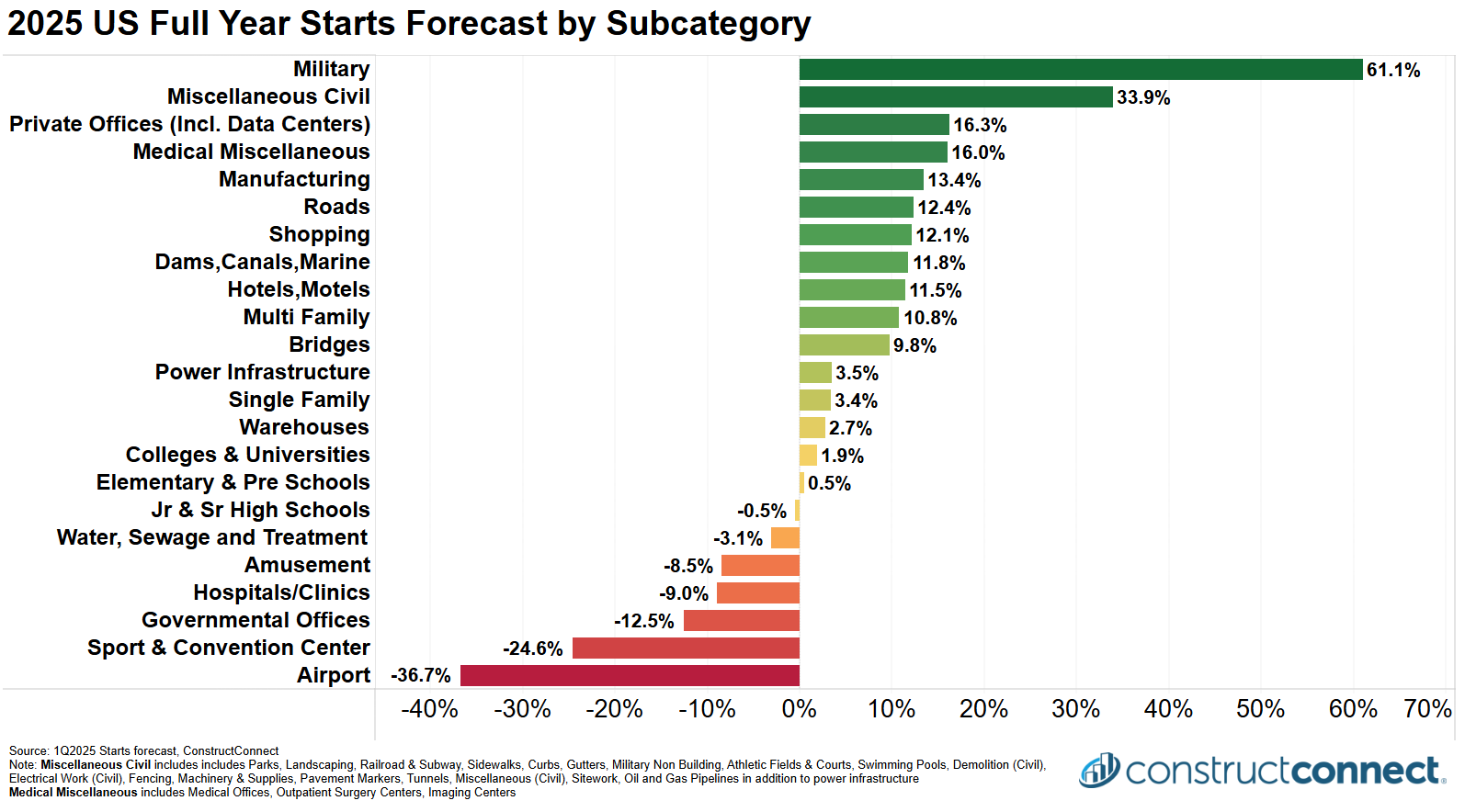
Spending on projects like wind and nuclear energy is predicted to reach record highs, boosting heavy engineering and civil construction. There’s also strong growth expected in manufacturing construction, which could rise 13.4% in 2025.
On the residential side, falling mortgage rates should help increase both single-family and multi-family housing projects after a 9% decline in 2024.
How Could Tariffs Affect the Market?
Even with growth predicted, tariffs on imported goods may still have a big impact. Higher material costs due to tariffs could lead some companies to consider domestic manufacturing instead.
“If enough manufacturers choose this path, it could substantially enhance the growth trajectory of U.S. manufacturing construction over our forecast period. However, those firms opting for this strategy face considerable risks,” says Guckes.
These risks include the challenges of setting up new manufacturing while maintaining profits. Businesses also need to be careful about the possibility that tariffs could be lifted at any time.
“Otherwise,” Guckes adds, “the addition of this new capacity, followed shortly thereafter by the removal of tariffs, could see the market swell with excessive product volumes, sending prices and profits lower.”
Guckes advises companies to stay calm and strategic. In his new commentary, Tariffs in Perspective, Guckes says, “(I)n the post-COVID economy, many companies have improved their understanding of supply chains. We recommend revisiting best practices from that time to keep inventory levels in check and control costs effectively.”
Other Challenges
Besides concerns about material costs, labor shortages are another big challenge. These shortages could get worse if stricter immigration rules are put in place.
The long-term effects of new policies will depend on how they are carried out. As Guckes explains, “While some policies may have ambiguous outcomes—such as heightened tariffs—how these policies are executed may be the greatest determinant as to whether such policies produce a net benefit for the industry or not.”
Looking Ahead
ConstructConnect’s forecast for 2025 encourages businesses to think strategically and take advantage of opportunities in the market.
According to Guckes, “Industry leaders who can find ways to benefit from [President Donald Trump] and Congress’ agenda, while minimizing their exposure to the risks of that agenda, may find their next few years to be quite rewarding.”
To learn more about what 2025 holds for the industry, check out The Construction Economy Yearbook. This user-friendly guide offers future insights and lessons from 2024.
Also, join us on May 8, 2025, for The Construction Economy Outlook Spring 2025. This free webcast features Guckes and other top economists discussing trends and opportunities for the year. Register now, and you’ll have the chance to get your questions answered by an expert.
See Related Posts
Construction Industry News

Read More
Georgianna Wrona