
Bitcoins
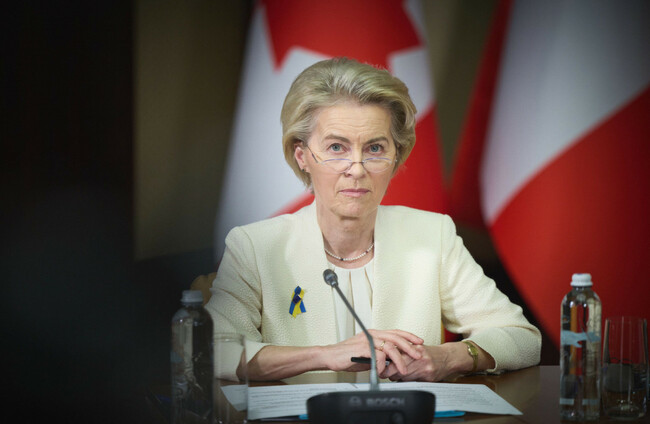

European Commission President Ursula von der Leyen Alamy Stock Photo
dangerous times
Von der Leyen also said that more of the EU budget would be diverted into investments in the defence sector.
LAST UPDATE
|
4 Mar
IRELAND WILL BE incentivised to “massively boost” spending on military capability and defence systems, as the EU enters an “era of rearmament”, under plans announced by the European Commission President today.
Ursula von der Leyen said that Europeans are living in “dangerous times” and that it is time for member states to “step up”, before laying out her €800bn ‘ReArm Europe’ plan, to facilitate massive increases in spending on defence.
The plan completely reforms spending rules for member states, and changes budgetary arrangements to allow governments to jointly-borrow funds to spend on defence systems, such as radar and fighter jets.
It also eases restrictions on overspending in individual member states’ budgets, which would normally come with significant penalties.
Such changes have caused anger among some members of the opposition in Ireland, who argue that the EU could have made similar arrangements and ease those restrictions in cases where money is spent on issues such as housing and healthcare.
However, defending the announcement, von der Leyen said the changes will allow member states to significantly increase their defence expenditures without impacting funds that are directed to those issues.
Additionally, member state governments will jointly enter procurement procedures – previously used during the allocation of Covid-19 vaccines – and that €150bn in loans will be made available to member states.
We are living in dangerous times.
Europe‘s security is threatened in a very real way.
Today I present ReArm Europe.
A plan for a safer and more resilient Europe ↓ https://t.co/CYTytB5ZMk
— Ursula von der Leyen (@vonderleyen) March 4, 2025
Separately, von der Leyen said the plan will allow member states to spend money collectively towards the individual defence of their nations.
The spending may be used for all types of domains, the European Commission President said, including air and missile defence, artillery systems, drones and anti-drone systems.
‘Cohesion funds’ – money which is used to finance inter-EU projects – may also be used to assist in the development of poorer European countries’ defence systems. A portion of the EU’s budget will also be diverted to joint investments into the defence sector as well.
The last two areas of the plan would involve the bloc’s lending arm the European Investment Bank – which EU states want to drop limits on lending to defence firms – and a savings and investments union to help companies access capital.
In total, the Commission President said the new plan could see “close to €800bn” being spent across the bloc.
“A new era is upon us,” von der Leyen said in a letter this morning. “Europe faces a clear and present danger on a scale that none of us has seen in our adult lifetime.”
‘Cynical’ decision
Politicians in Ireland have said today’s announcement from the European Commission was “cynically” using the war in Ukraine as a reason to change the rules around spending.
Sinn Féin TD Pearse Doherty said in the Dáil that spending rules have been “completely thrown out the window” in the announcement, and argued that it would’ve been more beneficial for the EU to allocate changes for issues such as housing and healthcare.
This opinion was shared by People Before Profit TD Paul Murphy: “Unfortunately, there hasn’t been a de-armament [in the EU] that they (European Commission) are reversing.
“Military spending has already been on a significant upward trend over the last number of years, and they’re talking about accelerating that even further.”
Despite the EU’s remit not including issues such as housing, healthcare or social protection, Murphy argued that spending rules could have been eased in relation to these issues, so member states have better access to funds.
Labour leader Ivana Bacik said von der Leyen’s claims that the EU needs to build up defences were correct, and pointed to concerns within the Baltic states over threats on their borders that “very clearly” highlight the need for a stronger focus on defence.
Bacik said, however, that the announcement has also reiterates the need for Ireland’s military neutrality to be constitutionally underpinned.
With reporting from AFP and Muiris Ó Cearbhaill
Want to know more about what’s happening in Ukraine and why? Check out our FactCheck Knowledge Bank for essential reads and guides to finding good information online.
Rubi Paris Read More