

Emerging technologies like robotics and artificial intelligence (AI) are replacing millions of people in the workforce, but new research suggests that the metaverse could put humans at the center of the manufacturing process once again.
Elsewhere, researchers at a Hong Kong university have devised a new lollipop-shaped gadget that simulates various flavors, giving users a real taste of the metaverse.
Human-centric manufacturing through the metaverse
The fourth industrial revolution, which began in the early 2010s, focused on integrating digital technologies into industrial processes, from the Internet of Things (IoT) and robotics to Big Data and, most recently, AI.
However, a new paper proposes that it’s time for the fifth industrial revolution, or Industry 5.0, which leverages the metaverse and other technologies to put humans at the heart of the industrial process once again.
Published in the peer-reviewed journal Sustainability, the paper notes that Industry 5.0 is a convergence of various technological advancements, ushering in an era of collaboration between humans and digital platforms and technologies. Specifically, it singled out the applications of augmented reality (AR) and virtual reality (VR), digital twins, and cyber-physical robotic systems. These advancements are underpinned by leaps in AI, Big Data, advanced analytics, and cloud-based simulations.
One key application would be in problem identification and resolution, the paper says. The metaverse can mirror industrial infrastructure onto a virtual domain, allowing humans to identify, predict, and solve issues before they escalate.
“This synthesis lays the foundation for intelligent factories characterised by unprecedented interconnectivity and automation,” the researchers say, adding that this cyber-physical production system would be fueled by blockchain, AI, digital twins, IoT, and extended reality.
On digital twins, the paper says that they must offer a virtual representation of physical systems and provide “unprecedented capability to monitor, analyse, and predict system behaviours.” Their real value must also be anchored in their ability to autonomously make decisions that boost system efficiency.
Blockchain has a big role to play too. First, its immutability makes it the ideal technology to store critical data, provide a platform for its verifiable and transparent transfer and enable trust.
“The harmonisation of blockchain with digital twins adds an additional layer of protection for data composing such virtual replicas, ensuring that they remain reliable and free from tampering.”
This approach has its challenges. High initial and maintenance costs and training time and costs are among the most significant hindrances.
The metaverse has already been integrated into some industrial processes with stellar results. In aerospace, some metaverse tech, such as AR, have become pivotal in non-destructive testing, which inspects for flaws without causing damage to aircraft components. The paper also cites a Chinese automotive manufacturer whose digital sales spiked after implementing metaverse-based interactions with customers. Robot-assisted manufacturing, underpinned by the metaverse and digital twins, was also found to reduce the operator’s workload and enhance workstation control.
“Manufacturing organisations should consider incorporating metaverse technology into their operations to harness its transformative potential,” the researchers concluded.
The paper paints a hopeful future where technological advancements don’t have to come at a human cost. Over the past five years, news headlines have been dominated by gloomy projections of up to 300 million people losing their jobs to AI. Other automation technologies have already replaced millions of workers, such as Amazon’s (NASDAQ: AMZN) pivot to using robots in its warehouses.
Tasting the metaverse
In Hong Kong, researchers have devised a new gadget that simulates taste flavors, giving the metaverse a new dimension.
The researchers from the City University of Hong Kong published a paper on the new device in 2024 but it was only recently made available. It describes a lollipop-shaped device with taste generators that stimulate nine distinct flavors, ranging from sugar and salt to milk and cherry.
The device is the latest effort by scientists to bring the virtual world into reality. However, most devices have focused on the other four human sensations—vision, auditory, haptics, and smell—and ignored gustation.
Prior taste devices relied on electrical stimulation to evoke the five basic flavors: salty, sweet, sour, bitter, and umami. They did this by controlling the intensity, frequency, and direction of electrical power on the human tongue. However, differences in gustation between individuals led to different simulations.
The Hong Kong researchers utilized iontophoresis in their new device, which pushes ions through biosafe hydrogels to transport tasteful chemicals at low electrical power.
The device is no bigger than a lollipop, which the researchers say is a massive achievement, as previous devices were much bigger and could only be used in scientific setups.
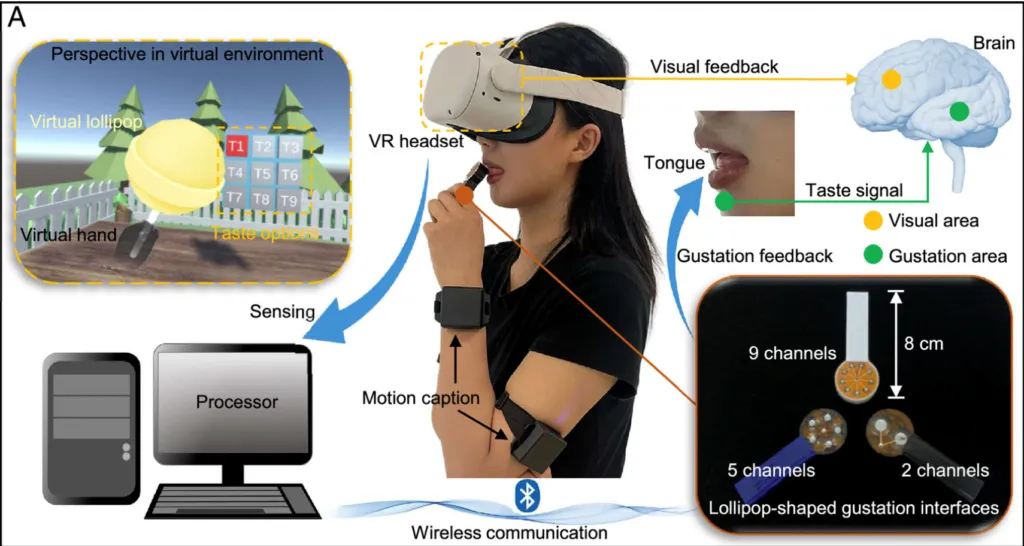
The new device brings the virtual world to life and, combined with other devices that simulate haptics, olfaction, and auditory sensations, could make VR and AR, and eventually the metaverse, an all-encompassing environment. Its applications are vast, from clients getting a taste of products before purchasing to entertainment and gaming purposes.
Researchers also believe the new device could have a massive impact on the medical field, where the metaverse has become increasingly popular in remote diagnosis, telemedicine, rehabilitation, and more.
Watch: The Web3 trifecta—AI, metaverse & blockchain
Tagged:
Read More
Steve Kaaru