

Also talks up the joys of the “rarely chosen path”
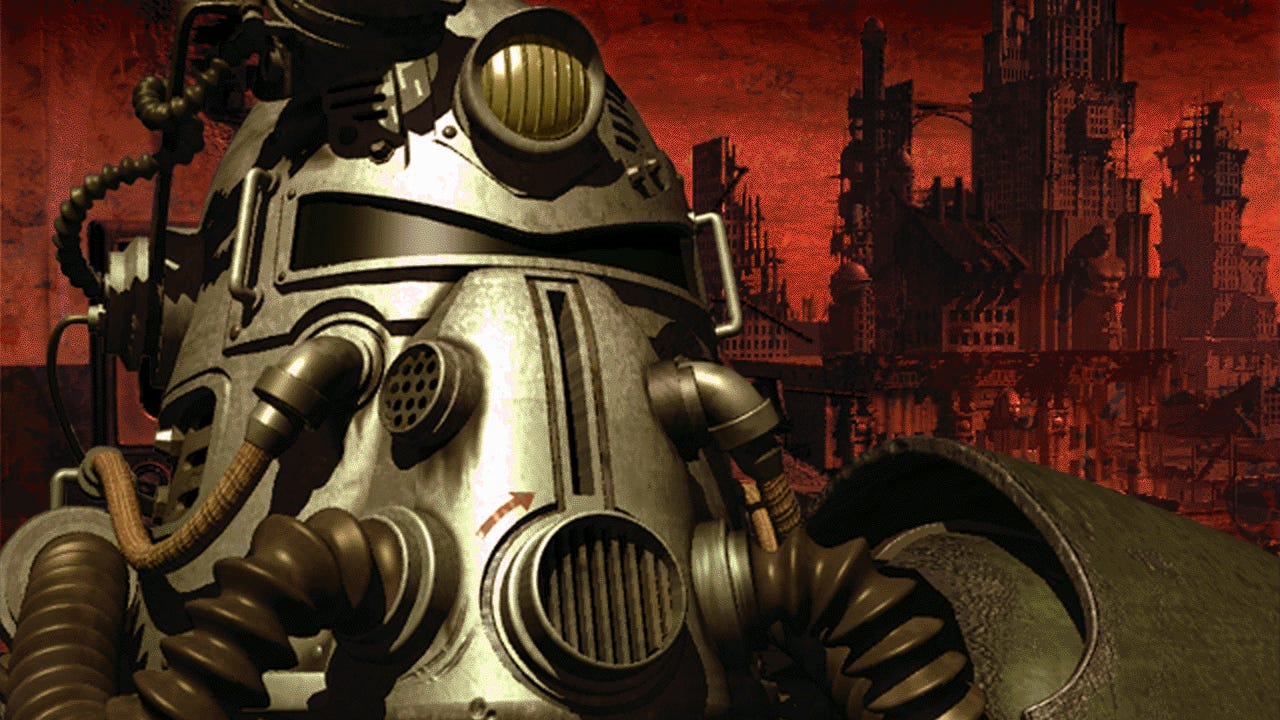
Image credit: Interplay Productions
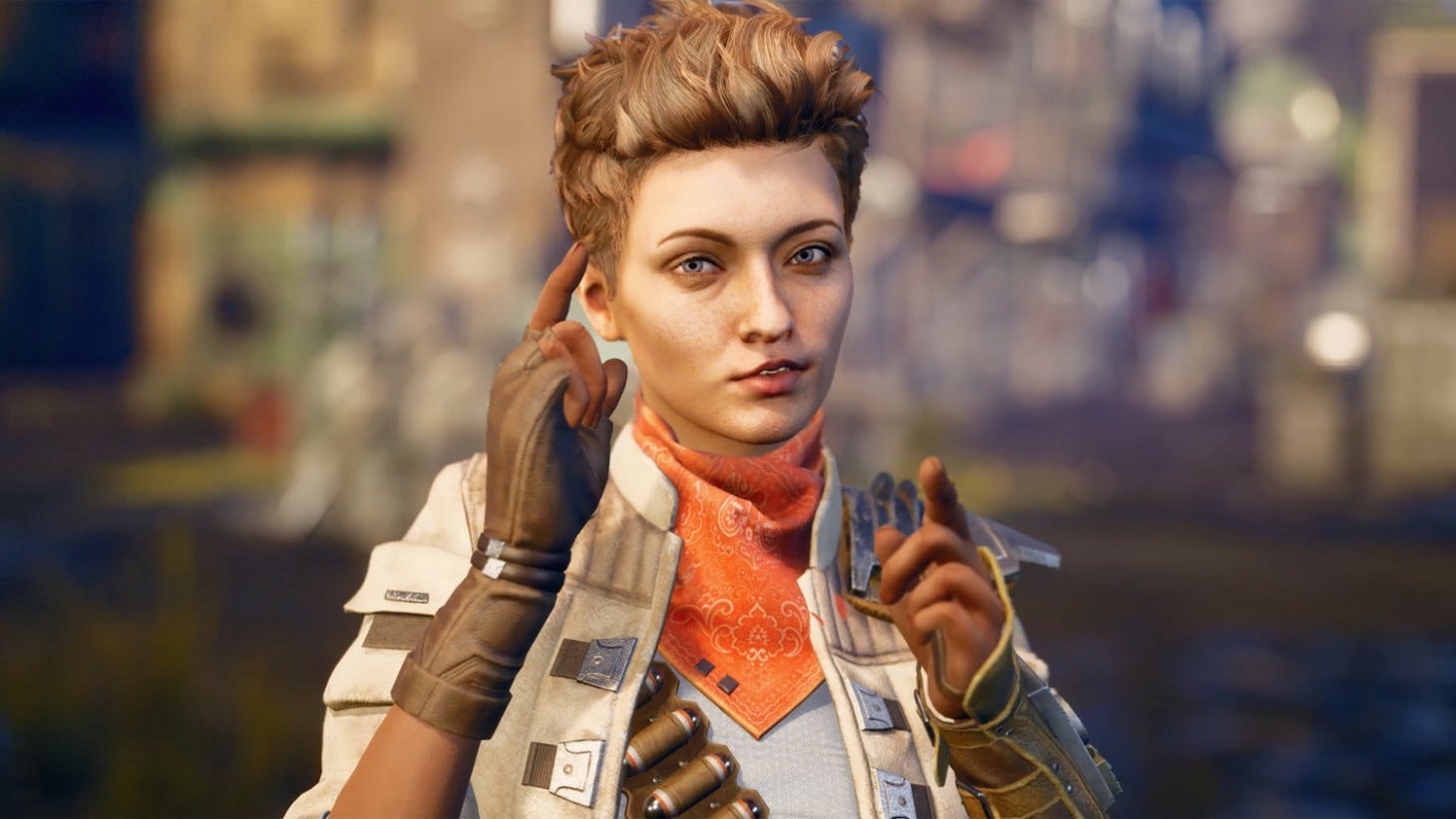
Original Fallout designer Tim Cain, also known for co-directing The Outer Worlds at Obsidian, has published a video responding to a player’s question about why violence is the “default” path in so many big budget RPGs. That’s specifically RPGs with “AAA” budgets, whatever AAA means these days. Cain is, of course, well aware that there are many RPGs from smaller teams that “evolve past the paradigm of violence being the default way in which the player interacts with the world”, and that there are plenty of puzzle games, adventure games and the like in which there is no violence at all.
His answer to the question isn’t very satisfying: violence is the focus at those production scales because games in which bashing, bruising and bloodening are central tend to sell more copies. If you’d like that to change, you must get off your arse and “vote with your dollars”. He does, however, have a few interesting reflections about his own experience as an RPG designer attempting to support more creative player approaches, whether peacenik or otherwise. Beyond that, the question of why violent games do numbers is always worth chewing over.
“I’ve always touted my RPGs as not only not needing violence, not needing you to make a combat character, but I don’t even tout that one as the default path – I don’t consider combat the main path and stealth and dialogue as the alternatives,” Cain comments in the video. “I’ve always said this game supports multiple paths – you want to talk your way through it, knock yourself out, you want to stealth your way through it, go for it. Even when there’s combat that has to be done, usually your companions can do it, or you can use stealth or dialogue to avoid it or reduce it so much that it becomes a relatively trivial fight.”
He points to the existence of easy modes, and more recently, story modes, as ways to sideline the process of decapitating elves and similar, even in games that prioritise violence. But the audience for such things is considerably smaller, he asserts, than the audience for wanton acts of elf murder. “There are options there, but people don’t take them as much. People play the non-story modes more often than story modes.”
Cain himself loves “rarely chosen paths” in RPGs, whether violent or non-violent, and is saddened by what he suggests is the mounting pressure in big budget RPGs to simplify everything to combat. “I put dumb dialogue in a lot of my games,” he says. “I like to support generalists or really bizarre specialists, and these are supported in my games.”
Even the original Fallout, published in 1997, isn’t as violence-led as the “war never changes” branding might indicate, Cain comments in the video. “You would think violence was the default in Fallout, but it really wasn’t. People frequently made quests and thought this isn’t what the player’s going to do, violence is not going to be the go-to in this one.”
Cain shares a few anecdotes from his play history of “rarely chosen paths”: being the first person to complete a 1-INT run of Fallout, playing Arcanum as a swordsman with no magic or technology, and surviving Temple Of Elemental Evil with a party of halfling bards. “A lot of games remove these less common paths and they see little to no reduction in sales, meaning there weren’t enough of you who liked those paths,” he gloomily observes.
Cain also makes some familiar observations about violent games lending themselves to more impactful trailers, with particular reference to why action RPGs, in his experience, outsell turn-based RPGs and the like. After all, it’s “easier to market those kind of games when you watch a trailer and you see people actually doing things – jumping, climbing, shooting, punching.”
Cain doesn’t really comment at all on the obvious broad question here: why people are drawn to violence in art and entertainment media at large, from the Homeric epics to the latest Netflix horror shows. I have many thoughts, most of them utterly vacuous. One is that depictions of violence tend to involve a subject and object. Considering violence apart from the question of what or who is being violent to who or what risks rendering the whole debate meaningless.
Another thought is that violence in video games is perhaps better read as a kind of kinetic, collaborative performance of metaphor and symbol, not the mere sating of a desire to do damage. I’ve written in the past about how turn-based combat systems remind me of poetic forms in being a cycling set of rules that are used to “compose” an encounter. Combat in such games is often a form of characterisation: party roles like tank, DPS or support correspond to particular narrative archetypes and personalities.
In shooters, meanwhile, guns are perhaps better interpreted as ways of calibrating the game’s spacetime. The range and rate at which they fire, whether they fire in a straight line or an arc, the choice of accompanying light and sound, the size of the clip – all these things are ways of setting the tempo, mapping the space, and determining how you frame and understand other entities. Hand me a slow-loading shotgun and I’ll start the level expecting a bunch of blind corners and point-blank quickdraw. I will develop a precise awareness of hand motions, details visible from certain orientations, and the seconds between an enemy looking my way and them noticing me. Hand me an assault rifle and I will tend to perceive enemies as a pleasantly mowable mass.
Thinking about violence this way makes me less glum about the undeniable bloodthirstiness of big budget games, from RPGs to open worlders. That said, I would absolutely love to play a “triple-A” RPG that prioritises non-violent methods. For example, a big budget video game adaptation of Alfred Valley’s pen-and-paper RPG Lay On Hands, which devotes all those triple-yay megabucks to the premise of being a travelling healer. It could still involve violence – can’t have a healer without some kind of violence, probably – but it would centre healing as a holistic vocation that extends across dialogue, community interactions and the battlefield. In the meantime, there’s Brendy’s tale of being a pacifist medic in Foxhole.
Edwin Evans-Thirlwell
Read More