

Music
(RNS) — There were three moments in the new Bob Dylan biopic “A Complete Unknown” that moved me to tears.
But, even before I get to the tears part, let me say that “A Complete Unknown” is a complete triumph. The performances (especially Timothée Chalamet as the young Dylan) were not simply imitations of the personalities in question — those performances were tributes. The movie is a celebration of a figure in popular culture who is more than a star; Dylan is a mythic figure.
So, what moved me?
The first time was seeing the young Bobby Dylan sitting at the bedside of veteran folk singer (we might even say the ur-folk singer) Woody Guthrie.
I find myself thinking of the December, 58 years ago, when I turned 12 years old. My birthday gift: my first guitar. My Hanukkah gift: a Bob Dylan song book, filled with songs and guitar chords.
That was how I first learned to play guitar. I was self-taught, and the first song I learned was “Mr. Tambourine Man.”
It changed my life. You might even say it defined my life.
The second time watching, I was struck by Edward Norton’s flawless performance as the iconic folk singer and activist Pete Seeger. He uncannily channels Seeger’s look, vocal inflections and mannerisms.
As far back as my early teens, I have loved Pete Seeger. I have availed myself of every opportunity to see him in concert: in the Berkshires, at college, wherever.
I admired his political struggles, especially his fight against the Red Scare. In the film, we see him before the House Un-American Activities Committee; in reality, this happened in 1955. It was one of several fictionalized accounts in the film. In later years, as I matured politically, I found Seeger’s support for Stalin, which he somewhat repudiated later in life, to be deeply troublesome.
I put those quibbles into a discrete mental file folder. I loved the man, his music, his passion and his sheer humanity.
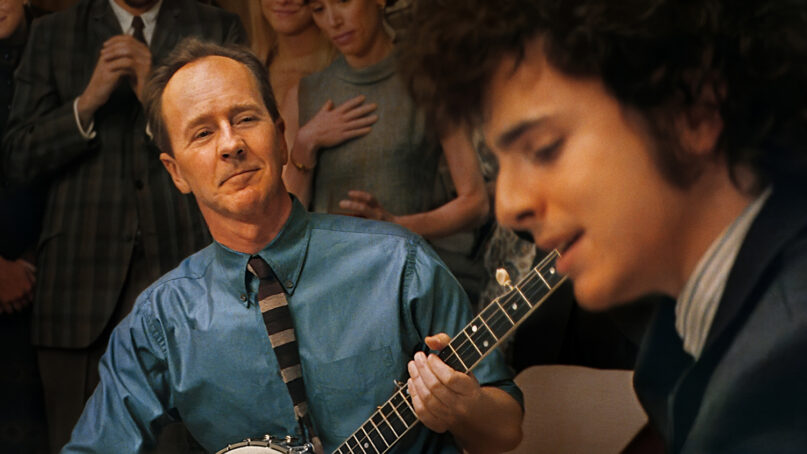
Edward Norton, as Pete Seeger, and Timothée Chalamet in “A Complete Unknown.” Photo by Macall Polay, courtesy of Searchlight Pictures
What was it about Pete Seeger in the movie that touched me? It was when we see him on stage, teaching the African song “Wimoweh” to a large crowd. In the 1950s, The Weavers, of which Pete was a member, popularized “Wimoweh.” I wore grooves out on their 1957 album “The Weavers at Carnegie Hall.” It was also the first time I heard the Israeli folk song “Tzena Tzena.” Pete and company were equal opportunity cultural importers. (He would have laughed at the notion of “cultural appropriation.”)
That scene, likewise, brought me back to my youth. My first guitar chords were Dylan’s. But, in subsequent years, I wanted to be Pete Seeger.
For much of my teens and early 20s, I was a song leader in the Reform youth movement. I taught and sang Jewish songs on weekend institutes, in dining halls at summer camp, at worship services. There were many of us. We found Israeli pop tunes and Hasidic songs, taught them and sang them. Most significantly, we wrote new songs, taught them and sang them. We would find a text that we liked — from prophets, Psalms or sayings by the sages — and write a melody for them.
Pretty soon, that music left camp and found its way into synagogues. In my files, I have a yellowed letter from a Reform cantor, ridiculing this music as being a fad that would quickly die. He was wrong. Rare is the Reform service without a guitar. Youth culture won.
Our musical forebears were (I hesitate to name names, so to speak, for fear of omitting good friends) the late Debbie Friedman and the duo Kol B’Seder (Rabbi Dan Freelander and Cantor Jeff Klepper), which recently celebrated their 50th anniversary. Their music is now traditional; Debbie’s “Mi Shebeirach” is part of the liturgical canon and way beyond the boundaries of the Reform movement. Kol B’Seder’s “Shalom Rav” is equally ubiquitous.
It was nothing less than an experience of transcendence. You could lead the same song 50 or 100 times and it never got boring.
A later generation of Reform song leaders and singer-songwriters all wanted to be Klepper-Freelander and/or Debbie Friedman.
The first generation, however — those of us who grew up in the 1960s and 1970s — we all wanted to be Pete Seeger. We saw and felt and heard how Pete could move and lift up a crowd, and we wanted to do that. And we succeeded.
We even used his repertoire. In the old days in the Reform youth movement, even as we were singing kibbutz songs, we were singing American folk songs at camp and youth events. Let me dig out my old NFTY Songster. There they are: “Ballad of the MTA;” “Die Gedanken Sind Frei” (“My Thoughts Run Free,” an old German folk song that Pete Seeger sang); the old spiritual “Follow the Drinkin’ Gourd”; “If I Had a Hammer”; “We Shall Overcome.” Song sessions at Reform Jewish youth events were like the Newport folk festival.
That’s what got to me about “A Complete Unknown.” We once again experienced the power of music to uplift and unite. It shaped and formed us.
Which leads me to the third time “A Complete Unknown” made me weep.
It was the segment in which Dylan made his infamous decision to go electric at the 1965 Newport Folk Festival. That violated a long-standing tradition: to present folk music in its acoustic purity. Bob had a different vision; he heard things differently. In the film, Johnny Cash urges Bob to “track some mud on the carpet” — to make a difference, to leave his mark. That is precisely what Dylan did. He sensed that electrified rock music was the new order of the day — that “the times they were a-changing.”
I was almost inexplicably moved by the film’s flawless rendition of “Like a Rolling Stone.” In 2004, and again in 2010, “Rolling Stone” ranked that song at No. 1 on its list of the “500 Greatest Songs of All Time.” It was not just the fact that the magazine shared its name with the song; the movie reminded me that “Like a Rolling Stone” is more than a great song; it is a great work of literature.
“How does it feel?” More like: “How did it feel?”
It was as if I knew my “direction home.”
RNS believes that matters of faith and spirituality aren’t just important; they shape our world. That’s why we’re committed to reporting on all the world’s religions, and showing how faith, and faith leaders, affect policy, politics, education, science, and almost any other issue you may care about. As a nonprofit newsroom, we depend on readers, just like you, for our support. If you value the articles, commentary and podcasts we provide, consider making a donation today to ensure we can keep the news coming in 2025.
Deborah Caldwell, CEO and Publisher