

SEOUL, South Korea – South Korea’s presidential guards and military troops prevented authorities from arresting impeached President Yoon Suk-yeol on Friday, January 3, in a tense six hour stand-off inside Yoon’s compound in the heart of Seoul.
Yoon is under criminal investigation for insurrection over his December 3 martial law bid that stunned South Korea and lead to the first arrest warrant to be issued for a sitting president.
“It was judged that it was virtually impossible to execute the arrest warrant due to the ongoing standoff,” the Corruption Investigation Office for High-ranking Officials (CIO) said in a statement.
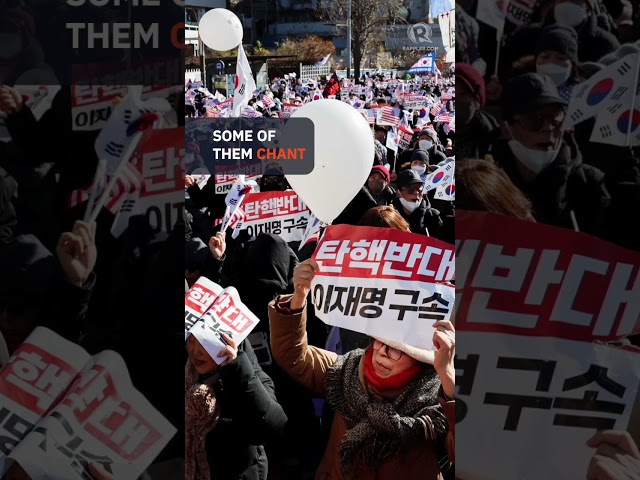
The CIO officials and police evaded hundreds of Yoon supporters who gathered in the pre-dawn hours near his residence on Friday, vowing to block the arrest “with our lives”.
Some chanted “President Yoon Suk-yeol will be protected by the people,” and called for the head of the CIO to be arrested.
Officials from the CIO, which is leading a joint team of investigators into possible insurrection charges related to Yoon’s brief declaration of martial law, arrived at the gates of the presidential compound shortly after 7 am (2200 GMT Thursday) and entered on foot.
Once inside the compound, the CIO and police were outnumbered by cordons of Presidential Security Service (PSS) personnel, as well as military troops seconded to presidential security, a CIO official told reporters.
More than 200 PSS agents and soldiers blocked the CIO officers and police, he added. While there were altercations and PSS agents appeared to be carrying firearms, no weapons were drawn, he said.
Yoon, who has been isolated since he was impeached and suspended from power on December 14, was not seen during the stand-off, he said.
South Korea’s defense ministry said the troops involved were under the control of the PSS.
The CIO called off the effort to arrest Yoon around 1:30 pm due to concerns over the safety of its personnel due to obstruction, and said it “deeply regretted” Yoon’s attitude of non-compliance.
The CIO said it would consider its next steps. The police, who are part of the joint investigation team, have designated the PSS chief and the deputy as suspects in a criminal case for obstruction of official duty and issued summons for them to appear for questioning on Saturday, Yonhap news reported.
Insurrection is one of the few criminal charges from which a South Korean president does not have immunity.
Yoon’s arrest warrant, approved by a court on Tuesday after he ignored multiple summons to appear for questioning, is viable until January 6.
In a statement after the arrest effort was suspended, Yoon’s legal team said the CIO had no authority to investigate insurrection and it was regrettable that it had tried to “forcibly execute an illegal and invalid arrest and search warrant” in a sensitive security area.
The statement warned police against supporting the arrest effort. The presidential office filed a criminal complaint against three broadcasters and YouTube channel owners for unauthorized filming of the presidential residence, which it said was “a secured facility directly linked to national security.”
The current warrant gives investigators only 48 hours to hold Yoon after he is arrested. Investigators must then decide whether to request a detention warrant or release him.
Kim Seon-taek, a Korea University law professor, said targeting the PSS leadership may allow the investigators to sap the service’s ability to put up resistance so they can try again to execute the warrant, which is “a rough way” to proceed.
A better way, he said, would be for acting President Choi Sang-mok to exercise his power to order the PSS to cooperate. Later on Friday, the CIO said it would ask Choi to give that order.
Choi’s office issued no comment on the arrest attempt.
Surprise martial law
Yoon sent shockwaves through Asia’s fourth-largest economy and one of the region’s most vibrant democracies with his late-night announcement that he was imposing martial law to overcome political deadlock and root out “anti-state forces”.
Within hours, however, 190 lawmakers had defied the cordons of troops and police to vote against Yoon’s order. About six hours after his initial decree, Yoon rescinded it.
He later issued a defiant defence of his decision, saying domestic political opponents are sympathetic to North Korea and citing uncorroborated claims of election tampering.
Two South Korean military officials, including army chief Park An-su who was named martial law commander during the short-lived declaration, have been indicted after being detained by prosecutors investigating insurrection charges, Yonhap reported on Friday.
Kim Yong-hyun, who resigned as Yoon’s defence minister after playing a major role in the martial law decree, has been detained and was indicted last week on charges of insurrection and abuse of power.
Separate from the criminal investigation, his impeachment case is currently before the Constitutional Court to decide whether to reinstate or permanently remove him.
A second hearing in that case was held on Friday and the court set the first oral arguments for January 14.
Yoon’s defense team, in arguing that there was no grounds for impeaching him, in its submission to the court cited a July 2024 US Supreme Court ruling that stated Trump had immunity for actions taken as president, Yonhap news reported.
North Korean state media published a detailed report on the political turmoil in the South, including the arrest warrant issued for Yoon, who it said “stubbornly refuses to be investigated, totally denying his crimes with sheer lies.”
North Korea has been harshly critical of Yoon, citing his hardline policy against Pyongyang as grounds in declaring the South a “primary foe” and announcing it had abandoned unification as a national goal. – Rappler.com
Reuters
Read More