

Music
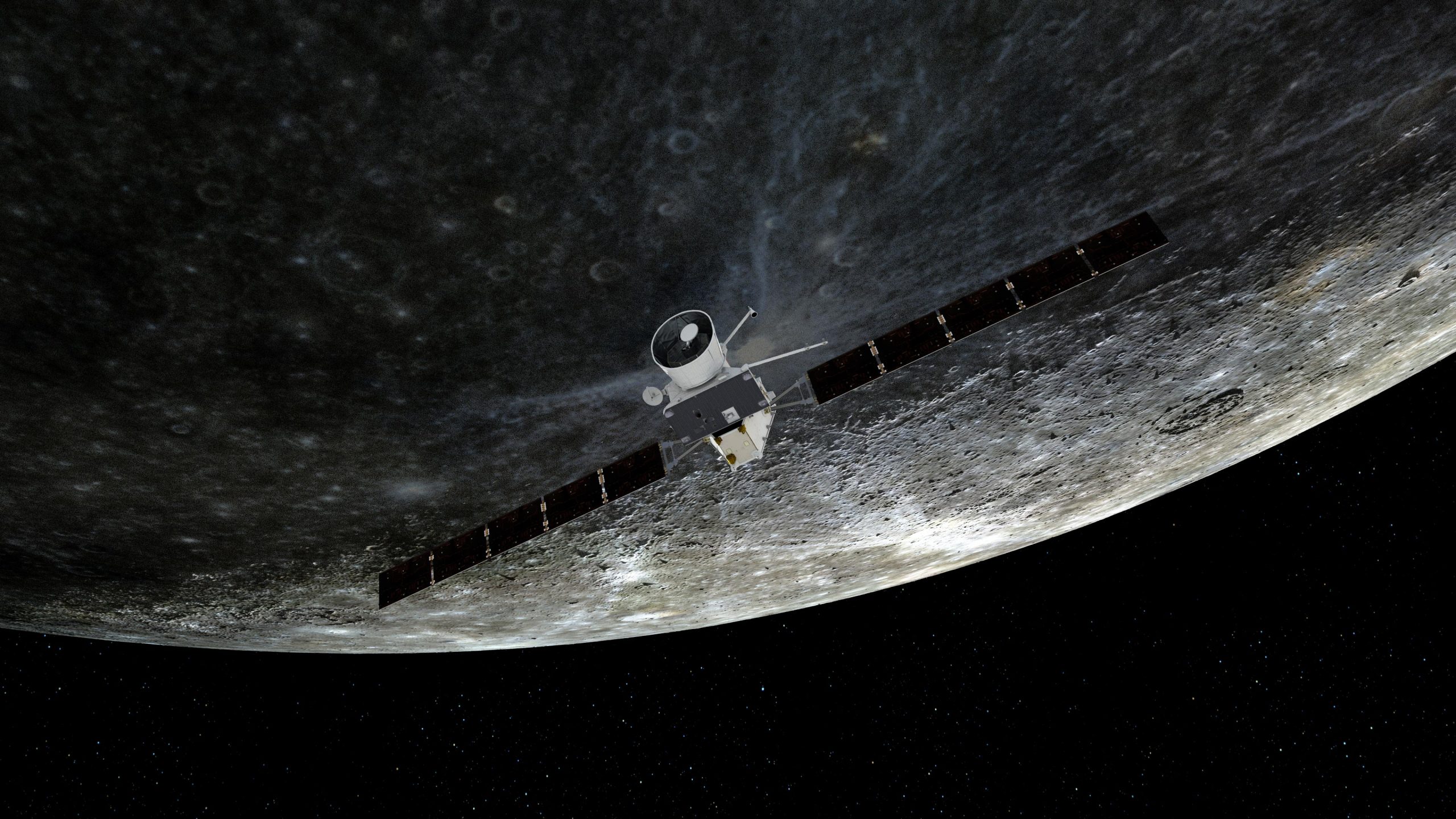
On September 4, 2024, the ESA/ESA/JAXA BepiColombo spacecraft sped past Mercury during its latest encounter on September 4, 2024.
This flyby marked BepiColombo’s closest approach to Mercury yet, and for the first time, the spacecraft had a clear view of Mercury’s south pole.
Capturing Mercury’s South Pole
This timelapse is made up of 128 different images captured by all three of BepiColombo’s monitoring cameras, M-CAM 1, 2, and 3. We see the planet move in and out of the fields of view of M-CAM 2 and 3, before M-CAM 1 sees the planet receding into the distance at the end of the video.
The first few images are taken in the days and weeks before the flyby. Mercury first appears in an image taken at 23:50 CEST (21:50
This crater was named after the famous Italian composer Antonio Vivaldi (1678–1741). The flyover of Vivaldi crater was the inspiration for using Antonio Vivaldi’s ‘Four Seasons’ as the soundtrack for this timelapse.
Peak ring basins are mysterious craters created by powerful asteroid or comet impacts, so-called because of the inner ring of peaks on an otherwise flattish floor.
A couple of minutes later, another peak ring basin came into view: newly named Stoddart. The name was recently assigned following a request from the M-CAM team, who realized that this crater would be visible in these images and decided it would be worth naming considering its potential interest for scientists in the future.
BepiColombo’s three monitoring cameras provided 1024 x 1024 pixel snapshots. Their main purpose is to monitor the spacecraft’s various booms and antennas, hence why we see parts of the spacecraft in the foreground. The photos that they capture of Mercury during the flybys are a bonus.
The September 4 gravity assist flyby was the fourth at Mercury and the seventh of nine planetary flybys overall. During its eight-year cruise to the smallest and innermost planet of the Solar System, BepiColombo makes one flyby at Earth, two at