

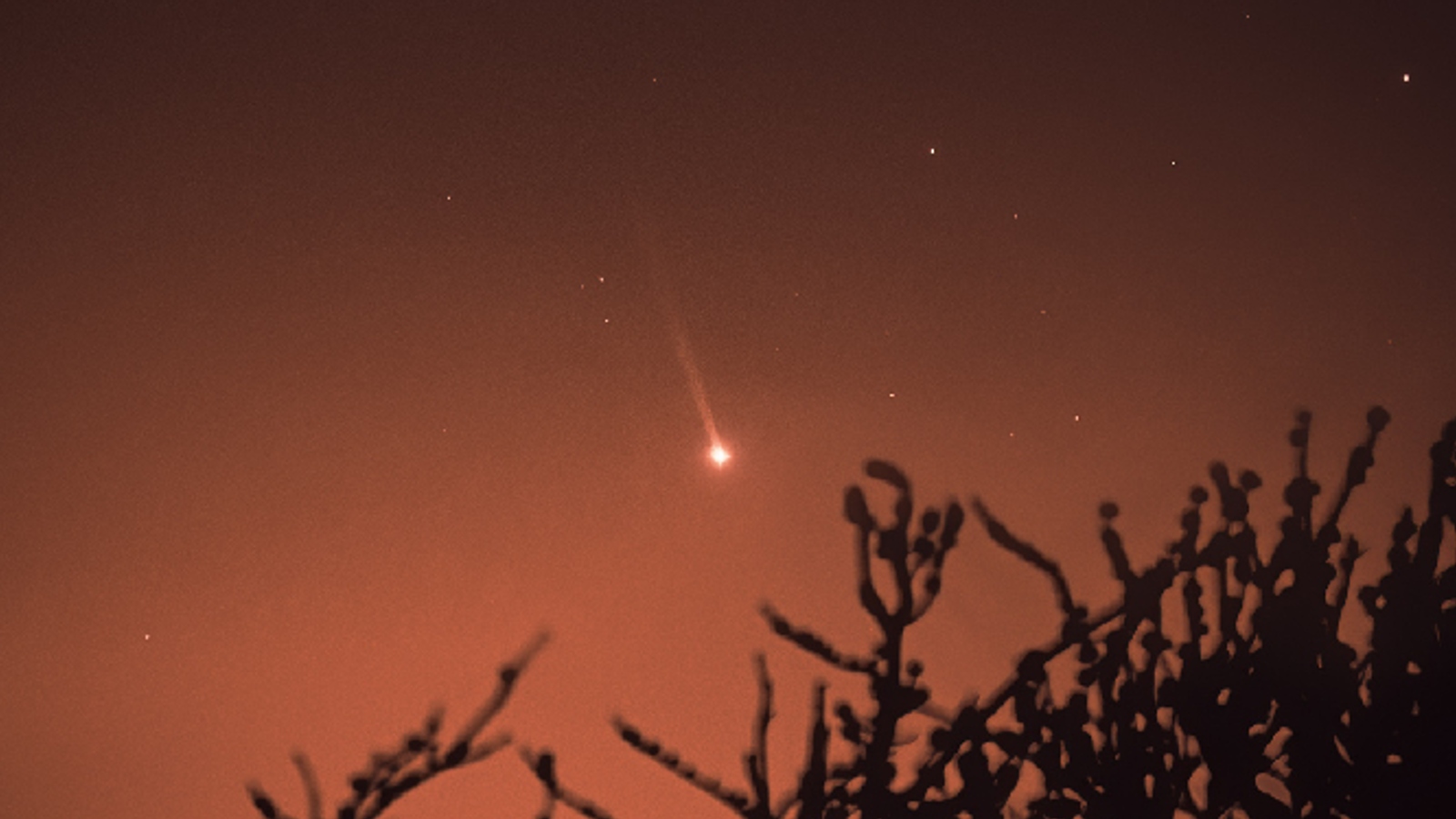
Mercury has been spotted cosplaying as a comet recently when the sun’s neighboring planet reached its nearest point to our star, exposing its massive, streaking tail in the night sky. One astrophotographer captured a truly epic shot of the charade.
Comets are orbiting chunks of frozen rocks, gases and dust that are almost always seen with distinctive twin tails trailing behind them — one made of gas that leaks from their interiors and another created by dust from their surfaces. These two tails are blown away from the comet in the same direction by charged particles from the sun known as solar wind.
Mercury, the solar system’s smallest planet, has a comet-like tail made predominantly of sodium ions, which are scattered from the planet’s surface by solar wind and micro-meteor impacts. Researchers have known about Mercury’s tail since 2001 and have since discovered that it grows and shrinks based on the planet’s proximity to the sun. At its peak, the tail stretches to around 14.9 million miles (24 million kilometers) long, according to Spaceweather.com (opens in new tab), which is around 62 times greater than the distance between Earth and the moon. The tail stretches this huge distance because Mercury has a very weak atmosphere and is close to the sun, which makes it easy for the solar wind to rip up the planet’s surface.
Related: Optical illusion gives rare green comet an ‘anti-tail’ that defies physics (opens in new tab)
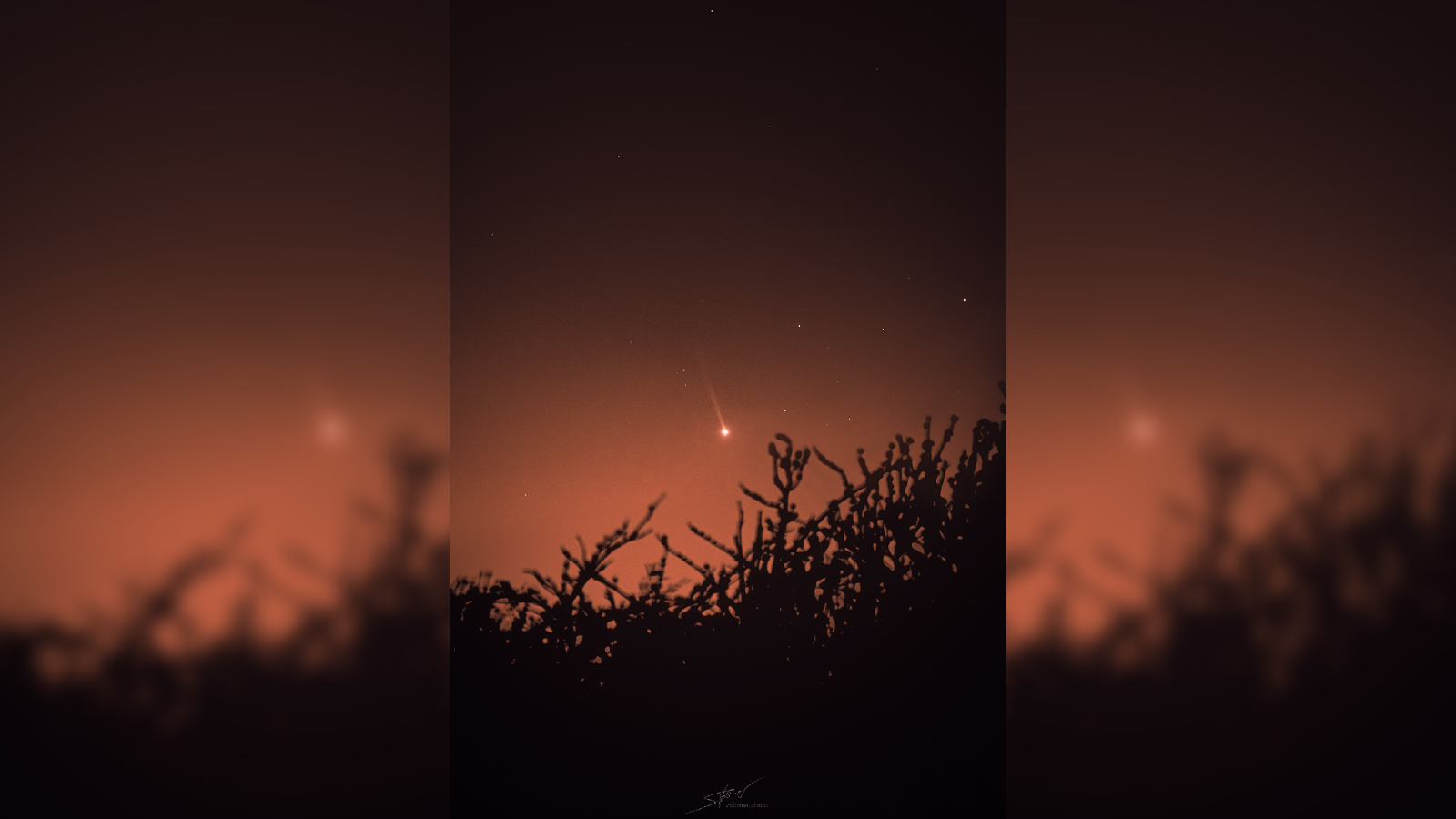
For unknown reasons, Mercury’s tail is most visible from Earth exactly 16 days after perihelion, or the point at which the planet is closest to the sun, according to Spaceweather.com. Mercury reached perihelion on April 1, meaning its tail appeared brightest on April 17. But on April 12, astrophotographer Sebastian Voltmer (opens in new tab) captured a stunning image (opens in new tab) of the planet’s tail from a spot near Spicheren, a commune in northeastern France.
To a casual observer, Mercury’s tail is very hard to see, which is why it went undiscovered until the 21st century. But Voltmer was able to photograph the giant plume thanks to a specialized filter that highlights yellow wavelengths of light, which are given off by the excited sodium particles in the tail.
“Without such a filter, Mercury’s tail is almost invisible to the naked eye,” Voltmer told Spaceweather.com.
Mercury is not the only celestial body in the solar system with a surprisingly comet-like tail. The moon also has a tail that is only visible once a month as Earth passes through it and wears it like a scarf (opens in new tab). Like Mercury, the moon’s tail is also predominantly made of millions of sodium atoms.
This story was provided by Live Science.
Join our Space Forums to keep talking space on the latest missions, night sky and more! And if you have a news tip, correction or comment, let us know at: co*******@***ce.com.
Read More
Tama Buresh