

Lunar exploration is undergoing a renaissance. Dozens of missions, organised by multiple space agencies – and increasingly by commercial companies – are set to visit the Moon by the end of this decade. Most of these will involve small robotic spacecraft, but NASA’s ambitious Artemis programme, aims to return humans to the lunar surface by the middle of the decade.
There are various reasons for all this activity, including geopolitical posturing and the search for lunar resources, such as water-ice at the lunar poles, which can be extracted and turned into hydrogen and oxygen propellant for rockets. However, science is also sure to be a major beneficiary.
The Moon still has much to tell us about the origin and evolution of the solar system. It also has scientific value as a platform for observational astronomy.
The potential role for astronomy of Earth’s natural satellite was discussed at a Royal Society meeting earlier this year. The meeting itself had, in part, been sparked by the enhanced access to the lunar surface now in prospect.
Far side benefits
Several types of astronomy would benefit. The most obvious is radio astronomy, which can be conducted from the side of the Moon that always faces away from Earth – the far side.
The lunar far side is permanently shielded from the radio signals generated by humans on Earth. During the lunar night, it is also protected from the Sun. These characteristics make it probably the most “radio-quiet” location in the whole solar system as no other planet or moon has a side that permanently faces away from the Earth. It is therefore ideally suited for radio astronomy.
Radio waves are a form of electromagnetic energy – as are, for example, infrared, ultraviolet and visible-light waves. They are defined by having different wavelengths in the electromagnetic spectrum.
Radio waves with wavelengths longer than about 15m are blocked by Earth’s ionoshere. But radio waves at these wavelengths reach the Moon’s surface unimpeded. For astronomy, this is the last unexplored region of the electromagnetic spectrum, and it is best studied from the lunar far side.
Observations of the cosmos at these wavelengths come under the umbrella of “low frequency radio astronomy”. These wavelengths are uniquely able to probe the structure of the early universe, especially the cosmic “dark ages” – an era before the first galaxies formed.
At that time, most of the matter in the universe, excluding the mysterious dark matter, was in the form of neutral hydrogen atoms. These emit and absorb radiation with a characteristic wavelength of 21cm. Radio astronomers have been using this property to study hydrogen clouds in our own galaxy – the Milky Way – since the 1950s.
Because the universe is constantly expanding, the 21cm signal generated by hydrogen in the early universe has been shifted to much longer wavelengths. As a result, hydrogen from the cosmic “dark ages” will appear to us with wavelengths greater than 10m. The lunar far side may be the only place where we can study this.
The astronomer Jack Burns provided a good summary of the relevant science background at the recent Royal Society meeting, calling the far side of the moon a “pristine, quiet platform to conduct low radio frequency observations of the early Universe’s Dark Ages, as well as space weather and magnetospheres associated with habitable exoplanets”.
Signals from other stars
As Burns says, another potential application of far side radio astronomy is trying to detect radio waves from charged particles trapped by magnetic fields – magnetospheres – of planets orbiting other stars.
This would help to assess how capable these exoplanets are of hosting life. Radio waves from exoplanet magnetospheres would probably have wavelengths greater than 100m, so they would require a radio-quiet environment in space. Again, the far side of the Moon will be the best location.
A similar argument can be made for attempts to detect signals from intelligent aliens. And, by opening up an unexplored part of the radio spectrum, there is also the possibility of making serendipitous discoveries of new phenomena.
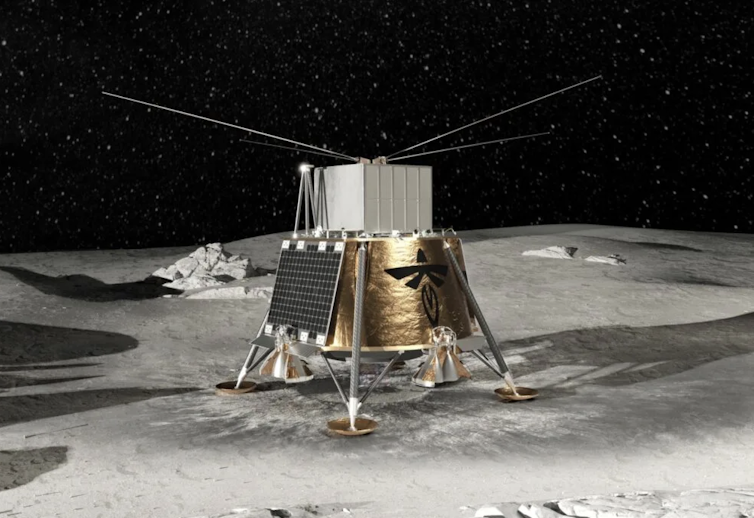
We should get an indication of the potential of these observations when NASA’s LuSEE-Night mission lands on the lunar far side in 2025 or 2026.
Crater depths
The Moon also offers opportunities for other types of astronomy as well. Astronomers have lots of experience with optical and infrared telescopes operating in free space, such as the Hubble telescope and JWST. However, the stability of the lunar surface may confer advantages for these types of instrument.
Moreover, there are craters at the lunar poles that receive no sunlight. Telescopes that observe the universe at infrared wavelengths are very sensitive to heat and therefore have to operate at low temperatures. JWST, for example, needs a huge sunshield to protect it from the sun’s rays. On the Moon, a natural crater rim could provide this shielding for free.
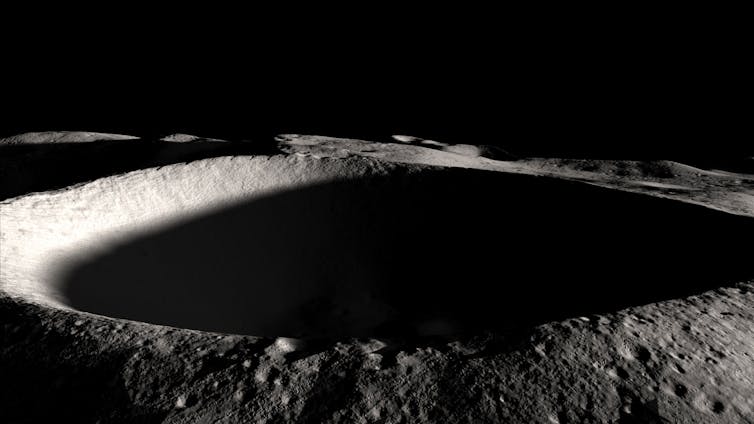
LROC / ASU / NASA
The Moon’s low gravity may also enable the construction of much larger telescopes than is feasible for free-flying satellites. These considerations have led the astronomer Jean-Pierre Maillard to suggest that the Moon may be the future of infrared astronomy.
The cold, stable environment of permanently shadowed craters may also have advantages for the next generation of instruments to detect gravitational waves – “ripples” in space-time caused by processes such as exploding stars and colliding black holes.
Moreover, for billions of years the Moon has been bombarded by charged particles from the sun – solar wind – and galactic cosmic rays. The lunar surface may contain a rich record of these processes. Studying them could yield insights into the evolution of both the Sun and the Milky Way.
For all these reasons, astronomy stands to benefit from the current renaissance in lunar exploration. In particular, astronomy is likely to benefit from the infrastructure built up on the Moon as lunar exploration proceeds. This will include both transportation infrastructure – rockets, landers and other vehicles – to access the surface, as well as humans and robots on-site to construct and maintain astronomical instruments.
But there is also a tension here: human activities on the lunar far side may create unwanted radio interference, and plans to extract water-ice from shadowed craters might make it difficult for those same craters to be used for astronomy. As my colleagues and I recently argued, we will need to ensure that lunar locations that are uniquely valuable for astronomy are protected in this new age of lunar exploration.
Read More
Thomas Guillemette