

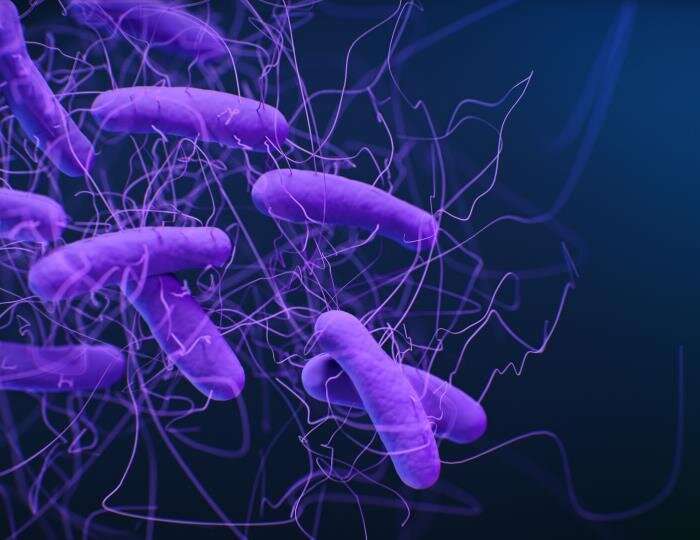
Antibiotics help to fight bacterial infections, but they can also harm the helpful microbes living in the gut, which can have long-lasting health consequences.
Now new research being presented at this year’s European Congress of Clinical Microbiology & Infectious Diseases (ECCMID) in Copenhagen, Denmark (15-18 April) has identified several protective drugs that may lessen the collateral damage caused by antibiotics without compromising their effectiveness against harmful bacteria.
The unique study by Dr. Lisa Maier and Dr. Camille V. Goemans from the European Molecular Biology Laboratory, Heidelberg, Germany and colleagues, which analyzed the effects of 144 different antibiotics on the abundance of the most common gut bacteria, offers novel insights into reducing the adverse effects of antibiotic treatment on the gut microbiome.
The trillions of microorganisms in the human gut profoundly impact health by aiding digestion, providing nutrients and metabolites, and working with the immune system to fend off harmful bacteria and viruses.
Antibiotics can damage these microbial communities, resulting in an imbalance that can lead to recurrent gastrointestinal problems caused by Clostridioides difficile infections as well as long-term health problems such as obesity, allergies, asthma and other immunological or inflammatory diseases.
Despite this well-known collateral damage, which antibiotics affect which types of bacterial species, and whether these negative side effects be mitigated has not been studied systematically because of technical challenges.
To find out more, researchers systematically analyzed the growth and survival of 27 different bacterial species commonly found in the gut following treatment with 144 different antibiotics. They also assessed the minimal inhibitory concentration (MIC)—the minimal concentration of an antibiotic required to stop bacteria from growing—for over 800 of these antibiotic-bacteria combinations.
The results revealed that the majority of gut bacteria had slightly higher MICs than disease-causing bacteria, suggesting that at commonly used antibiotic concentrations, most of the tested gut bacteria would not be affected.
However, two widely used antibiotic classes—tetracyclines and macrolides—not only stopped healthy bacteria growing at much lower concentrations than those required to stop the growth of disease-causing bacteria, but they also killed more than half of the gut bacterial species they tested, potentially altering the gut microbiome composition for a long time.
As drugs interact differently across different bacterial species, the researchers investigated whether a second drug could be used to protect the gut microbes. They combined the antibiotics erythromycin (a macrolide) and doxycycline (a tetracycline) with a set of 1,197 pharmaceuticals to identify suitable drugs that would protect two abundant gut bacterial species (Bacteriodes vulgatus and Bacteriodes uniformis) from the antibiotics.
The researchers identified several promising drugs including the anticoagulant dicumarol, the gout medication benzbromarone, and two anti-inflammatory drugs, tolfenamic acid and diflunisal.
Importantly, these drugs did not compromise the effectiveness of the antibiotics against disease-causing bacteria.
Further experiments showed that these antidote drugs also protected natural bacterial communities derived from human stool samples and in living mice.
“This Herculean undertaking by an international team of scientists has identified a novel approach that combines antibiotics with a protective antidote to help keep the gut microbiome healthy and reduce the harmful side effects of antibiotics without compromising their efficiency,” says Dr. Ulrike Löber, of the Max-Delbrück-Center for Molecular Medicine in Berlin, Germany who is presenting the research at ECCMID. “Despite our promising findings, further research is needed to identify optimum and personalized combinations of antidote drugs and to exclude any potential long-term effects on the gut microbiome.”
More information:
The research is based on a study published in Nature in 2021 : Lisa Maier et al, Unravelling the collateral damage of antibiotics on gut bacteria, Nature (2021). DOI: 10.1038/s41586-021-03986-2
Provided by
European Society of Clinical Microbiology and Infectious Diseases
Citation:
Scientists identify compounds that reduce the harmful side effects of antibiotics on gut bacteria (2023, April 16)
retrieved 16 April 2023
from https://medicalxpress.com/news/2023-04-scientists-compounds-side-effects-antibiotics.html
This document is subject to copyright. Apart from any fair dealing for the purpose of private study or research, no
part may be reproduced without the written permission. The content is provided for information purposes only.
Read More
Gaylene Klemp