

More companies are starting to consider the impact that quantum computing will have on their business in the coming years. According to a survey by Deloitte, about half of all companies believe that they are vulnerable to a “harvest now, decrypt later” attack, where encrypted information is stored until a future quantum computer can decrypt the data. No wonder, then, that 61% of firms have either conducted an assessment of their readiness or plan to analyze the issue within five years.
In 2022, the National Institute of Standards and Technology (NIST) made a significant decision to help companies prepare for a world where quantum computing is commonplace. The decision was also an effort to help protect today’s data from tomorrow’s quantum computers. The U.S. technology agency selected four algorithms for encryption methods to replace public key infrastructure (PKI) algorithms currently in use as a way of protecting data encrypted today against quantum computers developed in the future.
Delivering a quantum future
Because data can be saved and archived, classified and sensitive information—which may need to be protected longer than a decade, or more—needs to be protected with quantum-resistant algorithms. The four algorithms selected by NIST represent an early milestone in the development of the post-quantum encryption standard.
“Cryptographic protocols that are deployed today can still be in use in 10 years, in 20 years, in 30 years,” says Daniel Gottesman, a professor of theoretical computer science at the University of Maryland and a quantum computing consultant at Keysight Technologies, a U.S.-based provider of design, emulation, and test equipment for electronics. “If you send messages today, if they’re still going to be relevant in that time, then you need to worry about security against quantum computers of the future.”
Yet, quantum computing’s promise goes far beyond unlocking decades-old secrets.
Quantum computing offers the enticing promise of problem-solving abilities and computing power far exceeding today’s most powerful supercomputers. Google has built a quantum AI campus with the goal of creating a “useful, error-corrected quantum computer” by 2029. IBM expanded its quantum efforts with the goal of creating a 4,000-qubit quantum computer by 2025.
These more sophisticated platforms will allow a greater breadth of applications—such as chemical simulation and machine learning—and provide more momentum to the long-term development of quantum computer systems. According to analyst firm International Data Corporation (IDC), the global quantum computing market will grow 51% annually, as measured in spending, from $412 million in 2020 to $8.6 billion in 2027.
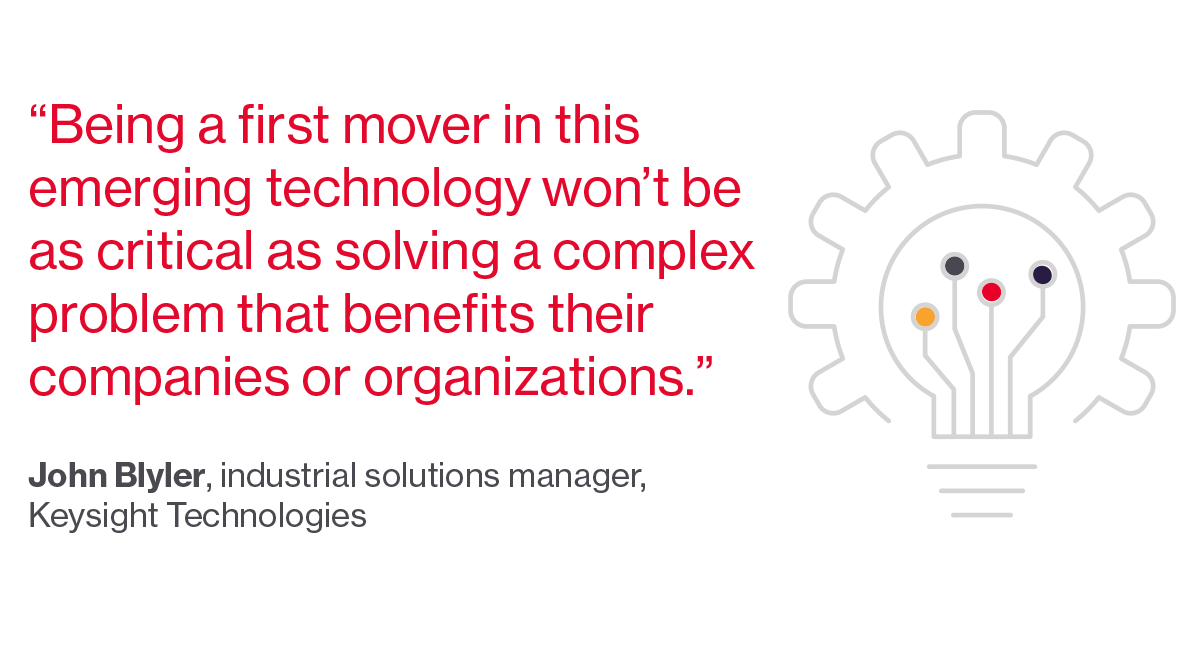
“Companies building quantum hardware and software services now have several platforms already used by niche customers in the financial and defense spaces,” says John Blyler, industrial solutions manager, wireline communications, at Keysight Technologies. “And new applications are being identified, such as the simulation of molecules that may result in new life-saving drugs that cure various diseases.”
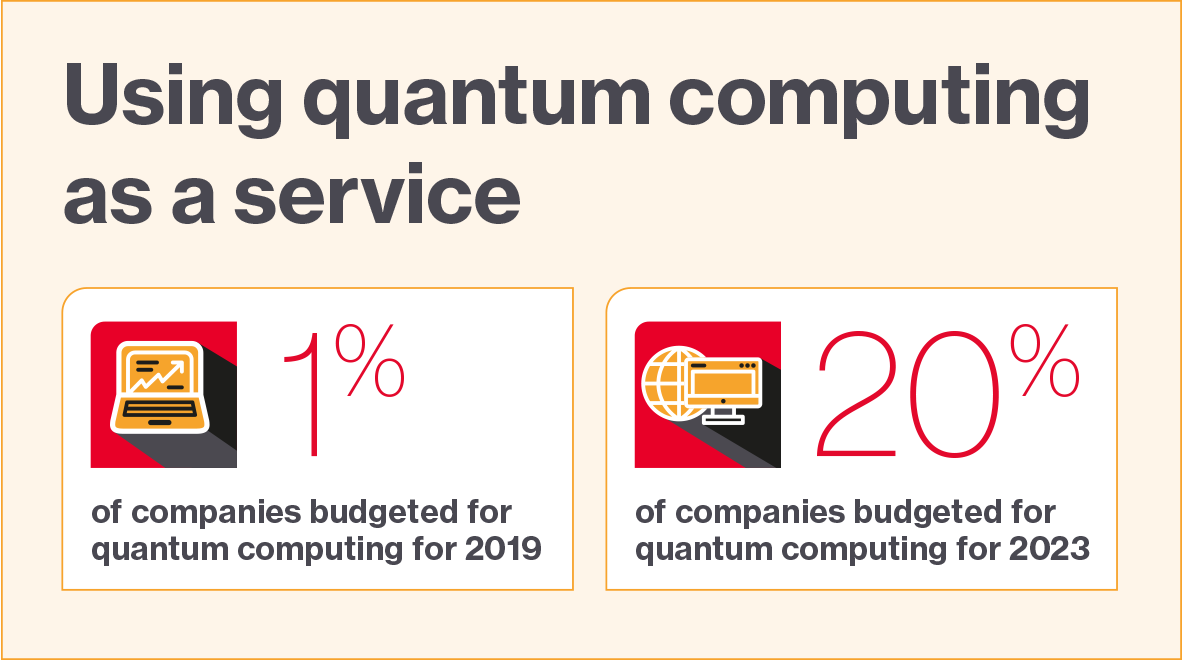
Companies that develop applications for the near-future quantum computers will derive a range of benefits and lead the market because of their quantum advantage, says Chad Rigetti, former CEO of Rigetti Computing, a company that provides quantum computing as a service. Quantum computing as a service, or QCaaS, allows customers to have access to a quantum computer through a cloud service that typically integrates with workloads based on classical computing. The result is a hybrid system that can be optimized for the specific problem: Most of the software will run on classical computers, while quantum algorithms and simulations can run on quantum systems.
While much of the discussion of quantum computing has focused on the risks to privacy and encrypted information, the far greater risk today is failing to plan for the ways that quantum computing can affect a company’s business.
This content was produced by Insights, the custom content arm of MIT Technology Review. It was not written by MIT Technology Review’s editorial staff.
Read More
MIT Technology Review Insights