
High-quality data enables medical research

High-quality data enables medical research

These complex questions, usually the province of medical research, became concrete seemingly overnight. While amateur epidemiologists scoured the internet for statistics to support their personal beliefs, professionals often appeared on the nightly news, even if just to say, “We don’t have good enough data.”

While our focus on the pandemic has now subsided, our health data quality problems remain. We’re swimming in health data—by some estimates, one-third of all data generated in the world is related to health and health care, and that amount increases more than 30% every year.

With all that data, then, why can’t we answer our most pressing heath questions? Which of the five top diabetes drugs (if any) will be best for me? Will back surgery be more effective than physical therapy for my spine? What are the chances that I will need chemotherapy in addition to radiation to make my tumor go away?

EHRs have become ubiquitous

Electronic health records (EHRs) have become pervasive in the U.S., largely thanks to a multi-billion-dollar federal initiative that made interoperable EHRs a national goal. The 2009 HITECH Act provided incentives for healthcare providers who computerized and penalties for those who did not. In addition to the improved patient care this would enable, the millions of digitized health records would create opportunities to transform medical research.
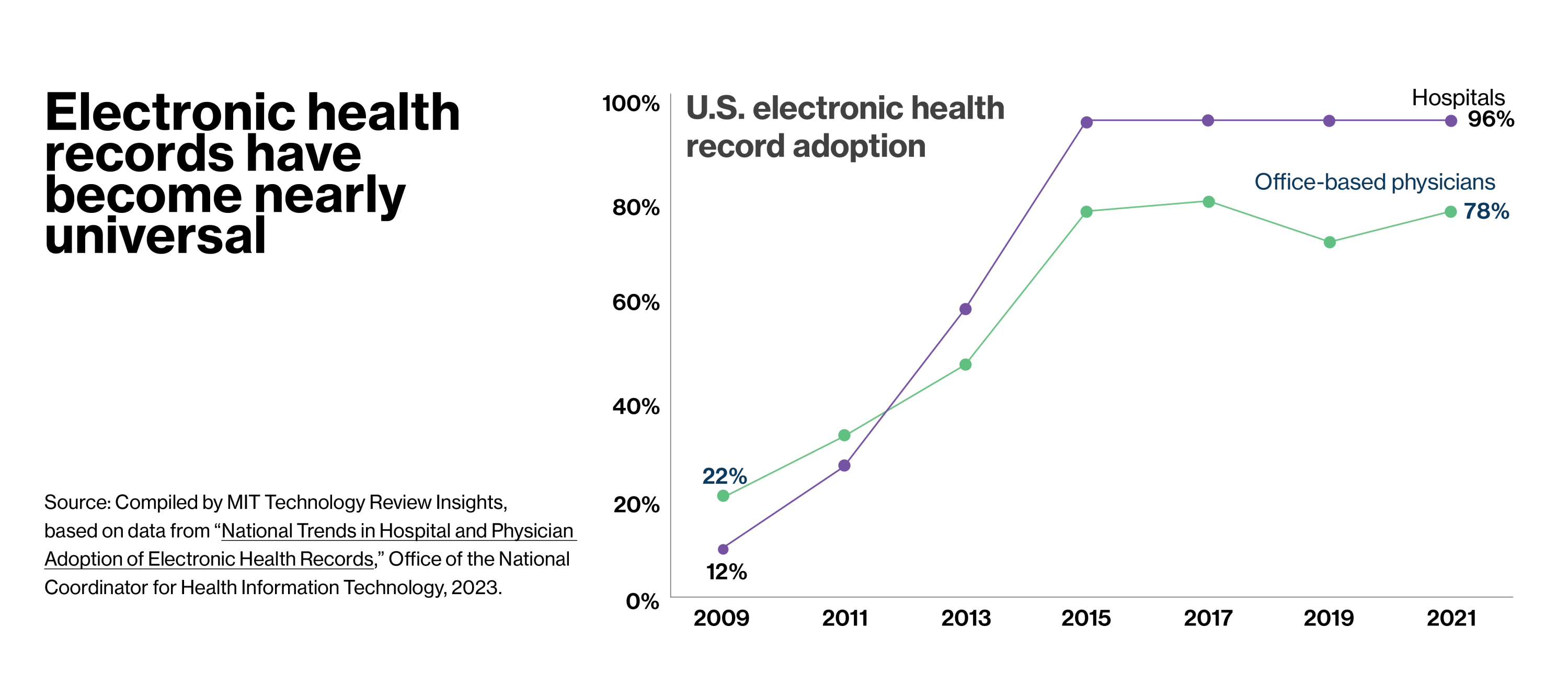
“Prior to EHRs, clinical research was all on paper,” says Dale Sanders, chief strategy officer at Intelligent Medical Objects (IMO), a healthcare data enablement company that offers clinical terminology and tooling to improve the quality of medical data. “You would transfer that paper-based data to spreadsheets and do your own data analysis in a very small local environment. It didn’t give a broader view of a patient’s life, and it certainly didn’t enable any kind of broader population analysis.”

Theoretically, EHRs should make it possible to aggregate, analyze, and search through information collected from millions of patients to discover patterns that aren’t evident on a smaller scale—as well as to track a single patient’s health status methodically over time. Imagine being able to quickly compare and analyze the cases of the few thousand people who have a particular rare condition or to follow users of a certain drug over a set period of time to observe long-term side effects that weren’t obvious in trials.
Of course, it’s not that easy. “There’s a lot of raw data [in EHRs] and it’s very, very dirty,” explains John Lee, MD, an emergency physician and clinical informaticist who has served as chief medical information officer for several health systems. “Some of it isn’t accurate, and the stuff that is accurate isn’t packaged up in a way that’s usable and scalable. There is an opportunity tantalizingly at our fingertips if we could get out of our own way.”

Sanders concurs. “Covid made us all realize that the data that we’re collecting with EHRs is not very good for clinical research, or for reacting to pandemics and public health challenges. It’s time to evolve the way we’re using them.”

Download the report.

This content was produced by Insights, the custom content arm of MIT Technology Review. It was not written by MIT Technology Review’s editorial staff.

Read More
MIT Technology Review Insights

Latest

Adebayo raises the alarm over police siege at SDP headquarters

Tension engulfed the national secretariat of the Social Democratic Party (SDP) on Thursday after security operatives stormed the party headquarters shortly after the screening exercise of the party’s former presidential candidate, Prince Adewole Adebayo. Adebayo alleged that the action was part of a coordinated attempt to disrupt the SDP’s presidential...

Leviste faces raps for solar business violations

Energy Secretary Sharon Garin has elevated to the Department of Justice  a complaint against Batangas Rep. Leandro Leviste over alleged violations tied to his solar company, which was granted a legislative franchise in 2019...

Mecalac to Move North American Headquarters to Fayat Group Campus in S.C.

The move to South Carolina will boost parts support, training and growth under Fayat Group, the company says...

How to reset NVRAM, PRAM, and SMC on a Mac: Intel and Apple silicon explained

Macworld When your Mac starts acting up, you’ll probably run through some common troubleshooting procedures, such as restarting it, running Disk Utility, and perhaps performing a Safe Boot. Your repair repertoire should also include a couple of additional procedures that can occasionally eliminate otherwise inscrutable problems: zapping the NVRAM and resetting the SMC...

Newsletter

Don't miss

Adebayo raises the alarm over police siege at SDP headquarters

Tension engulfed the national secretariat of the Social Democratic Party (SDP) on Thursday after security operatives stormed the party headquarters shortly after the screening exercise of the party’s former presidential candidate, Prince Adewole Adebayo. Adebayo alleged that the action was part of a coordinated attempt to disrupt the SDP’s presidential...

Leviste faces raps for solar business violations

Energy Secretary Sharon Garin has elevated to the Department of Justice  a complaint against Batangas Rep. Leandro Leviste over alleged violations tied to his solar company, which was granted a legislative franchise in 2019...

Mecalac to Move North American Headquarters to Fayat Group Campus in S.C.

The move to South Carolina will boost parts support, training and growth under Fayat Group, the company says...

How to reset NVRAM, PRAM, and SMC on a Mac: Intel and Apple silicon explained

Macworld When your Mac starts acting up, you’ll probably run through some common troubleshooting procedures, such as restarting it, running Disk Utility, and perhaps performing a Safe Boot. Your repair repertoire should also include a couple of additional procedures that can occasionally eliminate otherwise inscrutable problems: zapping the NVRAM and resetting the SMC...

EXCLUSIVE — ATF Director Robert Cekada: Hunter, AR-15 Owner, and Fan of an Armed Citizenry

Breitbart News was at the Bureau of Alcohol, Tobacco, Firearms, and Explosives (ATF) when Robert Cekada was sworn in Monday, and he sat down with us afterward to talk about growing up hunting with his dad, owning numerous AR-15s, and valuing the importance of an armed citizenry...

Your business texts could look like scam messages from July 1 if you don’t act now

From July 1, any branded SMS your business sends without a registered sender ID will be labelled “Unverified” and grouped with scam messages.  What’s happening: From 1 July 2026, any business or organisation that sends SMS using a branded name, such as “MyShop” or “AcmeServices”, instead of a phone number, must have that sender ID

Business groups are fighting Labor’s CGT changes. Here is where SMEs stand

Labor’s most contested tax reform in a generation cleared its first formal hurdle on Thursday and immediately ran into organised resistance. Treasurer Jim Chalmers introduced the government’s tax reform legislation to the House of Representatives on 28 May, bundling together four budget measures: the capital gains tax overhaul, new limits on negative gearing, a $250

Meet the most influential business owners from Southwest Nigeria

This article spotlights the most influential business owners from Southwest Nigeria, adjudged by their dominance in their respective sectors of the economy where they operate. The post Meet the most influential business owners from Southwest Nigeria appeared first on Nairametrics...