

JRdes/Shutterstock
Google’s answer to the dominance of ChatGPT in the AI chat space has finally arrived. The AI tool is called Bard, and Google has made it available to users in the United States and United Kingdom. With the rollout of the new AI option coming on March 21, 2023, AI and Google enthusiasts everywhere have been chomping at the bit with excitement over the new tool.
Like ChatGPT, and a crowded field of other AI systems that users are able to take advantage of, Bard can develop rich content that helps users complete a raft of requirements. But with its novelty to the public comes a minor setback in using the feature. Those hoping to get their first look at the Bard AI platform will have to join the waitlist and won’t get instant signup access. However, the process to join the list is simple, and once you’ve been granted access, using the tool to generate results is roughly equivalent to any other generative AI platform that users may be accustomed to. If you’re excited about Google’s new innovation and can’t wait to get started, this is how to sign up and start using the AI tool.
Join the waitlist
gguy/Shutterstock
Unlike some other beta testing or trial programs that have hit the internet, Bard requires users to join the waitlist before they can gain access to the AI system. In addition, those signing up to the waitlist will need a personal Google account (rather than a parent, friend, or guardian’s account), be at least 18, and use a browser that’s supported by the system (Google reports that these are Chrome, Safari, Firefox, Opera, and Edgium).
Wait times can vary depending on a variety of factors, including public demand for access to the system. Reported wait times have been as short as a few hours, but it’s also suggested that as users continued to sign up for access, this will likely grow longer, perhaps expanding to days or weeks for new waitlist signups. There’s currently no system in place to alert signups about their status in the queue. However as a reference, I requested access to the Bard AI waitlist at 8:58 a.m. on Saturday April 1, 2023 and received the email telling me I was able to use Bard just a few minutes later, at 9:02 a.m.
Using the Bard system
Daniel Feininger/SlashGear
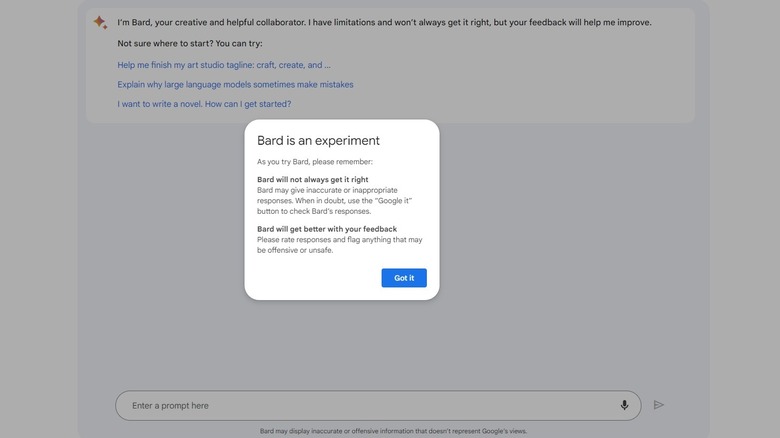
Once you receive an email from Google announcing that “It’s your turn to try Bard,” all you need to do is click the “Take it for a spin” link in the body of the email.
Then, you’ll need to agree to Google’s terms and conditions and acknowledge a short notice that reads in part: “Bard is an experiment… Bard may give inaccurate or inappropriate responses.” Although, the system comes equipped with a “Google it” button to verify the accuracy of the AI’s output. The more you participate with the AI, the better it will become at accurately feeding back useful information. Google notes that the system will remain heavily reliant on user feedback to improve generative results and to achieve greater accuracy in providing desired outcomes from users.
The tool itself offers three drafts of the same basic response. For instance, after completing my sign-up to use the AI, I asked it to “tell me about baseball,” in a nod to the sport’s Opening Weekend. It notes that information was scraped from Wikipedia and spat out a few paragraphs describing the basic premise of the game in the first draft: “Baseball is a bat-and-ball game played between two opposing teams.” The first version focused on Major League Baseball, while the second offered a more international take on the game alongside a longer history (“The first professional baseball game was played in 1869,” it notes). The third rehashed the first draft but relied on bullet points to make the information more concise. Personally, the response was a little rudimentary, with the word “baseball” appearing at the beginning of all but two paragraphs across the three drafts. Still, with user feedback improving the system the outputs should become increasingly fluid.
Read More
Marquis Grumbles