

Consumer rights —
Canada’s newly released budget considers consumers’ wallets and e-waste.
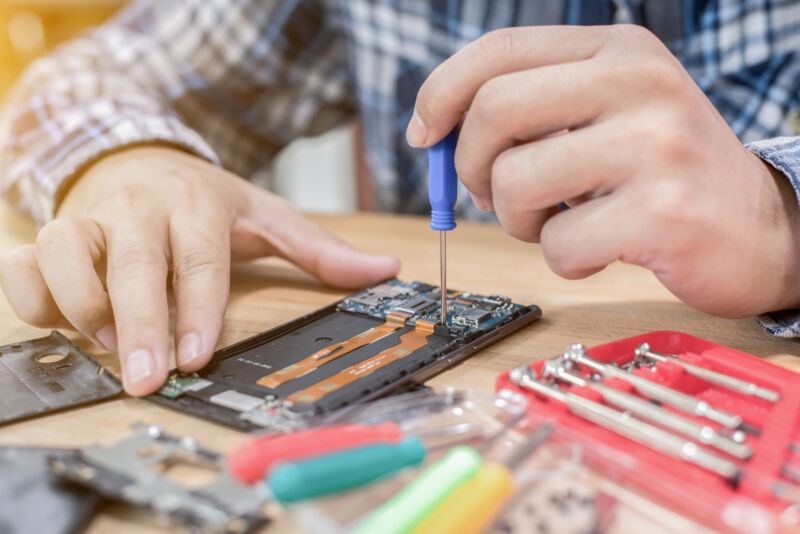
Like in other parts of the world, Canada is working out what the right to repair means for its people. The federal government said in its 2023 budget released Tuesday that it will bring the right to repair to Canada. At the same time, it’s considering a universal charging port mandate like the European Union (EU) is implementing with USB-C.
The Canadian federal government’s 2023 budget introduces the right to repair under the chapter “Making Life More Affordable and Supporting the Middle Class.” It says that the “government will work to implement a right to repair, with the aim of introducing a targeted framework for home appliances and electronics in 2024.” The government plans to hold consultations on the matter and claimed it will “work closely with provinces and territories” to implement the right to repair in Canada:
When it comes to broken appliances or devices, high repair fees and a lack of access to specific parts often mean Canadians are pushed to buy new products rather than repairing the ones they have. This is expensive for people and creates harmful waste.
Devices and appliances should be easy to repair, spare parts should be readily accessible, and companies should not be able to prevent repairs with complex programming or hard-to-obtain bespoke parts. By cutting down on the number of devices and appliances that are thrown out, we will be able to make life more affordable for Canadians and protect our environment.
The budget also insinuates that right-to-repair legislation can make third-party repairs cheaper than getting a phone, for example, repaired by the manufacturer, where it could cost “far more than it should.”
The budget’s release comes in the same month as the European Commission’s adoption of a proposal requiring tech makers to provide repairs for up to 10 years after purchase, depending on the product category. The European Parliament and Council must approve the proposal before it’s law.
A broader look at right-to-repair discussions around the globe shows the difficulties in creating a system that appeases consumer advocates and tech companies. The strength of EU’s right-to-repair legislation has been criticized for things like failing to cover specific types of electronics and not ensuring that necessary aspects, like spare parts, tools, and manuals, are affordably priced.
But some, like tech trade group DigitalEurope’s director-general, Cecilia Bonefeld-Dahl, think such legislation should be built around “manufacturer-led repair networks.”
At the (very) end of 2022, New York became the first state to implement an electronics right-to-repair law, but significant changes made to the Digital Fair Repair Act have been heavily detailed.
Meanwhile, self-repair initiatives by tech giants like Samsung and Apple have been scrutinized for lack of supported products and, in the case of Apple, requiring remote OEM authorization for repairs.
India announced that it was setting up a committee to hammer out a right-to-repair framework in July, and its legislation may cover four categories: electronics, automobiles, farming equipment, and consumer durables.
Universal charging port also under consideration
Canada’s 2023 budget also revealed the government’s interest in introducing a standard charging port for electronics. The budget says the government “will work with international partners and other stakeholders to explore implementing a standard charging port in Canada.” It says a universal charging port could help residents save money and e-waste.
“Every time Canadians purchase new devices, they need to buy new chargers to go along with them, which drives up costs and increases electronic waste,” the budget says.
The EU famously made universal charging port mandates a reality, requiring that smartphones, tablets, and other consumer gadgets with wired charging have a USB-C port by December 28, 2024. Laptops will be required to do the same by April 2026. The landmark legislation has pushed Apple to reluctantly work on a USB-C iPhone.
The incoming EU requirements also started a trickle-down effect around the world, where numerous countries are now considering some type of universal charging port rules of their own. India is considering such a mandate to take place by March 2025 and potentially excluding wearables, hearables, and feature phones, due to associated costs. Brazil also had a public consultation about a USB-C charging smartphone requirement that ended in August. And although the US hasn’t seen much visible movement around such a law, some politicians have asked the Secretary of Commerce for a strategy.
As governments, tech makers, and consumer advocates seek to define legislation that impacts how consumers use and buy electronics and create e-waste, debate around the right to repair and charging standards abound. This has brought the issues greater attention, including among consumers, some of which are demanding repairability and e-waste consideration in their products, legally mandated or not. Framework, which makes modular laptops, continuing to expand its portfolio is one indicator of consumer interest in repairability and choice. Regardless of how different geographies’ governments decide to handle things, these types of discussions have, rightfully so, become impossible to ignore.
Read More
Scharon Harding