

Catch —
Fishing wreaks havoc on North Sea cod evolution; long-term planning can help.
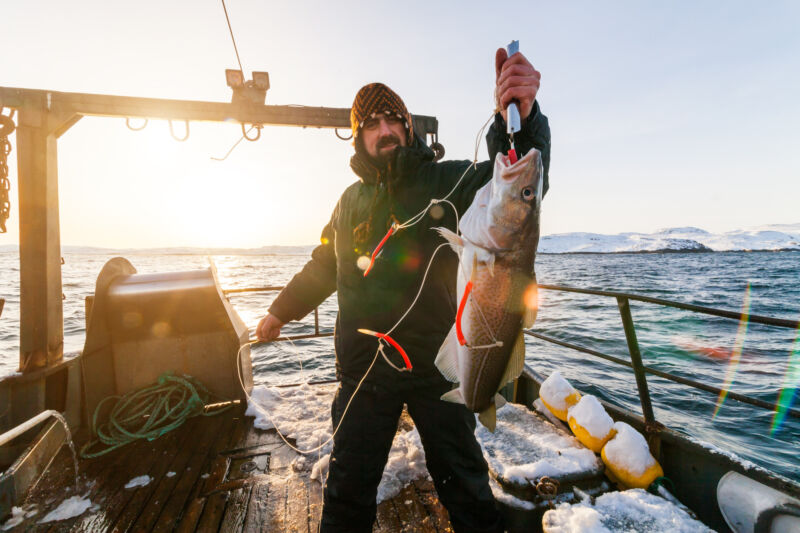
Generation over generation, catch after catch, fishing changes fish evolution. This phenomenon, called fisheries-induced evolution, is well documented, though it impacts the myriad species of fish differently. For the North Sea cod, it has meant that early bloomers thrive, while fish that are slower to mature get taken out of the gene pool. This has meant that the fish population is evolving toward smaller sizes. A recent paper models what it would take to reverse this effect through conservation, and what it would mean economically to do so.
“In general, fishing is one of the main drivers of change in marine ecosystems,” Hanna Schenk, a postdoctoral researcher at the German Centre for Integrative Biodiversity Research (iDiv) Halle-Jena-Leipzig and one of the paper’s authors, told Ars.
Fishing increases mortality rates among fish—particularly large fish, which are caught in higher numbers because they are more likely to stay within fishers’ nets. In turn, this puts selective pressure on a species: fish that mature quicker (but remain smaller) gain an advantage. These smaller, early bloomers then pass on their genes more often, which impacts the whole population over time.
“There is a trade-off between those two [factors], and once a cod matures, it grows less. So, when that happens earlier, it usually doesn’t reach such a large size as if it wasn’t spawning,” she said.
Of fish and funds
The new research focuses on North Sea cod, which is well studied in terms of mortality, growth, etc., and shows signs of fisheries-induced evolution. The team began working on the project in 2019 and started integrating an evolutionary model with an economic one. The biological model captures growth, mortality, reproduction, evolutionary changes, the effects of fishing, and other factors. The economic model works to project factors such as fishing costs and consumer preference.
They also fine-tuned various existing algorithms to optimize for fish stock management—in this case the North Sea cod—and economic benefit. “We first developed a model that basically captures all the essential components without being unnecessarily complex,” Schenk said.
The data on the cod came from the International Council for the Exploration of the Sea (ICES), which regularly provides stock assessment data on various species, including the cod. For the economic model, researchers relied on multiple sources, such as data from Germany’s Federal Ministry of Food and Agriculture. This provided the price for different sizes and types of fish. More data came from the Scientific, Technical, and Economic Committee for Fisheries (STECF) report, which looked into the profit margins of fishing.
The team used the model to optimize for evolutionary and economic health by tweaking different parameters that could be controlled by conservation goals and regulations. Management, in this case, is simply catching less fish by having a government set conservation targets. Schenk added that—even regardless of evolution—optimal management plans would involve taking fewer North Sea cod out of the ocean. That’s despite the fact that the total allowable catches (commonly called TAC) have already been lowered over recent years.
A trade-off
Through running the models, the researchers showed that fisheries-induced evolution can be reversed if management is considered on a very long timeline—roughly a century. This is needed because evolution happens slowly.
Conservation targets on a century-long timeline would effectively reverse fisheries-induced evolution with only a minor loss in profit over that time. This loss would depend on the ultimate conservation target and timeline. With an ambitious conservation target (a mean size of fish maturity of 53 cm, compared to 2019’s level of 50.6 cm) set for 2050, there would be a 10 percent surplus loss, for instance. The reason this scenario is only slightly less profitable is because management would involve reducing harvest at different points in the future to allow stocks to recover before starting to harvest again.
It’s hard to say if these findings would hold true for other fish species, Schenk said. This is because many traits vary by fish. These include past fishing pressures, the speed of evolution, etc. Going forward, the team hopes to analyze which types of fishing gear—which impacts the size of the fish caught—and which fish size would be ideal to reverse fisheries-induced evolution on the population.
Nature, 2023. DOI: 10.1038/s41893-023-01078-9 (About DOIs)
Read More
Doug Johnson