

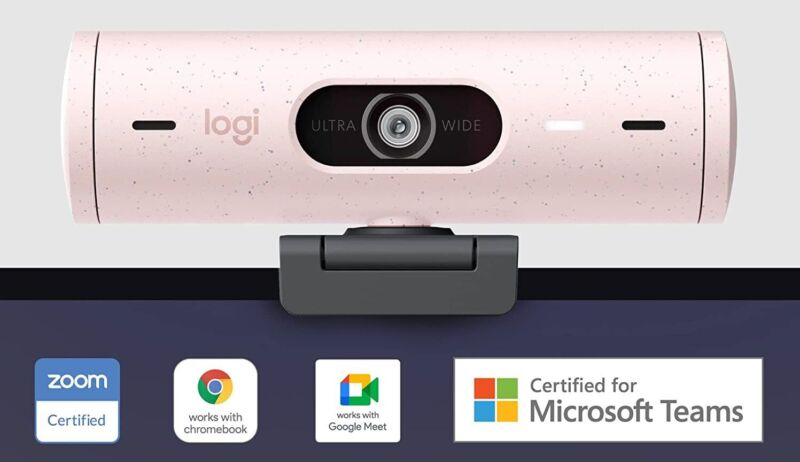
Enlarge / Logitech really wants you to know that its Brio 500 webcam works with Meet, Teams, Zoom, and Chromebooks.
Logitech made a peculiar announcement in January.
It proudly declared that its MX Master 3S wireless mouse, along with some of its other peripherals, had been certified to work with Intel Evo laptops. (Evo laptops are Intel-certified premium ultralights meeting certain criteria, like providing at least eight hours of battery life with a QHD display.) Imagine my shock when I realized I had been using that very mouse with a Dell XPS 13 (an Evo laptop) for almost eight months without Intel’s blessing.
Of course, even before the mouse gained Intel’s stamp of approval, I had enjoyed hours of problem-free use. The same can be said of every functioning USB webcam I’ve ever plugged into a computer. But that hasn’t stopped countless peripheral makers from touting that their devices have been certified for Google Meet, Microsoft Teams, and Zoom.
And while we’re at it, what’s the point of the Works With Chromebook certification program? Chromebooks are famous for the simplistic ChromeOS operating system. Does anyone really need proof beyond listed ChromeOS support that a mouse, keyboard, or webcam will work with a $200 Chromebook?
At best, vendor certification programs for peripherals seem to merely ensure support for something that’s almost certainly a given. At worst, these programs could potentially lead tech novices to believe that a PC accessory won’t work with their system just because a tech giant like Intel or Google hasn’t said so outright.
Do these programs hold any value for tech-savvy users or IT managers, or are they all just marketing programs in disguise? I spoke with Intel, Google, Microsoft, and Zoom about their peripheral certification procedures to find out.
Most companies have specific, relevant requirements for their PC accessory certification programs, but the majority don’t broadcast this information to the general public. But you may be pleasantly surprised by the sort of testing some of these programs put PC peripherals through. No, you don’t need Intel to tell you that a mouse will work with a pricey laptop using one of its processors, but the Evo stamp demands the inclusion of features that could be helpful—such as a confirmed Bluetooth range of at least 32.8 feet—and it may bring an elevated experience beyond basic compatibility.
Companies are relatively tight-lipped about these requirements, however. Not only does that make it seem like the stamps are redundant marketing gimmicks, it diminishes the value they could provide to tech-savvy consumers.
Other verifications with validity
Certification programs for PC peripherals have been around forever. When a certification requires that a product meet stringent standards designed around real potential use cases, it offers clear value. A well-planned verification scheme can help end users and even IT teams identify products for niche or power users, create a baseline for testing, and draw attention to critical specs and features.
Standards or certification programs created as a joint effort between various industry experts and companies, such as VESA’s DisplayHDR or ClearMR monitor certifications, the USB Implementers Forum’s (USB-IF’s) USB standards, or the Peripheral Component Interconnect Special Interest Group’s PCIe standards, detail capabilities and performance that aren’t a given otherwise.
But in contrast to industry standards, the programs we’re about to discuss—the ones from Google, Microsoft, Intel, and Zoom—are each controlled by a single tech company and highlight a peripheral’s compatibility with one of the company’s specific platforms.
These programs might call to mind Apple’s MFi program, but that certification doesn’t focus on computer peripherals. Apple products also have a history of not playing nicely with other third-party products, so there’s a more obvious need for the MFi program, even though that need is self-inflicted.
Read More
Scharon Harding