
Animal personalities can trip up science, but there’s a solution

Individual differences —

Individual behavior patterns may skew studies, but a new approach could help.
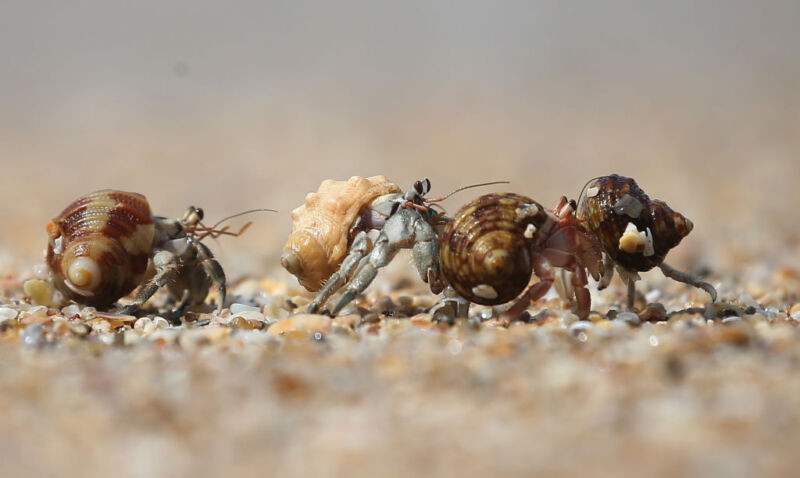

hermit crabs

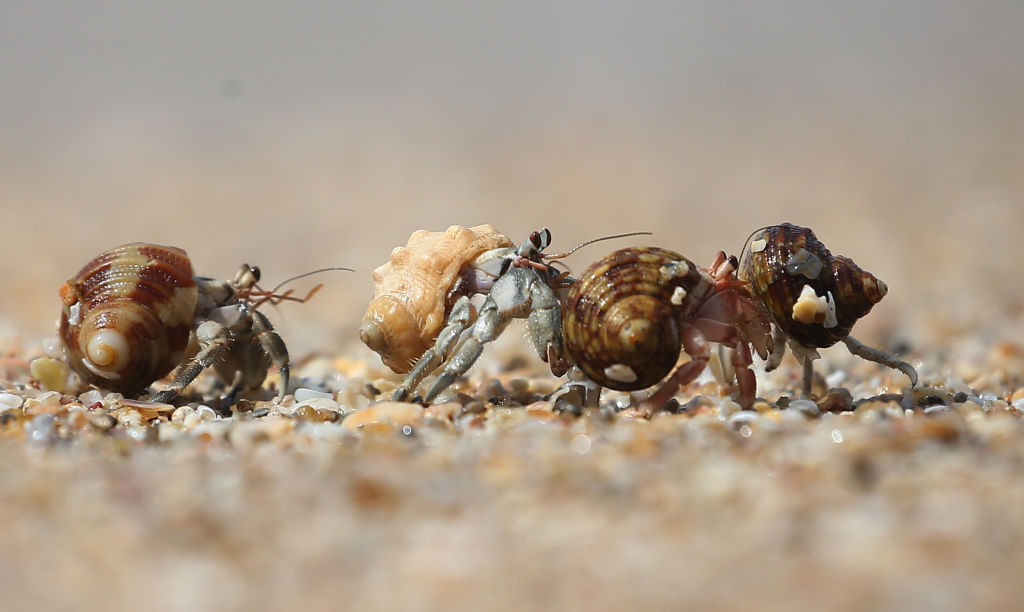
Enlarge / Even hermit crabs have individual patterns of behavior — personalities, if you like. When scientists ignore the effects of such differences, they may produce research that’s flawed.
Several years ago, Christian Rutz started to wonder whether he was giving his crows enough credit. Rutz, a biologist at the University of St. Andrews in Scotland, and his team were capturing wild New Caledonian crows and challenging them with puzzles made from natural materials before releasing them again. In one test, birds faced a log drilled with holes that contained hidden food, and could get the food out by bending a plant stem into a hook. If a bird didn’t try within 90 minutes, the researchers removed it from the dataset.

But, Rutz says, he soon began to realize he was not, in fact, studying the skills of New Caledonian crows. He was studying the skills of only a subset of New Caledonian crows that quickly approached a weird log they’d never seen before—maybe because they were especially brave, or reckless.

The team changed its protocol. They began giving the more hesitant birds an extra day or two to get used to their surroundings, then trying the puzzle again. “It turns out that many of these retested birds suddenly start engaging,” Rutz says. “They just needed a little bit of extra time.”

Scientists are increasingly realizing that animals, like people, are individuals. They have distinct tendencies, habits and life experiences that may affect how they perform in an experiment. That means, some researchers argue, that much published research on animal behavior may be biased. Studies claiming to show something about a species as a whole—that green sea turtles migrate a certain distance, say, or how chaffinches respond to the song of a rival—may say more about individual animals that were captured or housed in a certain way, or that share certain genetic features. That’s a problem for researchers who seek to understand how animals sense their environments, gain new knowledge and live their lives.

“The samples we draw are quite often severely biased,” Rutz says. “This is something that has been in the air in the community for quite a long time.”

In 2020, Rutz and his colleague Michael Webster, also at the University of St. Andrews, proposed a way to address this problem. They called it STRANGE.

This video from one of Christian Rutz’s experiments shows a wild New Caledonian crow bending a plant stem into a hook to retrieve food from a hole. Although some birds were hesitant to approach the materials at first, Rutz realized that many of them could solve the puzzle with extra time.

Personalities aren’t just for people

Why “STRANGE”? In 2010, an article in Behavioral and Brain Sciences suggested that the people studied in much of published psychology literature are WEIRD—drawn from Western, educated, industrialized, rich, and democratic societies—and are “among the least representative populations one could find for generalizing about humans.” Researchers might draw sweeping conclusions about the human mind when really they’ve studied only the minds of, say, undergraduates at the University of Minnesota.

A decade later, Rutz and Webster, drawing inspiration from WEIRD, published a paper in the journal Nature called “ How STRANGE are your study animals?

They proposed that their fellow behavior researchers consider several factors about their study animals, which they termed Social background, Trappability and self-selection, Rearing history, Acclimation and habituation, Natural changes in responsiveness, Genetic makeup, and Experience.

“I first began thinking about these kinds of biases when we were using mesh minnow traps to collect fish for experiments,” Webster says. He suspected—and then confirmed in the lab— that more active sticklebacks were more likely to swim into these traps. “We now try to use nets instead,” Webster says, to catch a wider variety of fish.

That’s Trappability. Other factors that might make an animal more trappable than its peers, besides its activity level, include a bold temperament, a lack of experience or simply being hungrier for bait.

Other research has shown that pheasants housed in groups of five performed better on a learning task (figuring out which hole contained food) than those housed in groups of only three—that’s Social background. Jumping spiders raised in captivity were less interested in prey than wild spiders (Rearing history), and honeybees learned best in the morning (Natural changes in responsiveness). And so on.

Read More
Knowable Magazine

Latest

FCS Draft Surge: The Rise of Small-School Prospects in Modern NFL Conversations

FCS Draft Surge: The Rise of Small-School Prospects in Modern NFL Conversations Every spring, draft chatter once focused almost entirely on blue-blood programs such as Alabama or Ohio State. Today that narrative feels outdated. Championship rosters increasingly feature players who sharpened skills on modest Football Championship Subdivision (FCS) fields, developing technique rather than basking in

Two Trap Games that Georgia Tech Football Cannot Overlook This Season

While Georgia Tech Football did not face its usual gauntlet of a schedule last season, the Yellow Jackets are no strangers to playing tough schedules, usually among the toughest in the country. Georgia Tech is going to be playing 11 power conference opponents this season, with eight ACC opponents and a non-conference schedule that includes

“I cannot divorce the two”: How Star Wars is blending technology, creativity, and products into the experience itself

(Image credit: Disney) “It’s like a community, right? And it’s a global community that people really love and identify with.” That’s how Bobby Kim, Global Creative Director at Disney Consumer Products, describes Star Wars fandom. And it’s a framing that feels especially fitting as another May the 4th is behind us and we’re weeks out

Trump administration defends right to ban content moderation experts from US

The Trump administration is fighting for the right to keep some social media moderation advocates out of the US. On Wednesday, US District Court Judge James Boasberg heard arguments in a lawsuit between the nonprofit Coalition for Independent Technology Research (CITR) and Secretary of State Marco Rubio and other Trump administration officials. The suit concerns

Newsletter

Don't miss

FCS Draft Surge: The Rise of Small-School Prospects in Modern NFL Conversations

FCS Draft Surge: The Rise of Small-School Prospects in Modern NFL Conversations Every spring, draft chatter once focused almost entirely on blue-blood programs such as Alabama or Ohio State. Today that narrative feels outdated. Championship rosters increasingly feature players who sharpened skills on modest Football Championship Subdivision (FCS) fields, developing technique rather than basking in

Two Trap Games that Georgia Tech Football Cannot Overlook This Season

While Georgia Tech Football did not face its usual gauntlet of a schedule last season, the Yellow Jackets are no strangers to playing tough schedules, usually among the toughest in the country. Georgia Tech is going to be playing 11 power conference opponents this season, with eight ACC opponents and a non-conference schedule that includes

“I cannot divorce the two”: How Star Wars is blending technology, creativity, and products into the experience itself

(Image credit: Disney) “It’s like a community, right? And it’s a global community that people really love and identify with.” That’s how Bobby Kim, Global Creative Director at Disney Consumer Products, describes Star Wars fandom. And it’s a framing that feels especially fitting as another May the 4th is behind us and we’re weeks out

Trump administration defends right to ban content moderation experts from US

The Trump administration is fighting for the right to keep some social media moderation advocates out of the US. On Wednesday, US District Court Judge James Boasberg heard arguments in a lawsuit between the nonprofit Coalition for Independent Technology Research (CITR) and Secretary of State Marco Rubio and other Trump administration officials. The suit concerns

Apple’s 2028 iPhone display sounds impossible, but Samsung and LG are scrambling to build it

Android phones have had curved displays for years and accepted the distortion as the price of aesthetics. Apple is spending two years and billions of supplier dollars to not accept it. Apple's all-screen iPhone 20 mockup Ice Universe / X Apple doesn’t ask its suppliers to build things. It tells them to, hands them a

WD sees sustainability as key business driver in an ‘AI economy’

Hard drive company WD promoted long-term operations and sustainability executive Jackie Jung to become its first chief sustainability officer in February, as it steps up sales to companies building AI data centers. Her vision: Turn sustainability into a “brand” for WD, a strategy that reduces risk for the $6 billion company (formerly known as Western

5 Business Ideas Worth Starting in 2026

If there is one thing Nigerians understand well, it is how to spot opportunity inside hardship. In 2026, that mindset will matter more than ever. The economy is tough, competition is rising, and many people are looking for smarter ways to earn, build, and survive. But even in a difficult environment, some businesses still stand

Getting a business loan now comes with a frequent flyer upside

Australian fintech Prospa has partnered with Qantas Business Rewards, letting eligible SMEs earn up to 500,000 points per loan. What’s happening: Australian fintech lender Prospa has partnered with Qantas Business Rewards to allow eligible small and medium business owners to earn up to 500,000 Qantas Points per loan when taking out a Prospa Small Business