


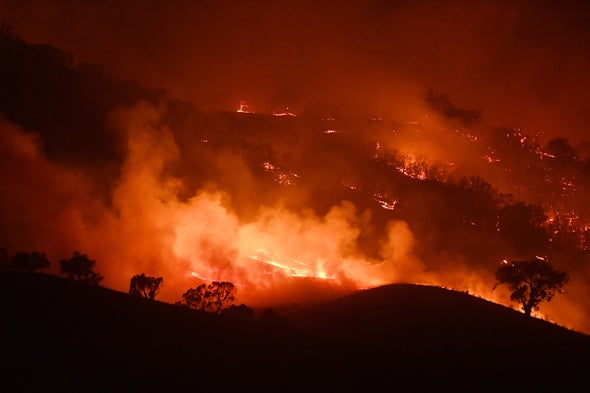
Smoke from the catastrophic 2019–2020 fires in Australia unleashed ozone-eating chlorine molecules into the stratosphere
Altered chemistry
Study co-author Susan Solomon, an atmospheric chemist also at MIT, suggests the smoke might have caused a chemical reaction that usually needs cold conditions to occur in warm air. Satellite data after the fires revealed that the levels of hydrochloric acid were especially low compared to other years in regions of the atmosphere away from the South Pole at warmer latitudes. The stratosphere “looked like another planet after those fires”, she says.
About 80% of the chlorine in the atmosphere is a legacy of chlorofluorocarbons, chemicals used in aerosol sprays and as refrigerants starting in the 1930s. Their use has mostly been phased out since an international treaty was implemented in 1987. Remnant chlorine is bound up as hydrochloric acid and chlorine nitrate, which are harmless to the ozone layer.
But when hydrochloric acid dissolves in water droplets, it forms reactive ozone-depleting molecules. That doesn’t usually happen away from the poles, because the air is too warm, says Stone.
The team used a computer model to predict how various organic acids contained in smoke particles would alter the solubility of hydrochloric acid. The changes produced in the simulations mirrored the changes to stratospheric chemistry that were observed after the fires.
Solomon says that hydrochloric acid latches onto the surface of the smoke particles and reacts with other molecules to produce molecular chlorine, which is broken down in sunlight to highly reactive ‘ozone-eating’ chlorine ions.
“Wildfire smoke at warm temperatures does things over Australia that couldn’t otherwise happen,” says Solomon.
Jim Haywood, an atmospheric scientist at the University of Exeter, UK, says that hydrochloric acid solubility in the wake of fires hasn’t been investigated previously. “It does seem to be a big missing piece of the puzzle,” he says.
Ozone recovery at risk
Chlorine-containing molecules that remain from before they were banned are slowly decaying and the annual ozone hole is shrinking. But Solomon says that more-frequent wildfires resulting from climate change could imperil the recovery of the ozone layer.
“It’s like a race,” she says. “Does the chlorine decay out of the stratosphere fast enough in the next, say, 40–50 years that the likely increase in intense and frequent wildfires doesn’t end up prolonging the ozone hole?”
Not all wildfire smoke reaches the stratosphere, says David Peterson, a meteorologist at the US Naval Research Laboratory in Monterey, California. But when an intense fire combines with moist air overhead, fire-driven thunderstorms form chimney-like clouds that pump the smoke high into the atmosphere. Understanding what causes some tall storm clouds to inject smoke all the way into the stratosphere will be crucial to figuring out how much of an impact fires will have on ozone recovery, he says.
Haywood would like to see the new chemistry integrated into a climate model to forecast how ozone depletion might be affected if intense wildfires become more common.
This article is reproduced with permission and was first published on March 8, 2023.
ABOUT THE AUTHOR(S)
Read More
Dyani Lewis, Nature magazine