

When Matthew Boyd was released from a Georgia state prison in December 2020, officials sent him home without medicines he uses to manage chronic heart and lung conditions and high blood pressure, he said.
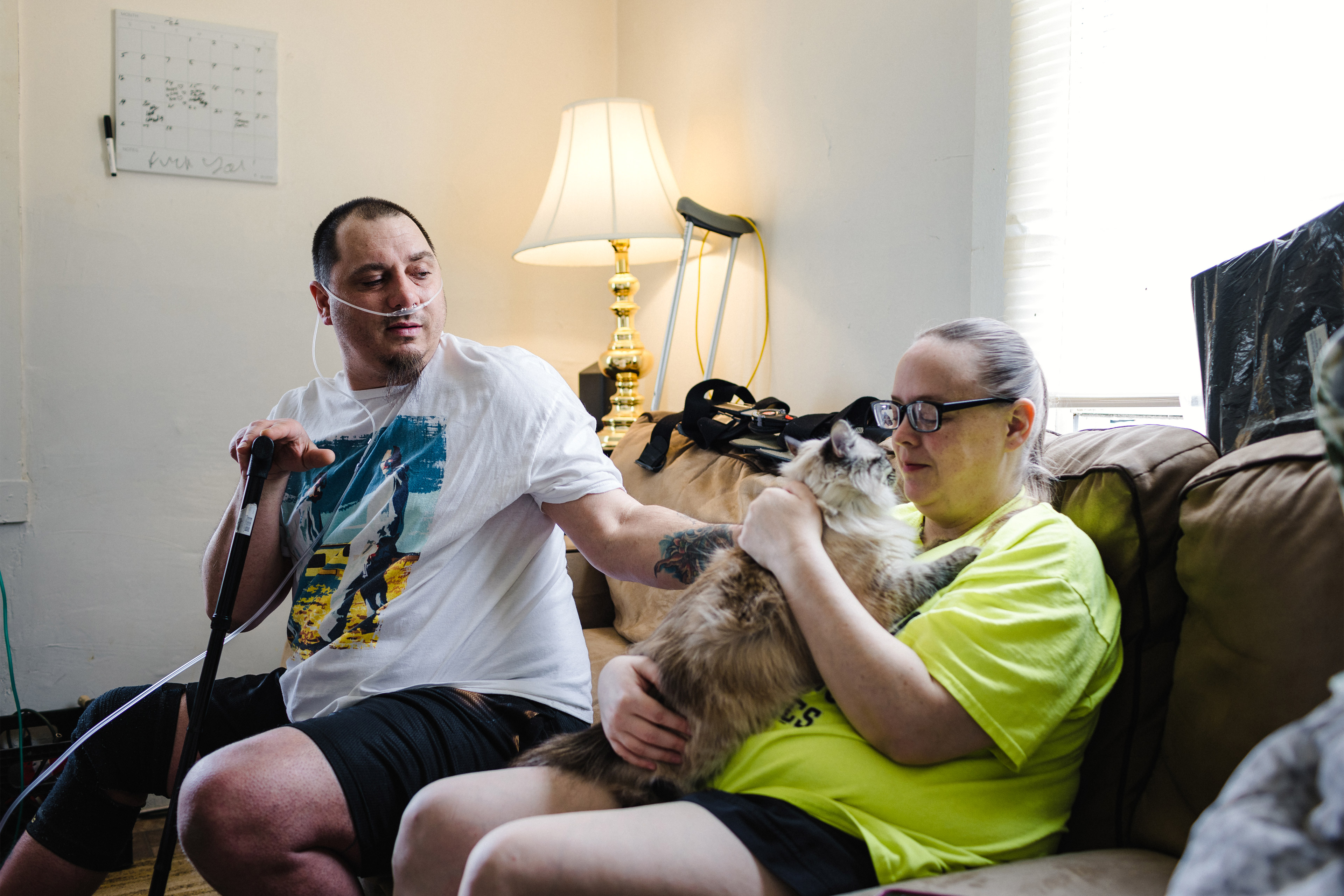
Less than a month later, he spent eight days in an intensive care unit, the first of more than 40 hospital stays since. These days, he can barely get out of bed in his home south of Atlanta.
“It makes my life so miserable,” said Boyd, 44, who has chronic obstructive pulmonary disease. He told his story to KHN over email and text because he sometimes has trouble talking without losing his breath.
While Medicaid is generally prohibited from paying for the services people receive inside a prison or jail, the Biden administration opened the door for the federal program to cover care not long before a person is released, to help them better manage their health conditions during the transition. In February, the administration announced that states could also use Medicaid to pay for substance abuse treatment in state jails and prisons. Congressional efforts to reactivate Medicaid before inmates’ release nationwide have so far failed.
And across much of the South, where many states have not expanded Medicaid, reentry services that connect people like Boyd to health care resources are often minimal or nonexistent.
More than 600,000 people are released from state and federal prisons every year in the U.S. and the majority have health conditions. A 2019 judicial decision suggested that people who are incarcerated have a constitutional right to adequate medical discharge planning before their release, including supplies of medication or prescriptions. But it’s far from clear whether states are required to do so.
In Georgia, correctional facilities are supposed to create a discharge plan that includes making medical appointments and supplying medications. Joan Heath, director of the public affairs office at the Georgia Department of Corrections, didn’t respond to questions about why the official policy wasn’t followed in Boyd’s case.
Despite official policies, people regularly leave prison or jail lacking medications, medical records, a provider appointment, or health insurance. About 84% of men and 92% of women who were incarcerated had a physical or mental health condition or substance use disorder, according to a sample of people interviewed before and after their release from prison by the Urban Institute, a nonprofit that researches issues around equity.
Without timely care, formerly incarcerated patients are more likely to develop a health crisis and turn to costly emergency rooms. Or they experience a mental health episode or commit crimes related to substance use disorder that lands them back in prison or jail.
“There is no bridge,” said Stephanie Jones-Heath, CEO of Diversity Health Center, a federally qualified health center in southeastern Georgia. By the time formerly incarcerated patients come to the center, their health conditions are uncontrolled and they have no medical records, she said. “We have to start all over because we have no continuity of care,” she said.
The United States has one of the highest rates of incarceration in the world. Conditions such as the use of solitary confinement, limited health care access, high stress, and poor-quality food can also create or exacerbate illness.
“This is the sickest population in the country,” said Dr. Marc Stern, a University of Washington public health faculty member who previously worked for the state’s Department of Corrections. Stern co-authored one of the few studies on the topic. That 2007 study found people who were incarcerated were 3.5 times as likely to die as other state residents — many deaths took place within the first two weeks of a person’s release.
In January, California became the first state to obtain a partial waiver allowing incarcerated people to get services through Medicaid 90 days before release. More than a dozen other states are pursuing similar waivers. They argue that more seamless care will reduce deaths from overdose — the leading killer of people leaving prison — improve health outcomes, and save money by keeping patients out of the emergency room.
In Georgia, even basic discharge planning can be rare, said Craig Burnes, a certified peer-support specialist for incarcerated people. In 2014 he was released from state prison after a nearly 15-year stay with a $20 debit card that mistakenly hadn’t been activated, he said. Burnes, who has bipolar and post-traumatic stress disorders, depression, and anxiety, said he found his own way to a safety-net foundation for mental illness treatment near his home in Dalton.
Most of the people Burnes works with have no idea how to access care. Often, they lack family support and stable housing, struggle with mental health or substance abuse issues, and lack the skills to navigate the bureaucracy that comes with reclaiming their life after prison.
“It’s a terrible circle that has no beginning,” he said. Burnes regularly sends people to the emergency room so they can get medications and a referral to a free clinic.
Stephen McCary, 40, couldn’t find treatment for a heroin addiction after he was released from an Alabama prison in 2011.
In May 2019, an addiction recovery facility told him that funding to pay for his care was not immediately available. McCary, who also struggled with periodic homelessness, never followed up. He suffered an overdose, was re-arrested for a pharmacy theft, and is now serving another prison sentence.
“None of these crimes I would have committed if I had somewhere to go,” he said in a phone call from Ventress Correctional Facility in Alabama.
Alabama has not expanded Medicaid, which could have helped McCary secure care after his release. In Connecticut, a study found that when people are connected with primary care after incarceration they are less likely to be hospitalized or to be re-incarcerated, which can save the state money.
“We have to look at the big picture,” said Dr. Shira Shavit, who is a clinical professor of family and community medicine at the University of California-San Francisco and executive director of the Transitions Clinic Network, and worked on the studies. “If we invest in Medicaid, we can save money in the prison system.”
Black people, who are more likely than the general population to be incarcerated and lack insurance coverage, are disproportionately affected by the absence of post-incarceration health services.
One reason people fall through the cracks is because no one agency takes responsibility for the problem, said Dr. Evan Ashkin, a professor of family medicine at the University of North Carolina-Chapel Hill and director of the North Carolina Formerly Incarcerated Transition Program, which helps former inmates obtain health care. Health systems often don’t differentiate the needs of people who were imprisoned from others lacking insurance, he said. Justice systems don’t have budgets or a mandate to care for people once they leave custody. About 90% of patients in the program’s clinics lack insurance. North Carolina has not yet expanded Medicaid, though lawmakers recently struck a deal to do so.
A key piece of the new California waiver is the ability for providers to get reimbursed to coordinate care, which is especially important for people coming out of prison, Shavit said. “All of their basic needs are up in the air at once, and often health care takes a back seat,” she said.
Medicaid expansion along with a program for enrolling patients in Medicaid just before release has helped people coming out of Louisiana’s notoriously grim prison health care system, said Dr. Anjali Niyogi, a Tulane University School of Medicine professor who founded a clinic serving formerly incarcerated people. Still, insurance coverage alone isn’t enough to compensate for the lack of care people receive while incarcerated, she said.
Anthony Hingle Jr. never got the results of a biopsy that took place just days before he was released from Louisiana State Penitentiary in Angola in 2021 after 32 years of incarceration.
Hingle, 52, learned he had prostate cancer after calling the New Orleans hospital on his own to request the biopsy results. Even though he had Medicaid coverage, he had to wait several more months for insurance from his job to kick in before he could afford treatment and surgery to remove his prostate. Hingle, who works as an office assistant at Voice of the Experienced, a nonprofit that advocates for incarcerated and formerly incarcerated people, wonders how his life might have unfolded if he had been diagnosed sooner.
Without a prostate, “having children with my wife, that’s gone,” he said.
Read More
Renuka Rayasam