

Apple keep their 5 nm chips. Apple have introduced their new SoCs, the M2 Pro and M2 Max. Following the slight lack of efficiency in the M2 compared to the M1, now we will shine the spotlight onto both of the new chips in the MacBook Pro models: the M2 Pro and the M2 Max.
Andreas Osthoff, ???? Andreas Osthoff, ✓ Brian Burriston (translated by Daisy Dickson), Published ???????? ???????? …
Just over half a year ago, Apple introduced their new M2 System on a Chip (SoC), which is being used in the MacBook Air, the MacBook Pro 13, as well as the Mac mini. Just like its predecessor, the M2 chip will be produced using the 5 nm process, which has been further improved. Some other changes have been made as well, such as a new Media Engine – but the higher core clock speeds (P-Cores max. 3.48 vs 3.2 GHz; E-Cores max. 2.4 vs 2.1 GHz) are responsible for the increased performance of the new chips. The basic construction and core configuration with a performance cluster (4 cores) and a power-efficiency cluster (4 cores) remain unchanged. Our analysis showed that Apple managed to improve performance – but with an increase in energy consumption as a result. This means that efficiency under high load is worse than that of the M1.
We were already expecting the new M2 Pro and M2 Max SoCs in the fall of last year and there were rumours of a new 3 nm production, which could have offered much better efficiency. However, the launch was pushed back to January 2023 and Apple have stuck with their 5 nm chips. Other than the higher clock speeds, there are more cores in the processor as well as the graphics card. We were already able to test the MacBook Pro 14 2023 and MacBook Pro 16 2023 in great detail – but now we wanted to take a closer look at the new SoCs. They definitely offer increased performance, but did this take its toll on their efficiency as it did with the regular M2 chips?
Apple have slimmed down their processor lineup, now offering four different SoCs: two M2 Pro chips and two M2 Max SoCs. All models now have two additional power-efficiency cores and retain six or eight performance cores. Another new feature is the single-core turbo of up to 3.69 GHz in the M2 Max and 3.504 in the M2 Pro. In multi-core mode, the maximum is 3.264 GHz. Additionally, the L2 cache has increased from 28 to 36 MB.
Furthermore, the graphics cards also benefit from a higher number of cores as well as higher clock speeds of 1.4 GHz. The M2 Pro has 16 or 19 GPU cores and the M2 Max has 32 or 38 cores. The slimmed-down M2 Pro chip is only available in the base model of the smaller MacBook Pro 14. Apple have increased the maximum amount of RAM from 64 to 96 GB (LPDDR5-6400) – but only in the M2 Max. The M2 Pro is limited to 32 GB RAM.
| SoC | CPU cores | GPU cores | RAM |
|---|---|---|---|
| M2 Pro | 4 power-efficiency cores & 6 performance cores | 16 | 16 or 32 GB |
| M2 Pro | 4 power-efficiency cores & 8 performance cores | 19 | 16 or 32 GB |
| M2 Max | 4 power-efficiency cores & 8 performance cores | 30 | 32, 64 or 96 GB |
| M2 Max | 4 power-efficiency cores & 8 performance cores | 38 | 32, 64 or 96 GB |
Aside from the base model of the M2 Pro, the CPU performances are practically identical – which we were already able to determine in our reviews of the MacBook Pro 14 2023 and the MacBook Pro 16 2023. The big difference lies in the graphics performance. We will now check the performance of the new Apple SoCs, as well as compare them to processors and graphics cards from AMD, Intel and Nvidia.
Additionally, we will analyse the efficiency – however, Apple has made this a little harder with the new M2 models, as the integrated PowerMetrics function doesn’t show the chips’ package power anymore (this also applies to tools such as Asitop or MX Power Gadget). Instead, only the true consumption of the CPU and GPU is shown. As a result, we will be using the Cinebench R23 benchmark on an external monitor to compare efficiencies, so that the integrated panel can be excluded as an influencing factor. With the graphics card, we will be using the true GPU consumption in the 3DMark Wild Life Extreme Unlimited benchmark to compare between Apple products, as well as the game The Witcher 3 to compare them with Windows devices. More on this later.
Apple advertize an enhanced processing performance of up to 20% – however, this is not for single-core performance. We were able to identify an enhanced performance of 6-8% compared to the old M1 Pro and M1 Max CPUs – but this can solely be put down to the higher clock speeds. Compared to the last generation, the M2 Pro and the M2 Max show a clear advantage over the regular M2 processors in the MacBook Pro 13 and the MacBook Air.
| Cinebench R23 – Single Core | |
| Apple M2 Pro MacBook Pro 14 2023 M2 Pro |
|
| Apple M2 Pro 10-Core MacBook Pro 14 2023 M2 Pro Entry |
|
| Apple M2 Max MacBook Pro 16 2023 M2 Max |
|
| Apple M2 MacBook Pro 13 2022 M2 |
|
| Apple M2 MacBook Air M2 10C GPU |
|
| Apple M1 Max Mac Studio 2022 M1 Max |
|
| Apple M1 Pro MacBook Pro 16 2021 M1 Pro |
|
| Apple M1 Pro 8-Core MacBook Pro 14 2021 M1 Pro Entry |
|
| Apple M1 Max MacBook Pro 16 2021 M1 Max |
|
| Geekbench 5.4 – Single-Core | |
| Apple M2 Max MacBook Pro 16 2023 M2 Max |
|
| Apple M2 Pro MacBook Pro 14 2023 M2 Pro |
|
| Apple M2 MacBook Pro 13 2022 M2 |
|
| Apple M2 MacBook Air M2 10C GPU |
|
| Apple M1 Max Mac Studio 2022 M1 Max |
|
| Apple M1 Max MacBook Pro 16 2021 M1 Max |
|
| Apple M1 Pro 8-Core MacBook Pro 14 2021 M1 Pro Entry |
|
| Apple M1 Pro MacBook Pro 16 2021 M1 Pro |
|
| Cinebench R20 – CPU (Single Core) | |
| Apple M2 Max MacBook Pro 16 2023 M2 Max |
|
| Apple M2 Pro MacBook Pro 14 2023 M2 Pro |
|
| Apple M1 Max Mac Studio 2022 M1 Max |
|
| Apple M1 Pro MacBook Pro 16 2021 M1 Pro |
|
| Apple M1 Max MacBook Pro 16 2021 M1 Max |
|
| Apple M2 MacBook Pro 13 2022 M2 |
|
| Apple M2 MacBook Air M2 10C GPU |
|
| Cinebench R15 – CPU Single 64Bit | |
| Apple M2 Max MacBook Pro 16 2023 M2 Max |
|
| Apple M2 Pro MacBook Pro 14 2023 M2 Pro |
|
| Apple M2 MacBook Pro 13 2022 M2 |
|
| Apple M2 MacBook Air M2 10C GPU |
|
| Apple M1 Pro 8-Core MacBook Pro 14 2021 M1 Pro Entry |
|
| Apple M1 Pro MacBook Pro 16 2021 M1 Pro |
|
| Apple M1 Max Mac Studio 2022 M1 Max |
|
| Apple M1 Max MacBook Pro 16 2021 M1 Max |
|
Energy consumption under single-core load has risen ever so slightly, but this varies from chip to chip. For example, both M2 Pro models are slightly more efficient compared to the old M1 Pro, whereas the M2 Max falls behind when compared to the old M1. The differences may look quite big here, but you have to remember that we are talking about a range between 4-6 watts, which really isn’t much in the bigger scheme of things.
| Power Consumption / Cinebench R23 Single Power Efficiency – external Monitor | |
| Apple M2 MacBook Air M2 10C GPU |
|
| Apple M2 MacBook Pro 13 2022 M2 |
|
| Apple M2 Pro MacBook Pro 14 2023 M2 Pro |
|
| Apple M2 Pro 10-Core MacBook Pro 14 2023 M2 Pro Entry |
|
| Apple M1 Pro MacBook Pro 16 2021 M1 Pro |
|
| Apple M1 Max Mac Studio 2022 M1 Max |
|
| Apple M2 Max MacBook Pro 16 2023 M2 Max |
|
| Power Consumption / Cinebench R23 Single (external Monitor) | |
| Apple M2 Max MacBook Pro 16 2023 M2 Max |
|
| Apple M1 Max Mac Studio 2022 M1 Max |
|
| Apple M1 Pro MacBook Pro 16 2021 M1 Pro |
|
| Apple M2 Pro 10-Core MacBook Pro 14 2023 M2 Pro Entry |
|
| Apple M2 Pro MacBook Pro 14 2023 M2 Pro |
|
| Apple M2 MacBook Pro 13 2022 M2 |
|
| Apple M2 MacBook Air M2 10C GPU |
|
* … smaller is better
Thanks to the increase in single-core performance, Apple were able to almost completely close the gap between them and Intel, although this varied depending on the test. In the Geekbench test, the Apple SoC performed extremely well and even beat the newest Raptor Lake Core i7-1360P by 10%. In the Cinebench R23 test, however, the M2 Pro and M2 Max remained on par with the previous Alder Lake CPU, and the new Raptor Lake i7 came out on top by 15% – thanks to its higher single-core turbo. Apple triumphed over the old AMD Ryzen 7 6800U with Zen 3+ cores, although this could change soon enough with the release of the Zen 4 models.
When it comes to single-core efficiency and compared to AMD and Intel, Apple were the clear winners with their M2 Pro by a mile. The M2 Max‘s result was seemingly much worse than that of the M2 Pro – however, since we are dealing with quite a low calibre when it comes to the Apple chips’ performance under single-core load, the smaller additional consumption became much more noticeable here.
Intel were able to slightly improve their single-core efficiency with their new Raptor Lake Core i7, but this still falls short compared to AMD’s Zen 3+ chips.
| Power Consumption / Cinebench R23 Single Power Efficiency – external Monitor | |
| Apple M2 Pro MacBook Pro 14 2023 M2 Pro |
|
| Apple M2 Max MacBook Pro 16 2023 M2 Max |
|
| AMD Ryzen 7 PRO 6850U ThinkPad T14 G3-21CF004NGE |
|
| AMD Ryzen 7 6800U Yoga 7-14ARB G7 |
|
| Intel Core i7-1360P Yoga 9 14IRP G8 |
|
| Intel Core i7-1260P MateBook X Pro 2022 |
|
| Intel Core i7-12700H Vision 14 2022 RTX 3050 Ti |
|
| Power Consumption / Cinebench R23 Single (external Monitor) | |
| Intel Core i7-12700H Vision 14 2022 RTX 3050 Ti |
|
| Intel Core i7-1260P MateBook X Pro 2022 |
|
| Intel Core i7-1360P Yoga 9 14IRP G8 |
|
| AMD Ryzen 7 6800U Yoga 7-14ARB G7 |
|
| AMD Ryzen 7 PRO 6850U ThinkPad T14 G3-21CF004NGE |
|
| Apple M2 Max MacBook Pro 16 2023 M2 Max |
|
| Apple M2 Pro MacBook Pro 14 2023 M2 Pro |
|
* … smaller is better
All the new M2 Pro and M2 Max SoCs have received two additional power-efficiency cores, which have of course had a positive impact on multi-core performance. In everyday use, the two additional cores also help make the chip more efficient, as the fast and energy-draining performance cores don’t have to be used as often. Moreover, the results of the multi-core tests were significantly better and in the best-case scenario, the two additional cores in combination with the previously mentioned optimisations led to a 20% improvement in multi-core performance compared to the old M1 Pro and M1 Max. The new base model of the M2 Pro with 10 cores lies 23% ahead of the old M1 Pro with 8 cores (Cinebench R23) and 5% behind the old M1 Pro/M1 Max with 10 cores. Both new chips with 12 cores are 25% faster than the base model M2 Pro.
| Cinebench R23 – Multi Core | |
| Apple M2 Pro MacBook Pro 14 2023 M2 Pro |
|
| Apple M2 Max MacBook Pro 16 2023 M2 Max |
|
| Apple M1 Max Mac Studio 2022 M1 Max |
|
| Apple M1 Max MacBook Pro 16 2021 M1 Max |
|
| Apple M1 Pro MacBook Pro 16 2021 M1 Pro |
|
| Apple M2 Pro 10-Core MacBook Pro 14 2023 M2 Pro Entry |
|
| Apple M1 Pro 8-Core MacBook Pro 14 2021 M1 Pro Entry |
|
| Apple M2 MacBook Pro 13 2022 M2 |
|
| Apple M2 MacBook Air M2 10C GPU |
|
| Geekbench 5.4 – Multi-Core | |
| Apple M2 Max MacBook Pro 16 2023 M2 Max |
|
| Apple M2 Pro MacBook Pro 14 2023 M2 Pro |
|
| Apple M1 Max MacBook Pro 16 2021 M1 Max |
|
| Apple M1 Max Mac Studio 2022 M1 Max |
|
| Apple M1 Pro MacBook Pro 16 2021 M1 Pro |
|
| Apple M1 Pro 8-Core MacBook Pro 14 2021 M1 Pro Entry |
|
| Apple M2 MacBook Air M2 10C GPU |
|
| Apple M2 MacBook Pro 13 2022 M2 |
|
Of course, the additional cores and higher clock rates also increase energy consumption compared to the M1 Pro when all cores are in use. This shows that the new chips don’t really offer much improvement, as the efficiency sank in the multi-core tests. As expected, the M2 Max with the largest amount of RAM did the worst within the Apple lineup, but also the M2 Pro with 12 cores fell behind its predecessor.
With the entry-level M2 Pro with 10 cores, the maximum energy consumption rose to around 28 watts (M1 Pro with 8 cores: 21 watts) – the bigger 12-core model had a consumption of around 34 watts (M1 Pro with 10 cores: 27 watts) and the M2 Max had a consumption of around 34-36 watts (M1 Max: 29 watts). Without taking that next step in the production process, Apple simply cannot magic up lower energy consumption, considering the two additional cores as well as the higher clock rates.
| Power Consumption / Cinebench R23 Multi Power Efficiency – external Monitor | |
| Apple M2 MacBook Pro 13 2022 M2 |
|
| Apple M2 MacBook Air M2 10C GPU |
|
| Apple M1 Pro MacBook Pro 16 2021 M1 Pro |
|
| Apple M2 Pro MacBook Pro 14 2023 M2 Pro |
|
| Apple M1 Max Mac Studio 2022 M1 Max |
|
| Apple M2 Pro 10-Core MacBook Pro 14 2023 M2 Pro Entry |
|
| Apple M2 Max MacBook Pro 16 2023 M2 Max |
|
| Power Consumption / Cinebench R23 Multi (external Monitor) | |
| Apple M2 Max MacBook Pro 16 2023 M2 Max |
|
| Apple M2 Pro MacBook Pro 14 2023 M2 Pro |
|
| Apple M2 Pro 10-Core MacBook Pro 14 2023 M2 Pro Entry |
|
| Apple M1 Max Mac Studio 2022 M1 Max |
|
| Apple M1 Pro MacBook Pro 16 2021 M1 Pro |
|
| Apple M2 MacBook Pro 13 2022 M2 |
|
| Apple M2 MacBook Air M2 10C GPU |
|
* … smaller is better
Thanks to the chips’ increased performance, Apple were able to set themselves apart from their competitors in the multi-core tests. In the Geekbench test, the M2 chips showed extremely good performance in any case – but they also performed well in the Cinebench R23 test. The Apple chip only had to admit defeat to the Core i7-12700H in the Schenker Vision 14 – which, however, also uses more energy (60/40 watts). Therefore, Apple shouldn’t be afraid of the new Core i7-1360P from Intel’s newest Raptor Lake generation (despite higher consumption).
AMD’s Zen 3+ chips were also defeated by Apple in the multi-core tests, but this could change with the coming Zen 4 chips.
Due to the M2 Max’s lower multi-core efficiency at maximum load, the chip fell behind the Ryzen 7 Pro 6850U. The M2 Pro was still able to keep its head above the water, but the Zen 4 CPUs of the U-series at the latest should offer much better efficiency and therefore trump Apple’s ARM SoCs. Intel currently sits at the bottom of the efficiency scores.
Out of interest, we ran the new Ryzen 9 7945HX (Zen 4, 5 nm) at 35 watts and the results were 16,872 points in the Cinebench R23 multi-test – so the AMD chip is more efficient than the M2 Pro.
| Power Consumption / Cinebench R23 Multi Power Efficiency – external Monitor | |
| Apple M2 Pro MacBook Pro 14 2023 M2 Pro |
|
| AMD Ryzen 7 PRO 6850U ThinkPad T14 G3-21CF004NGE |
|
| Apple M2 Max MacBook Pro 16 2023 M2 Max |
|
| AMD Ryzen 7 6800U Yoga 7-14ARB G7 |
|
| Intel Core i7-1360P Yoga 9 14IRP G8 |
|
| Intel Core i7-1260P MateBook X Pro 2022 |
|
| Intel Core i7-12700H Vision 14 2022 RTX 3050 Ti |
|
| Power Consumption / Cinebench R23 Multi (external Monitor) | |
| Intel Core i7-12700H Vision 14 2022 RTX 3050 Ti |
|
| Intel Core i7-1360P Yoga 9 14IRP G8 |
|
| Apple M2 Max MacBook Pro 16 2023 M2 Max |
|
| Apple M2 Pro MacBook Pro 14 2023 M2 Pro |
|
| Intel Core i7-1260P MateBook X Pro 2022 |
|
| AMD Ryzen 7 6800U Yoga 7-14ARB G7 |
|
| AMD Ryzen 7 PRO 6850U ThinkPad T14 G3-21CF004NGE |
|
* … smaller is better
We already saw that Apple seemingly changed more when taking a look at the normal M2-SoC, as the efficiency also improved along with its greater performance. In total, the M2 Pro and the M2 Max now have four different iGPUs- the M2 Pro has 6 or 19 GPU cores and the M2 Max has 32 or 38 GPU cores.
The new base GPU with 16 cores was around 20% faster in the Wild Life Extreme Unlimited test compared to the old base model and 8% faster than the old 16-core GPU of the M1 Pro. The version with 19 cores was once again 16% faster, which is 18% behind the old M1 Max GPU with 24 cores.
As it stands, we don’t yet have benchmarks for the new M2 Max with 32 cores, but we will add these as soon as possible. The super-fast M2 Max GPU with 38 cores is 24% ahead of the old top-of-the-range M1 Max with 32 GPU cores.
Determining the energy consumption of Apple’s iGPUs is no mean feat, and especially with the M2 Max (as it was with the M1 Max) it is not easy to even push the iGPU to its maximum load for an extended period of time. In the following table, we have listed all the energy consumption figures. We were able to determine the highest energy consumption of the iGPUs using the Novabench test – this wasn’t possible using any other test.
| 3DMark Wild Life Extreme Unlimited | Novabench | |
|---|---|---|
| M1 Pro 16C | ~20 watts | 24 watts |
| M2 Pro 16C | ~23,5 watts | 27,5 watts |
| M2 Pro 19C | ~26 watts | 30 watts |
| M1 Max 32C | ~44 watts | ~49 watts |
| M2 Max 38C | ~48 watts | 64 watts |
Taking a glance at efficiency, we will start with the M2 Pro 16C, whose higher performance is basically cancelled out by its higher consumption – ultimately, its efficiency is identical to that of the M1 Pro GPU with 16 cores. The new 19-core model is, however, 6% more efficient.
Most impressive is the new M2 Max GPU with 38 cores – in our Wild Life Extreme Unlimited test it improved by 14%. Thus, this confirms our results from the M2 analysis and it seems that Apple have changed more than just the number of cores in their iGPUs.
Compared with its Windows competitors, the M2 Max GPU also manages to keep the new GeForce RTX 4070 laptop in check, which is quite an impressive feat considering its much lower energy intake. On the flip side, both M2 Pro GPUs sit between the GeForce RTX 3050 Ti and the new RTX 4050 laptop – also a good result.
Comparing efficiencies is not the easiest, as we usually only measure the energy consumption of Windows devices using The Witcher 3. With the tool CrossOver, we can manage to run The Witcher 3 on the Mac (very well in fact), so we can measure its energy consumption here too. The results are still not 100% comparable though, since we had to deactivate HBAO+ and Nvidia HairWorks on the Mac. If you take into account the fact that this game isn’t optimized for Apple SoCs and how well the Apple-native Resident Evil runs, we can only hope that more games are released in future for Apple’s processors specifically.
Looking at energy consumption rates, Apple GPUs lie well ahead of their competitors – even the new RTX 40 models don’t stand a chance.
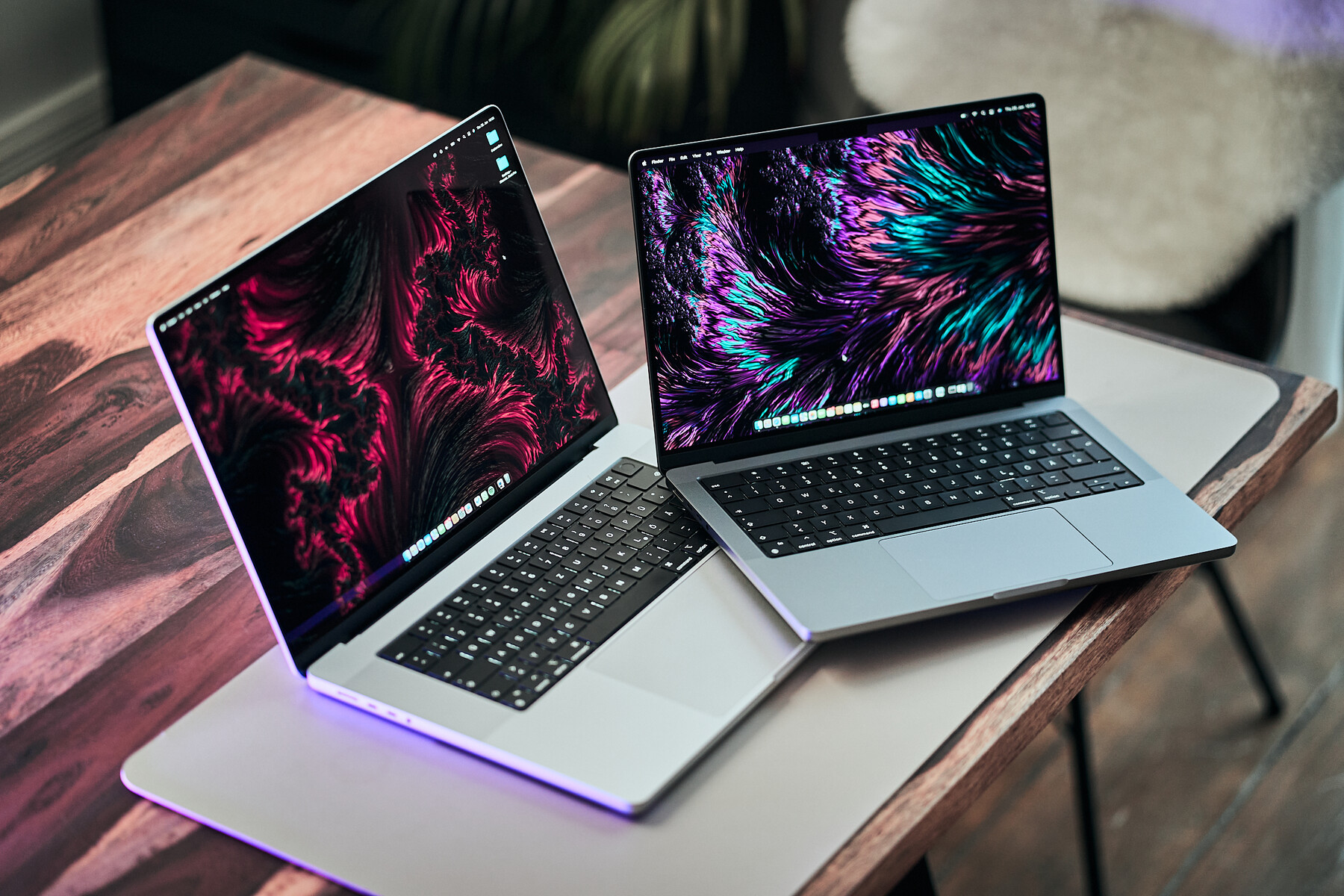
Even if this update is missing big jumps in efficiency and Apple have continued to use the 5 nm process to manufacture the M2 Pro and M2 Max chips, it is still a solid effort. Apple were able to increase both the single and multi-core performance of the processors. At maximum load, the two additional cores make for slightly lower efficiency compared to the M1 Pro and M1 Max, but overall, the additional power-efficiency cores have had a positive impact on the chips, as the performance cores don’t need to be used as often. In total, you can definitely see an improvement in the total efficiency of the new CPUs.
Although Intel offer higher single-core performance with their Raptor Lake mobile processors (13th generation), they cannot compete with Apple when it comes to multi-core performance and efficiency. This proves to be slightly different for AMD, as the Ryzen 9 7945HX‘s (also 5 nm) first benchmarks show that it is more efficient than the M2 Pro at 35 watts and we expect to see even better results from the U-series chips with Zen 4 (4 nm).
When it comes to the integrated graphics card, neither Intel nor AMD can keep up with Apple in the slightest – instead, Apple even manage to take on dedicated graphics cards like the RTX 3050 Ti or in the case of the M2 Max (38 cores), even the new GeForce RTX 4070 laptop. Alongside improved performance, Apple also managed to further improve the efficiency of their integrated graphics card.
Especially in comparison with Windows computers, you have to remember two things: Under low load, the power consumption of the MacBooks is extremely low and in addition to this, even with the M2 Max at maximum performance levels you can get away with relying on the Mac’s battery – which would simply not be possible with comparable Windows components.
It also has to be said that Apple will soon gain some competition from the likes of AMD, at least in terms of processors. We are extremely curious to see how the new U-series Zen 4 chips will perform and if Apple will soon manage to make that leap ahead with their 3 nm chips, which we so desperately want to see.

Editor of the original article: Andreas Osthoff – Managing Editor Business Laptops – 1466 articles published on Notebookcheck since 2013
I grew up with modern consumer electronics and my first computer was a Commodore C64, which encouraged my interest in building my own systems. I started working as a review editor for Notebookcheck during my dual studies at Siemens. Currently, I am mainly responsible for dealing with business laptops and mobile workstations. It’s a great experience to be able to review the latest devices and technologies and then compare them with each other.

Translator: Daisy Dickson – Translator – 3 articles published on Notebookcheck since 2023
Originally from Scotland, I grew up and lived in Germany until I completed my high school qualifications before moving back to Scotland to complete my university studies. Growing up bilingual led me to form a close relationship with the English and German languages, often working in the fields of teaching and translation. Most of my childhood was shaped by playing around on new consoles, computers and gadgets and getting to grips with the new craze of the internet and smartphones. This interest has stayed with me well into adulthood. Nowadays, I live in Glasgow and work as a freelance translator and digital media coordinator. I have been translating for Notebookcheck since early 2023.
Andreas Osthoff, 2023-03- 6 (Update: 2023-03- 6)
Read More
Andreas Osthoff