
Qualcomm wants to replace eSIMs with iSIMs, has the first certified SoC

It’s smaller —

SIMs were plastic cards, then motherboard chips, and soon will just be in the SoC.


Qualcomm wants to replace eSIMs with iSIMs, has the first certified SoC

Qualcomm

Here’s an interesting bit of news out of Mobile World Congress: Qualcomm says the Snapdragon 8 Gen 2 has been certified as the “world’s first commercially deployable iSIM (Integrated SIM).” What the heck is an iSIM? Didn’t we just go through a SIM card transition with eSIM? We did, but iSIM is better than eSIM. We’ll explain, but the short answer is that iSIM is the next step in the continual march to reduce the size of SIM cards.

OK, so SIM cards are (in the smallest “nano” size) little 12×9 mm plastic cards that you physically stick into your phone. SIM stands for “Subscriber Identity Module,” and these cards mostly just identify you to your cell carrier, allowing your device to be provisioned for the cellular service that you pay a monthly bill for. The idea is that if you buy a new phone, or have multiple phones, you can just move the SIM card over, and—if there aren’t any compatibility problems—your service could be easily moved between phones.

In ye olden days, these cards would store some actual data like contacts and messages, but with the advent of smartphones, all of that moved to the cloud. Today a SIM card can store up to 265KB of data in that 12×9 mm card, which is absolutely horrible data density considering similarly sized MicroSD cards can go up to 1TB, or about 4.2 million times more data. SIM cards are a huge waste of space in an industry that is very aggressive about saving space, so they needed to go.

Enter eSIMs, the newish standard that does away with the physical, removable SIM card and instead solders a tiny chip on the motherboard of your phone. These came to the Google Pixel line in 2017, the iPhone in 2018, and some Samsung phones in 2021, and, for a few models, they lived alongside physical cards. A major turning point for most carriers was Apple killing the physical SIM card in 2022 with some iPhone 14 models and going eSIM-only. An eSIM-only device has no removable card at all, and therefore no card slot, simplifying device design, saving space, and removing one possible spot for water ingress. Instead of sticking a hunk of plastic in the phone, you provision your device via some app, usually by signing in to your account with your carrier. eSIMs are a big size savings over physical cards, and the smallest chips are around 2.5×2.3 mm.
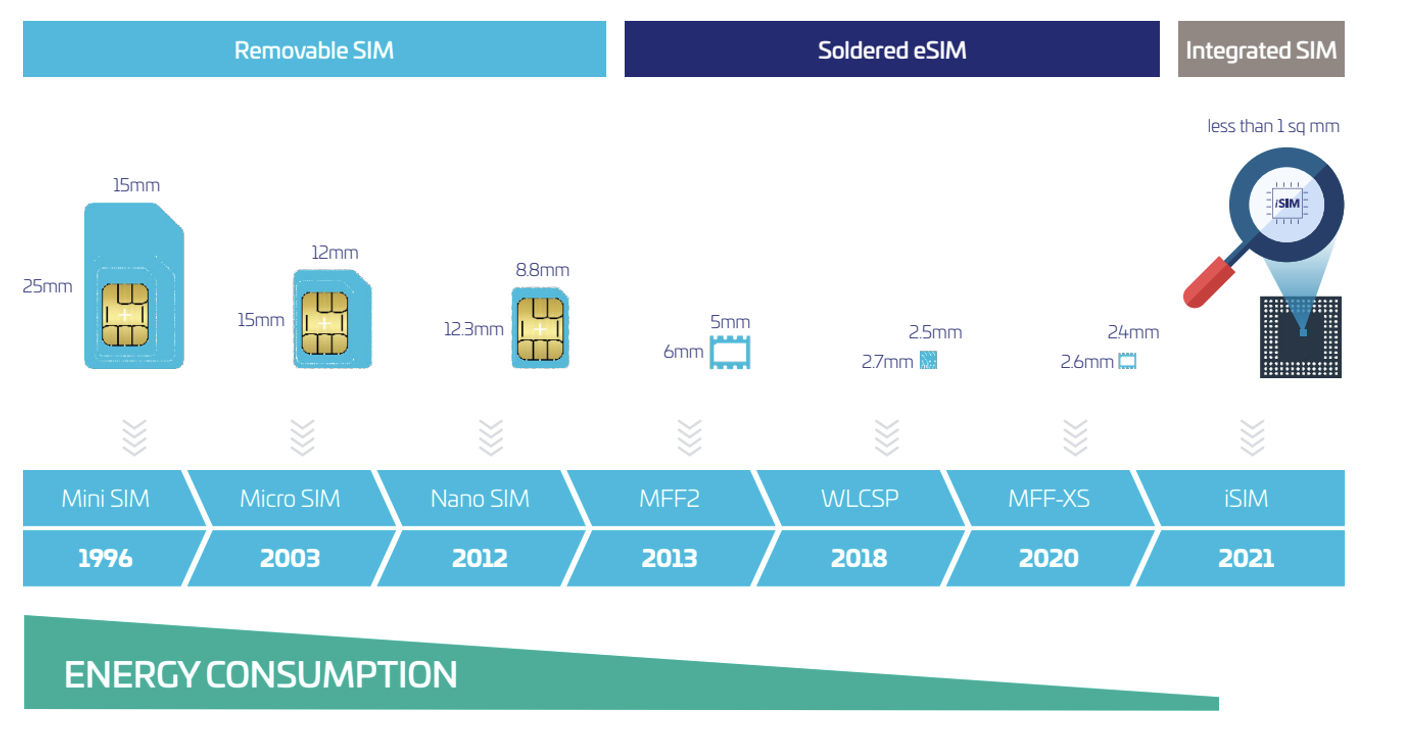
Qualcomm is doing this iSIM project with the tech company Thales, and they made this lovely graphic.

Enlarge / Qualcomm is doing this iSIM project with the tech company Thales, and they made this lovely graphic.

eSIMs are still a chip taking up space on your motherboard, and that’s not ideal if you want to squeeze every square millimeter of space out of a phone. The next shrinking step is iSIM—an Integrated Subscriber Identity Module. Rather than a chip on the motherboard, iSIMs are integrated directly onto the SoC. SoC (system on a chip) integration is the technology that makes smartphones possible. Instead of a thousand little chips for things like the CPU, GPU, RAM, modem, and a bunch of other things, everything gets packed into one single do-everything piece of silicon. Individual chips require more space and power thanks to having to make motherboard traces to connect everything and having to deal with chip packages.

Building everything in one chip, with the tiniest transistors you can muster, is the cheapest and most space-efficient and power-efficient way to do things, and now SIM cards are going to disappear into that big block of stuff. iSIMs will be measured in fractions of a millimeter, and as part of the SoC, they will continually shrink every year as chip process nodes hit ever-smaller nm measurements. It sounds like this is the endgame for SIM technology, and besides helping out phones, will be great for evermore space-constrained devices like smartwatches.

Of course, we’ll need carriers to be on board with this, and that’s what Qualcomm’s announcement is mostly about. The iSIM solution in the Snapdragon 8 Gen 2 SoC—which is shipping now—has been certified by the GSMA, aka the world’s cell carriers. Qualcomm says “the new iSIM is fully compliant with the GSMA Remote SIM Provisioning standard; meaning its subscriptions are remotely manageable through any standard platforms.” That’s the same standard as eSIM, and it’s held to all the same security requirements, so theoretically, any carrier that works with eSIM shouldn’t see a difference between an eSIM and an iSIM. iSIM is still just a hunk of silicon that needs software provisioning—where the silicon lives shouldn’t really matter to your carrier.

Like many Qualcomm SoC components, using iSIM is optional even though it’s built into the chip. All current Snapdragon 8 Gen 2 phones use discrete eSIM chips instead of iSIM. Now that the solution is certified, the wait is on for some phone manufacturer to build iSIM into its next product design.

Read More
Ron Amadeo

Latest

Bitcoin Treasuries Are Cracking as Public Companies Turn into BTC Sellers

A wave of bitcoin selling from public companies and sovereign entities is adding pressure to the bitcoin market, as firms that once called themselves long-term holders sit on long-term losses and move to shore up balance sheets, repay debt, and fund strategic pivots. Companies including Riot Platforms, Genius Group, and Nakamoto Holdings have all reduced

Analyst Says Bitcoin Closing 6 Red Monthly Candles Isn’t Bearish, What To Expect

Bitcoin’s recent price structure has not been easy to sit through. The price action has spent months moving sideways to lower, printing a series of bearish monthly closes since October that have placed the crypto sentiment in fear. That kind of slow pressure tends to feel worse than sharp sell-offs. According to a crypto analyst

Bitcoin breaks critical support as dollar and oil move together, raising risk of a deeper drop

Bitcoin spent the past 24 hours returning to the key levels on my channel map rather than continuing its breakout. It tested a boundary, failed to convert that test into acceptance, and rotated lower into the next pocket of support memory. Bitcoin price slid from the upper $68,000s and low $69,000s to around $66,400 by

Mapletree Notches Fifth US Logistics Disposal With $207.5M Sale to Dalfen

Mapletree Investments has sold a US logistics portfolio to last-mile specialist Dalfen Industrial for $207.5 million, as the Singapore-based group continues a string of disposals across its North American warehouse platform. The transaction marks Mapletree’s fifth major US logistics divestment... Read More>> The post Mapletree Notches Fifth US Logistics Disposal With $207.5M Sale to Dalfen appeared first

Newsletter

Don't miss

Bitcoin Treasuries Are Cracking as Public Companies Turn into BTC Sellers

A wave of bitcoin selling from public companies and sovereign entities is adding pressure to the bitcoin market, as firms that once called themselves long-term holders sit on long-term losses and move to shore up balance sheets, repay debt, and fund strategic pivots. Companies including Riot Platforms, Genius Group, and Nakamoto Holdings have all reduced

Analyst Says Bitcoin Closing 6 Red Monthly Candles Isn’t Bearish, What To Expect

Bitcoin’s recent price structure has not been easy to sit through. The price action has spent months moving sideways to lower, printing a series of bearish monthly closes since October that have placed the crypto sentiment in fear. That kind of slow pressure tends to feel worse than sharp sell-offs. According to a crypto analyst

Bitcoin breaks critical support as dollar and oil move together, raising risk of a deeper drop

Bitcoin spent the past 24 hours returning to the key levels on my channel map rather than continuing its breakout. It tested a boundary, failed to convert that test into acceptance, and rotated lower into the next pocket of support memory. Bitcoin price slid from the upper $68,000s and low $69,000s to around $66,400 by

Mapletree Notches Fifth US Logistics Disposal With $207.5M Sale to Dalfen

Mapletree Investments has sold a US logistics portfolio to last-mile specialist Dalfen Industrial for $207.5 million, as the Singapore-based group continues a string of disposals across its North American warehouse platform. The transaction marks Mapletree’s fifth major US logistics divestment... Read More>> The post Mapletree Notches Fifth US Logistics Disposal With $207.5M Sale to Dalfen appeared first

Bitcoin slips below $67k as ETF outflows curb risk appetite

Key takeaways BTC is down 2%, erasing the recovery earlier this week, US-listed spot ETF recorded an outflow of $173.73 million on Wednesday, breaking its two days of inflow this week. Bitcoin faces continued losses amid weaker institutional demand Bitcoin (BTC) prices continued to decline on Thursday, trading below $67,000, almost completely erasing the recovery

Tesla’s Business Has Become Much More Diversified in Just the Past Five Years. Does That Make Its Stock a Better Buy Today?

Key Points Tesla's energy generation and storage segment generated 27% revenue growth last year. The company's non-automotive segments were able to help offset a double-digit decline in auto revenue in 2025. These 10 stocks could mint the next wave of millionaires › Tesla (NASDAQ: TSLA) is known for its electric vehicles (EVs), and while they

WD sees sustainability as key business driver in an ‘AI economy’

Hard drive company WD promoted long-term operations and sustainability executive Jackie Jung to become its first chief sustainability officer in February, as it steps up sales to companies building AI data centers. Her vision: Turn sustainability into a “brand” for WD, a strategy that reduces risk for the $6 billion company (formerly known as Western

5 Business Ideas Worth Starting in 2026

If there is one thing Nigerians understand well, it is how to spot opportunity inside hardship. In 2026, that mindset will matter more than ever. The economy is tough, competition is rising, and many people are looking for smarter ways to earn, build, and survive. But even in a difficult environment, some businesses still stand