

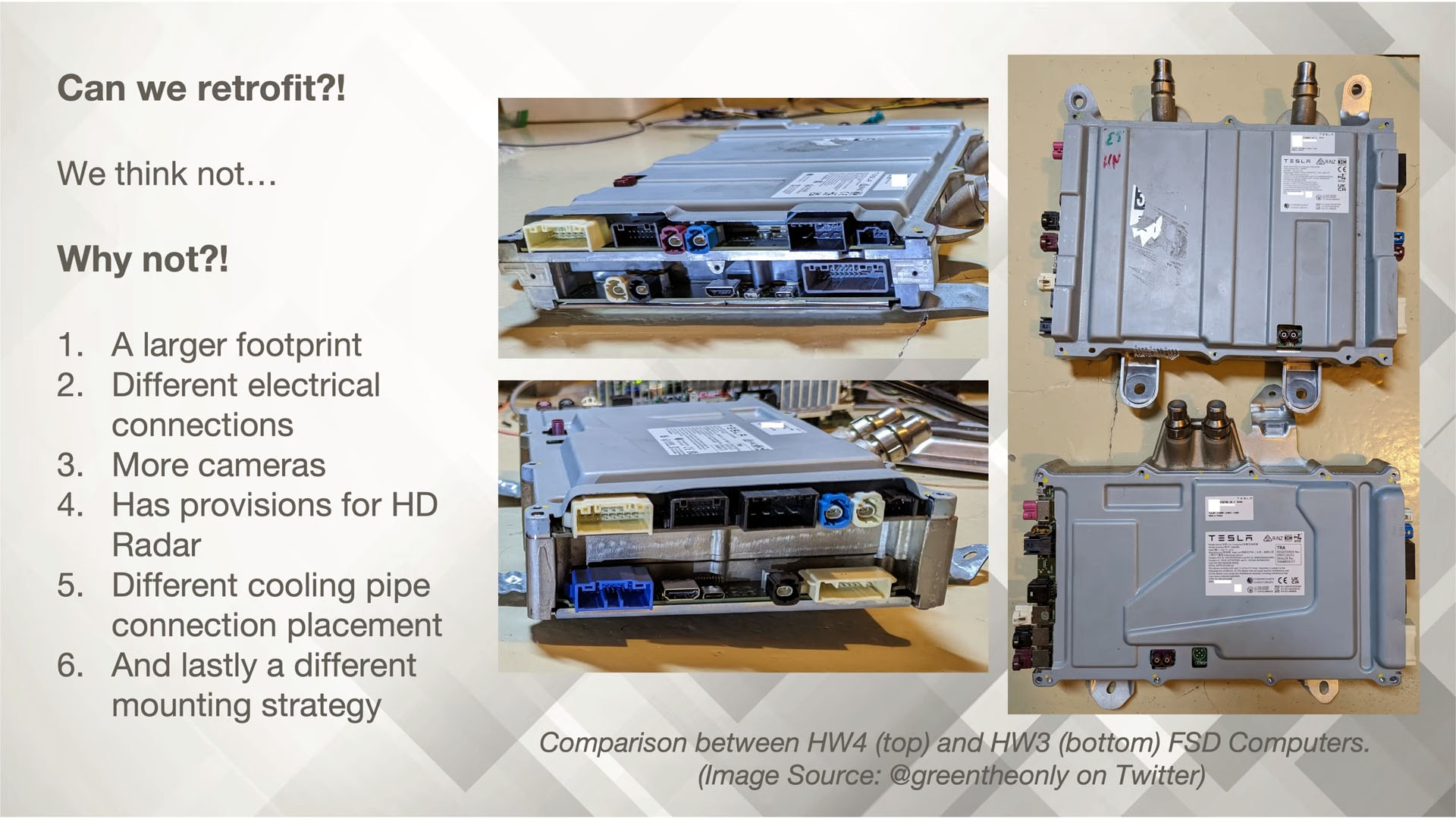
The creative destructors from Munro Live have sussed Tesla’s upcoming HW 4.0 computer that will do all the autonomous driving calculations in its new or upgraded models. Unfortunately, while the engineering talent at Munro found the new HW 4.0 design to be more efficient than before, that also means it can’t be retrofitted to existing cars in a simple board swap.
After Tesla’s new HW 4.0 self-driving computer was pulled from an upgraded Model X not long ago, it is now time for the automotive teardown engineers from Munro Live to analyze it and confirm if it can be retrofitted to existing vehicles. The upgrade from HW2 to HW3 offers this possibility, for which some owners had to pay US$1,500, a sum which was subsequently reduced by Tesla to US$1,000.
Still, that only went for those who got the Full Self-Driving Beta as a US$199/month subscription option, rather than buying it outright for a price that now amounts to US$15,000. In other words, those who rented FSD instead of buying it are not entitled to the free HW3 upgrade that Tesla promised. One of them even sued Tesla in small claims court and won a free FSD computer upgrade on the basis of “false advertising”. Tesla simply didn’t show up at the hearing so as not to legitimize the claim and was sentenced to pay them US$1,106 for the HW 3.0 swap.
With Tesla’s FSD HW 4.0, however, such a simple swap may not be possible. The conclusion by Munro Live’s engineers is based on the difference in the HW4 computer board’s size, features, and layout that would prevent it from fitting neatly in existing casts. They did find that it is all for the better, though, as the new HW 4.0 motherboard has a much more efficient design that integrates the AMD graphics subsystem and had good words to say about its upgraded performance.
While the AMD processor and graphics chips may have remained the same, the co-processor that is tasked with crunching the input from the self-driving cameras and sensors has been enlarged and has apparently gotten a performance increase. Tesla is expected to equip its 2023/2024 models like the Cybertruck or the upcoming “Highland” Model 3 upgrade with more and better cameras all around which will bring with them more information to be analyzed and acted upon at any given time. Those new camera orders have reportedly now all gone to Samsung which is expected to be the sole supplier of upgraded 5MP Tesla Vision cameras for the Cybertruck.
Recently, an energy sustainability watchdog calculated that autonomous driving computers like Tesla’s HW 4.0 board could at some point be responsible for climate change emissions to rival all data centers. According to their study, a typical self-driving EV system with ten high-res cameras feeding it neural network processing images would result in more than 21 million interferences per hour of driving. When two-thirds of the current global fleet of cars is replaced by electric cars with HW4-like computers, that would result in more interferences per hour than Facebook’s data centers generate in a day.
We are still a long way off from such dystopian future, yet every bit of early self-driving computer design thoughtfulness like the integrated Tesla HW 4.0 circuitry would help to offset the increase in emissions stemming from the drastic increase in the number of powerful computers on wheels. Moreover, the graphics board integration saves Tesla at least US$2 a pop, which is a nice chunk of change as Elon Musk said Tesla may hit 2 million electric cars produced this year.
Related Articles
Daniel Zlatev – Tech Writer – 609 articles published on Notebookcheck since 2021
Wooed by tech since the industrial espionage of Apple computers and the times of pixelized Nintendos, Daniel went and opened a gaming club when personal computers and consoles were still an expensive rarity. Nowadays, fascination is not with specs and speed but rather the lifestyle that computers in our pocket, house, and car have shoehorned us in, from the infinite scroll and the privacy hazards to authenticating every bit and move of our existence.
Daniel Zlatev, 2023-02-25 (Update: 2023-02-26)
Read More
Daniel Zlatev