
One evening late last summer, the owner of a white 2019 VanMoof S2, which retails for upwards of $3,000, parked the bike at home, a Manhattan residence, locking it to a fence with a sturdy Abus lock. By 7:00 a.m. the next day, the bike was gone. Later that morning, the owner filed a police report, adding the bike to the thousands-strong roster of bicycles reported stolen every year in New York City—a list representing only about 20 percent of all bikes stolen there. Nearly all are never seen again by their owners.
Before notifying the police, however, the owner did something even more important: opened the VanMoof iPhone app and pressed a button marked “Report stolen.”
This set several events into motion. First, the bike switched to “stolen mode,” turning off the e-assist and any “smart” features. Second, the following day, the company activated its team of Bike Hunters—employees who are tasked with tracking down stolen VanMoofs.
This is all covered under VanMoof’s Peace of Mind program ($340 for three years), which promises that if the Bike Hunters can’t find the bike in two weeks, the company will replace it with, as the website notes, “one of the same (or better) age and condition.”
It’s a rather bold premise: To end, via technology and the occasional human-powered search-and-rescue mission, the scourge of bike theft—a hallmark of New York City life so drearily routine that it’s nearly a rite of passage, one that’s become even more common during the pandemic.
And so, the day after the reported theft, in VanMoof’s bright, spare showroom in Williamsburg, Brooklyn, Daan Rekkers, the company’s U.S. general manager and a veteran Bike Hunter, is peering at an open laptop. On the screen is a series of intersecting circles overlaid on a map of New York City. Those circles represent “pings,” or signals automatically beamed out by the stolen bike every time it’s moved.
GET UNLIMITED ACCESS TO BICYCLING.COM ????????????
The circles are clustered in Fort Greene, Brooklyn, a few neighborhoods away from the VanMoof shop. “It was stolen on the 21st, and we have only eight signals right now,” Rekkers says, “which is not much.” What this means, he surmises, is that the bike was stolen and then ridden (or perhaps even driven) from Manhattan to Fort Greene, and not moved again. “Ideally, we see a bike moving around a lot,” he says.
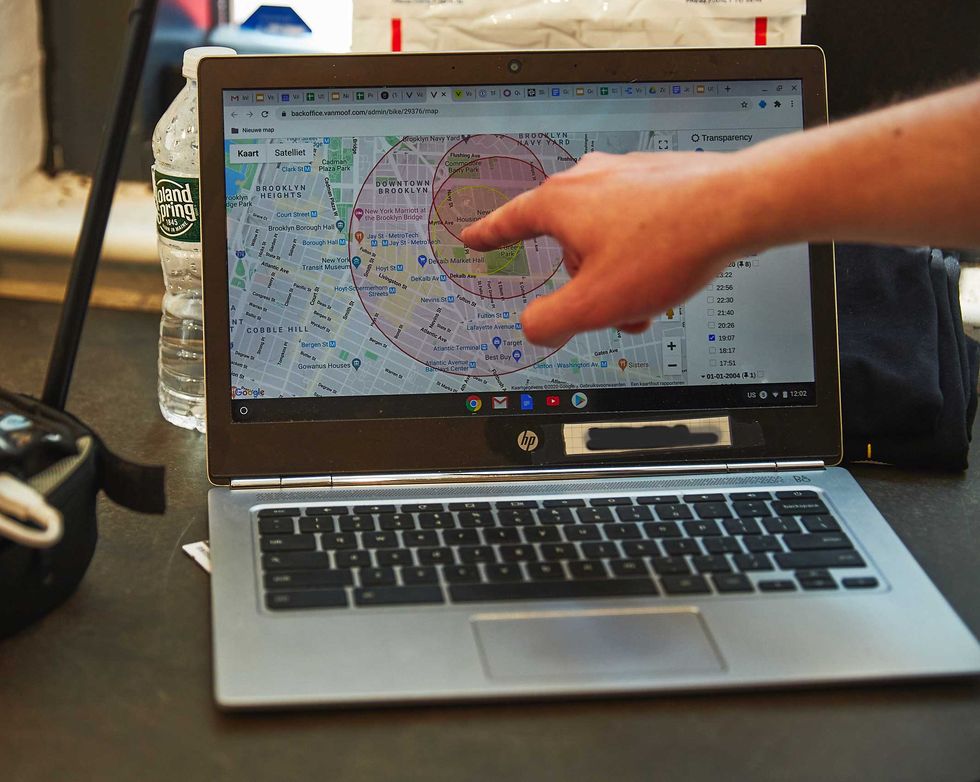
A laptop at the VanMoof Brooklyn store. The red circles are GSM-ping indicators, which show the general area a stolen bike might be found.
Rekkers, who’s from the Netherlands, has tracked VanMoofs stolen in New York City as far as Philadelphia and upstate—once to a town where, he says, he trudged through “completely desolate” streets covered in a foot of snow. (They never found the bike.)
Whereas San Francisco hunters retrieve about 70 percent of stolen bikes, Rekkers puts the New York rate a bit lower. (The company generally hunts bikes in or around big cities where it has a retail store—in the U.S., that’s Brooklyn, San Francisco, and Seattle.) He attributes this to “more professional” thieves, plus an abundance of basements and tall buildings. “It makes it a lot harder for us to track here,” he says. He himself has had two VanMoofs stolen (the pre-electric variety, before anti-theft technology was introduced). After the first one was taken, he employed a second lock, but the thieves simply used an angle grinder to cut away the cast-iron fence the bike was attached to.
Today Rekkers, along with me and part-time Bike Hunter Tim Speaks, who’s also a VanMoof sales rep, will travel—by VanMoof bike—to Fort Greene, where we will trace a route in and amongst the Venn diagram of circles charted by the signals that last bounced off the surrounding cellphone masts before the bike went dark.
There are several possible outcomes for the hunt, Rekkers tells me. We might locate the bike, chained somewhere outside as they’re typically found. If it seems safe, he says, the team will usually add their own lock to the bike, come back with their own tool to cut the other lock, and notify the police. The second possibility is that the bike will be inside someone’s house or apartment; absent a search warrant, there’s nothing further to do except wait for the bike to move again. The most problematic result is that we find the bike with a person attached to it.
“It could be quite dangerous,” Rekkers says. “You have to have enough courage to approach a group of people in the dark who have the bike.” Still, this is no vigilante squad. “At the end of the day it’s just a bike,” he says. “We are not there for some social justice reason, or to get someone thrown in prison. We are there for the bike.”
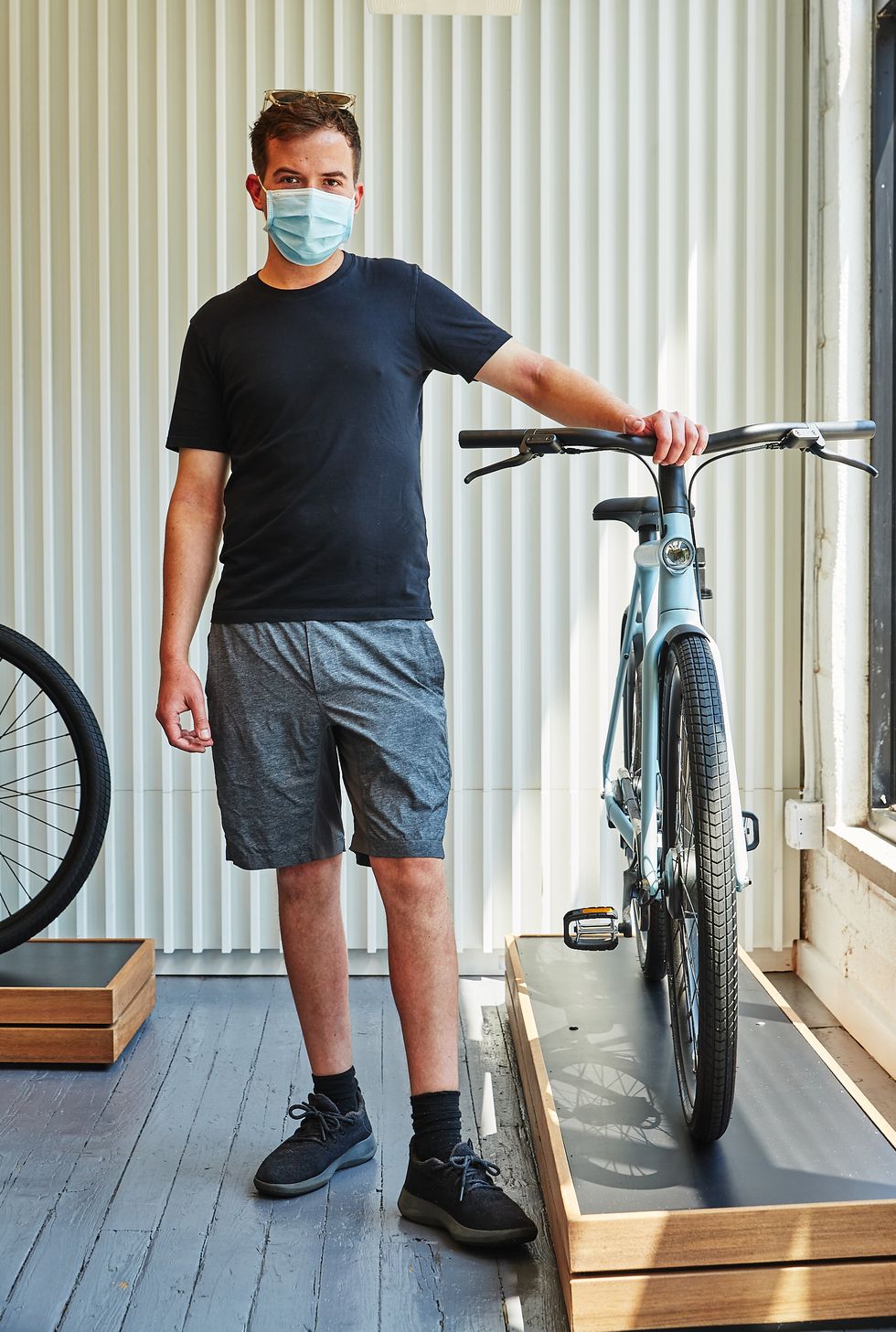
Once Rekkers has attached the tracking unit, a bespoke bit of hardware with an antenna and blinking lights, to his handlebar, we pedal off, like some nerdy modern-day version of the old and beloved PBS segment The Bloodhound Gang, in search of the missing VanMoof.

Taco Carlier, the Dutch cofounder of VanMoof, actually got the idea for the company while riding around New York City in 2006.
Visiting the city on business, he’d rented a bike. “Because that’s what the Dutch do,” he jokes over the phone from Amsterdam. As he explored the city by bike, he had a revelation. “New York is a beautiful city to ride a bike,” he says. He says he was “amazed by the possibilities for cycling.” But he was also struck by how few cyclists he saw.
An industrial designer who graduated from TEU Delft (“Holland’s MIT,” he says, “but not that cool”), Carlier had been designing products for outdoor festivals like Lollapalooza, along with his brother, Ties. After that eye-opening Gotham ride, they decided to start a bike company. They called it Moof, or “move” in Dutch. “We wanted to start a movement to promote the Dutch way of cycling—not using the bike on Sunday afternoon to ride around Central Park, but as a commuter tool.” They added the “Van” to make it sound more Dutch.
The first VanMoofs, produced in 2009, were single-speed, coaster-brake city bikes. They were angular and minimal—like the Bauhaus in a bike—marked by integrated engineering (e.g., the headlight was part of the top tube). They were intended, Carlier says, as contemporary updates on the traditional Dutch commuting bikes, lighter and more compact for cities like New York.
After a few years, however, he had another revelation. “I found that if you want to get the masses on bikes in cities like San Francisco or New York—and I’m not talking about 28-year-old kids who are really fit—you have to rely on electric bikes,” he says. “In New York in the summer, it’s just not possible to commute on a normal bike without sweating.”
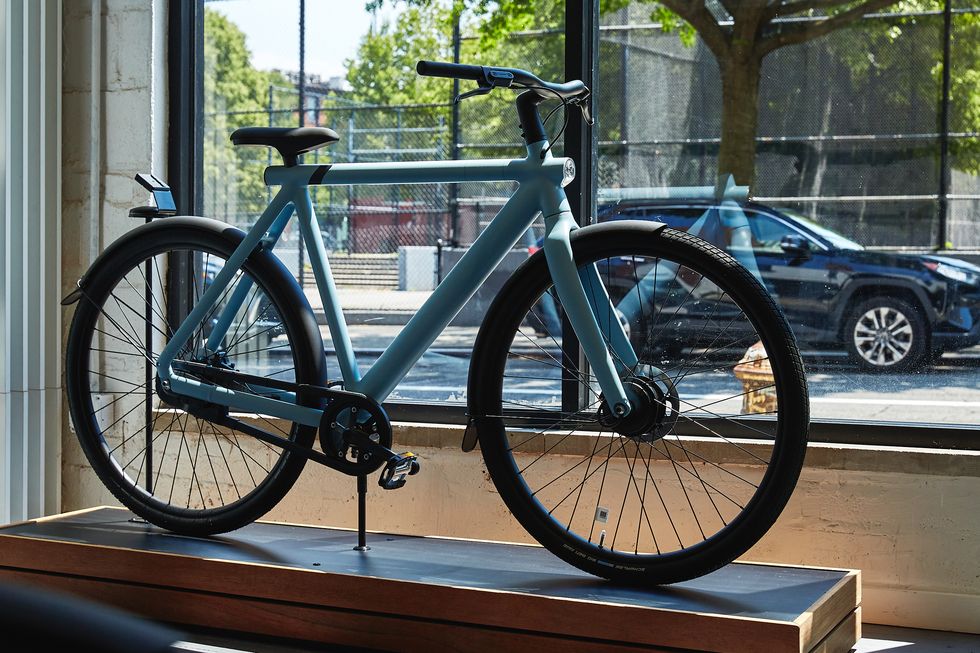
An electric VanMoof S3 on display in the Brooklyn store.
So five years ago, VanMoof introduced its first electric bike. Since then, Carlier says, revenue has doubled every year, and in 2020 the company’s sales increased by 200 percent over the previous year, attributable to a general rise in e-bike purchases during the pandemic.
But e-bikes presented a problem: Theft. “We thought, if we are going to build an electric bike for urban commuters, we have to solve the problem,” Carlier says, “because nobody’s going to park a $2,000 or $3,000 bike on the street.” So they applied their design background and penchant for integrating systems to finding a solution.
In the latest iteration of the approach, the rider, after parking the bike, immobilizes the rear wheel by tapping the kick lock, a small button the size of a thru-axle bolt located on the frame near the rear hub. If the bike is jostled, it flashes its lights and emits a brief warning sound, while an LED skull icon appears on the top tube. If you want, the bike will send your phone a push notification that this is happening. If the movement goes on for longer than a minute, it enters its second phase—a continuous flashing and alarm sound. If the system isn’t disarmed within two minutes, it enters phase three: The bike’s motor and smart systems shut down and it sends a notification to VanMoof. In cities like New York, bike parts are often stolen, so VanMoof created its own proprietary screws that can only be removed with special tools. (The tools are included with every bike sold.)
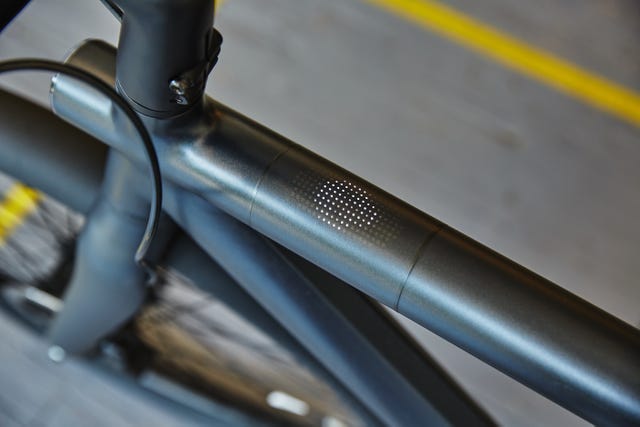
When a potential thief tampers with a VanMoof, a beeping noise will sound, lights will flash, and a skull symbol will light up on the top tube.
Carlier, who notes that the company has filmed would-be bike thieves on the streets of Amsterdam, says the first stage is usually sufficient. “Once they see it’s alarmed, it scares them off,” he says. “They’d rather pick another bike.” Nonetheless, bikes still get stolen. Sometimes an owner (like the one whose bike we’ll be hunting in Fort Greene) will forget to engage the kick lock, and a bike gets ridden away or tossed into a van. That’s why VanMoof installed the next layer of defense—integrated 3G and Bluetooth sensors. The sensors are on the same PCB (printed circuit board) as the battery, so even if the bike’s e-assist runs out of juice, the tracker can operate for another three months.
The company made a vow: If your bike is stolen, we’ll help you find it. Some customers, Carlier says, didn’t quite believe that. So they decided to guarantee it—and the Bike Hunters were born.
It’s a shrewd business move, and not the first time VanMoof has deployed clever marketing. The company made headlines in 2017 for shipping bikes in boxes labeled as if they contained large televisions instead of bikes. (“Damages in the U.S. went down from 20 percent to below 1 percent,” Carlier says.) More recently, an ad the company filmed depicting a rather dystopian view of car culture got banned from French television for creating “a climate of anxiety.” This, of course, yielded all kinds of further—and free—publicity.
With the Bike Hunters, VanMoof has also created, via a series of YouTube shorts, an instant genre of reality television: Two weeks to track down a stolen bike, The Greatest Race meets Locked Up Abroad. When a bike was pilfered in Berlin, its Hunters traveled to war-torn Ukraine, where the team tracked it as far as a sprawling secondhand goods marketplace. (They were then stopped by local police in a testy encounter.) Usually the team will find a bike within a few days, but when a bike went missing in Paris, Hunters finally retrieved it a year later in Casablanca, where a medical student had bought it, unaware that it had been stolen—or that it was being tracked. The Hunters enlisted him to find the person who’d sold it, giving him a new VanMoof for his efforts. In both cases, they’d encountered fairly well-trod networks for stolen bikes, run by organized crime outfits.
VanMoof obviously isn’t going to put a dent in the flourishing trade of stolen bikes. Carlier is more interested in reducing theft as an obstacle to the cycling movement he set out to create. “It’s the reason people are afraid to invest in a good bike, and therefore it’s holding back the growth of cycle commuting,” he says. “The current solution to the problem of bike theft,” he laments, “is just buying crappy bikes.”
WATCH: VANMOOF BIKE HUNTERS IN LONDON, PARIS, AND SAN FRANCISCO
This content is imported from youTube. You may be able to find the same content in another format, or you may be able to find more information, at their web site.
On an autumn day in New York City, Rose Hyatt parked her bike outside a drugstore on Ninth Avenue for a moment while she went inside. When she returned, her bike was gone. She contacted police, who eventually found parts of the missing bike at a bike shop whose owner, as the thieves would later recount, “asked no questions about them.”
The year was 1895. In New York, among other places, there have been bicycle thieves as long as there have been bicycles. Indeed, one of the few constants in the ever-changing evolution of bikes is their propensity to be stolen. In today’s New York City, restaurant delivery workers have been assaulted for their e-bikes, while Citi Bike riders have had their bikes taken from them mid-rental.
Linda Vojtová, a fashion model living in Manhattan and a regular VanMoof e-bike rider (she says doesn’t like to arrive to shoots sweating), had her bike stolen from outside her Tribeca apartment a few years ago. It was traced to a restaurant in Greenwich Village, where Bike Hunters found not only her bike but a second missing VanMoof. (Rekkers speculates that they may have been purchased for use as delivery bikes.) A few days later, testing the cosmos, she locked the bike outside again. “It’s a luxury apartment with a 24-7 doorman,” she says. “I thought it was fine.” The bike was promptly stolen—and this time never found. (VanMoof gave her a new one.)

Various VanMoof models tied to a pole right outside the company’s Brooklyn store. The bike in front is an electric VanMoof X2.
Every city has its own kind of bike theft. Where European cities often see organized rings, the effort in cities like San Francisco tends to be more ad hoc. Folkert Salomons, a veteran Bike Hunter who manages the San Francisco store, says bikes stolen there are typically found a day or two later.
To lend himself an air of professionalism and authority when he’s hunting a bike, Salomons typically carries business cards and wears VanMoof-branded clothing. But he’s become familiar in certain areas, so he’ll sometimes don a hoodie and sunglasses, or even rent another bike to use on a hunt.
Salomons has retrieved kick-locked bikes abandoned after a few blocks of presumably tiresome schlepping; he’s found bikes disguised with stickers or paint. When he finds the bike still with its thief, he’ll ask, with disarming Dutch directness: “Hey there, I’m a Bike Hunter and this is a stolen bike. Can I have it back?” When that doesn’t work, he reminds them that because the bike costs more than $1,000, the thief could be looking at a felony rap.
In Fort Greene, we arrive at the edge of the map quadrant that the tracking unit had zeroed in on. Based on the last signal sent, it could be here. Rekkers activates the tracker; its lights begin blinking. The more lights that glow blue, the stronger the Bluetooth signal and the closer we are to the bike. For now, just one is lit. We dismount and begin walking our bikes down the sidewalk to get a more robust Bluetooth signal. Bluetooth, Rekkers tells me, has changed the bike-hunting game. GPS, by contrast, is plagued by inaccuracy; to demonstrate, he opens Google Maps on his iPhone, which shows us to be some 60 to 100 feet east of where we actually are.
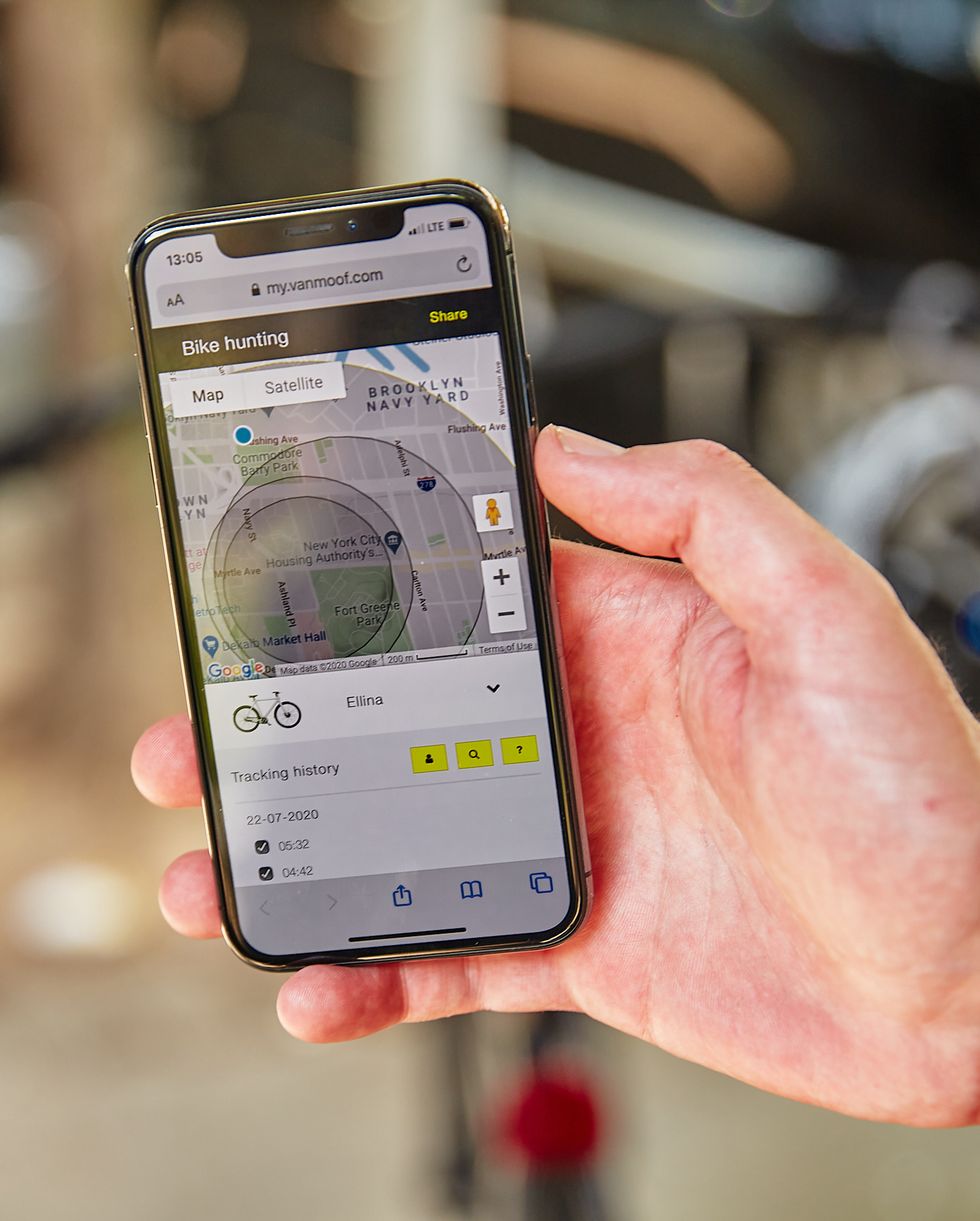
The mobile version of VanMoof’s tracking system.

Rekkers consults the GSM-ping indicators while searching for a stolen bike. His own bike is equipped with a tracking device that helps determine the final location of the missing bike.
Sometimes the tracker is scarcely needed. When a bike is moving a lot, the Hunters will simply get on their bikes and zigzag around the last reported location until they visibly acquire the target. And the methods are not always so high-tech. Speaks tells me he once spotted a stolen bike as he was walking to his apartment; he locked it up and notified the police. He also regularly trawls Craigslist, where bikes sometimes end up.
It’s an exceedingly balmy summer day in New York City. We pass a community garden enclosed in chicken wire, where large and luscious tomatoes shine in the sun. In warm weather, Rekkers says, people are generally using their bikes, so they’re stolen less. There’s a peak of thefts in the fall, he says, “when it starts getting rainy and thieves know people don’t use their bikes as much.”
I try to take on the eyes of a Bike Hunter, to see the landscape as a series of places where a bike could be stashed. I peer under scaffolding, behind dumpsters, down stairwells. At once, the three of us do a double-take at a sleek-looking black bike chained to a fence. Alas, it’s a Wing, a locally produced VanMoof knockoff. Hours pass and we see no VanMoofs; the Bluetooth tracker hasn’t budged.
Someone, somewhere, almost certainly has a VanMoof stashed away—perhaps, who knows, even wrapped in some Bluetooth-deflecting material. Rekkers will keep looking for the pings as long as the stolen bike’s battery has the strength to send them out. In the meantime, the thief has a bike with a use value of essentially zero. It’s not only a non-electric e-bike, but the moment the thief tries to use it or pass it on to someone else, the digital scent will be reactivated.
And even though their client didn’t kick-lock the bike, leaving VanMoof legally off the hook, Rekkers tells me they’ve offered a free used replacement, or a discount on a new ride. The bike may be lost, but they never want to lose a customer.
5 Bike Locks We Love




Tom Vanderbilt is the author of the best seller Traffic and his most recent book is Beginners: The Joy and Transformative Power of Lifelong Learning.
Read More
Stephania Geddes