

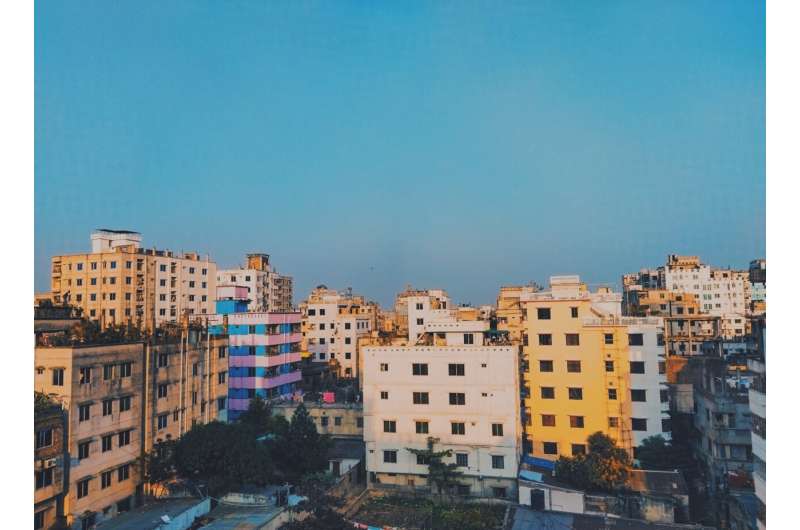
Extreme heat and humidity and other climate-related events have an alarming impact on mental health outcomes in terms of depression and anxiety in Bangladesh, the world’s seventh most vulnerable country to climate change. A study examining this relationship by scientists at Georgetown University and colleagues at George Washington University and the World Bank in Bangladesh, appeared February 5, 2023, in The Lancet Planetary Health.
“We have now established a high-water mark that alas could soon be eclipsed for how climate can impact mental health in a highly vulnerable country. This should serve as a warning for other nations,” says the study’s lead author Syed Shabab Wahid, DrPH, MPH, an assistant professor in the Department of Global Health at Georgetown University’s School of Health.
“Previous global research has found a link between these climate-related phenomena and adverse mental health outcomes in terms of depression and anxiety. As climate change worsens, temperatures and humidity will continue to increase, as will natural disasters, such as extreme flooding, which portends worsening impact on our collective mental health, globally.”
The researchers measured climate-related variables at 43 weather stations in Bangladesh for changes in seasonal temperatures and humidity over a two-month period and noted instances of exposure to flooding from study respondents. They say this was not long enough to see major climate change impacts, which could take many years to study, but gives an indication of how even small changes in weather events linked to climate change can impact mental health outcomes.
Additionally, the researchers conducted two sets of surveys, in both urban and rural areas, between August and September 2019 and January and February 2020 to assess depression and anxiety in adults in representative households. They received evaluable responses from over 7,000 people.
The researchers found that people experiencing one-degree Celsius higher temperatures during the two months preceding the study had a 21% higher probability of an anxiety disorder and a 24% higher likelihood of both depression and an anxiety disorder simultaneously. Similarly, a one gram of moisture per cubic meter of air increase in humidity was found to create a 6% higher probability of a co-occurrence of anxiety and depression. No links between heat or humidity were identified with depression alone.
Exposure to worsening flooding linked to climate change in the region was attributed to increased odds of all conditions: depression by 31%, anxiety by 69% and the presence of both conditions by 87%. The overall prevalence of depression in the Bangladeshi population was 16.3%, which is considerably higher than global estimates of depression of 4.4% found in other studies. In addition to the finding of the large disparity in depression levels in Bangladesh compared to global estimates, they found anxiety levels of 6.0% in Bangladesh compared to estimates of 3.6% globally.
“Our next steps are two-fold. We want to develop and evaluate community-based interventions that are culturally appropriate for Bangladesh, such as offering mental health services to climate-affected communities, of which there are many throughout the country. We also plan to conduct further research in Bangladesh and globally on the associations identified in this study using longer-term approaches to narrow down the causes and effects of climate changes on mental health,” concludes Wahid.
More information:
Syed Shabab Wahid et al, Climate-related shocks and other stressors associated with depression and anxiety in Bangladesh: a nationally representative panel study, The Lancet Planetary Health (2023).
Citation:
Study finds adverse impact of climate on mental health in Bangladesh (2023, February 6)
retrieved 7 February 2023
from https://medicalxpress.com/news/2023-02-adverse-impact-climate-mental-health.html
This document is subject to copyright. Apart from any fair dealing for the purpose of private study or research, no
part may be reproduced without the written permission. The content is provided for information purposes only.
Read More
Michele Serna