
When did Rome fall?

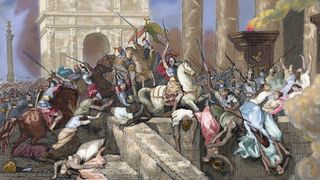
Colored engraving of the sack of Rome by the Visigoths led by Alaric I in 410. Soldiers are wielding swords and attacking the city on horseback.


Here we see a colored engraving showing the sack of Rome by the Visigoths led by Alaric I in 410, during the reign of Emperor Honorius.
(Image credit: PHAS / Contributor via Getty Images)

The “Fall of Rome” usually refers to the collapse of the Western Roman Empire in the fifth century A.D. But historians don’t agree about the exact date, nor about its causes. And some historians argue that the Roman Empire lasted until it fell in the East, centuries later. 

At its height around A.D. 100, the Roman Empire stretched from modern Britain, France and much of Germany in the northwest to Egypt, Israel and Jordan in the southeast, and from what are now Morocco and Spain to Romania, Armenia and Iraq. Later emperors divided it into more manageable pieces, resulting in the Western and Eastern Roman Empires. But by the end of the fifth century A.D., the Western Roman Empire, from Britain to Italy, had collapsed and been replaced by a patchwork of “barbarian” kingdoms. 

“Part fell to invaders, and part disintegrated,” Bryan Ward-Perkins (opens in new tab), a historian at the University of Oxford and author of “The Fall of Rome and the End of Civilization (opens in new tab)” (Oxford University Press, 2006), told Live Science in an email. “What difference this made to people on the ground is disputed.”

Related: Did Nero really fiddle while Rome burned?

Sack of Rome, A.D. 410
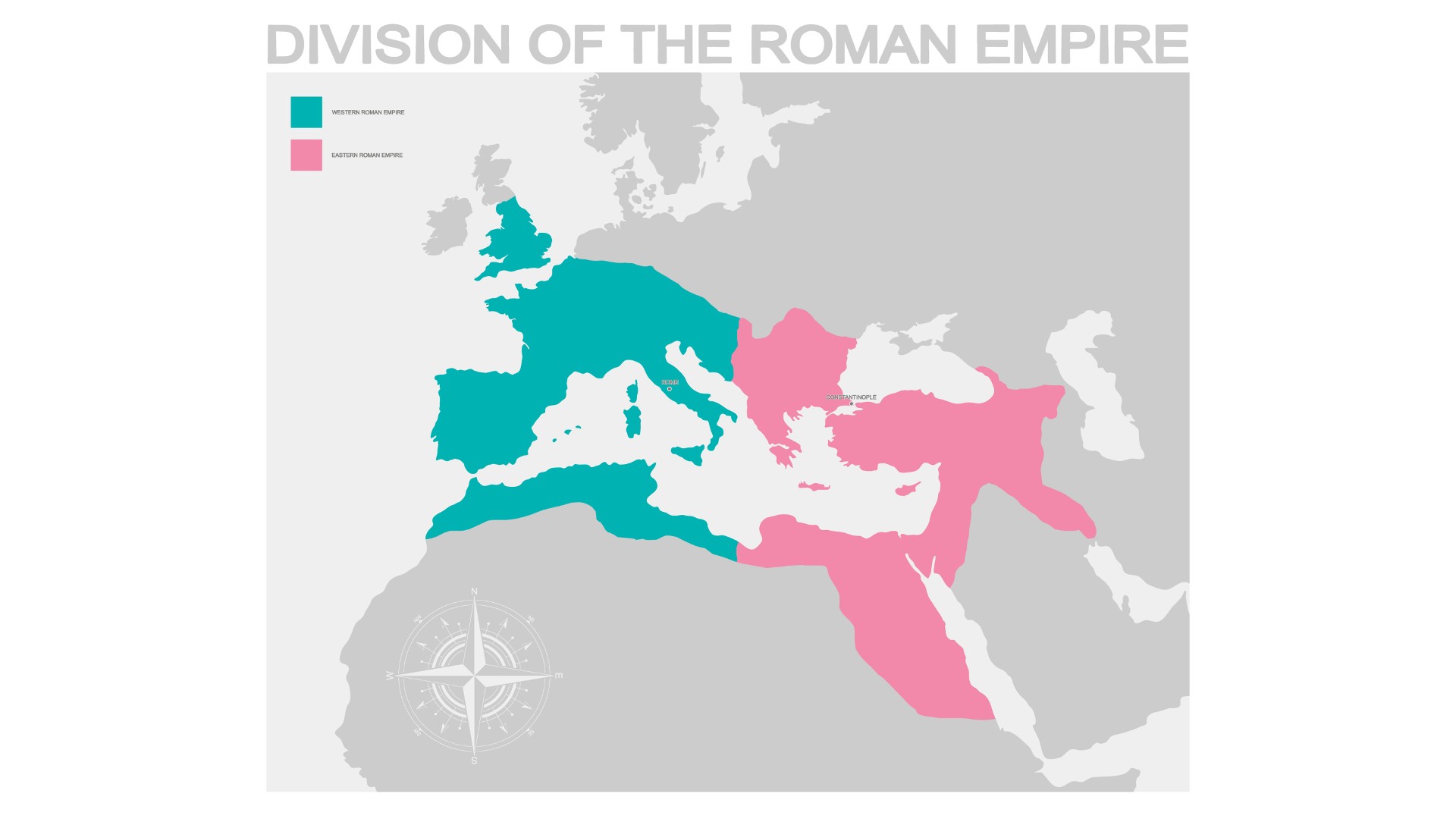
A map showing the division of the Roman Empire, with the Western in aqua and the Eastern in pink.

A map showing the division of the Roman Empire, with the Western in aqua and the Eastern in pink. (Image credit: Sidhe via Shutterstock)

Some historians regard Aug. 24, 410, as the decisive date of the fall of Rome. On this date, an army of Visigoths sacked the city of Rome — the first time since it had been overrun by Gauls during the early Roman Republic, almost 800 years earlier. The Visigoths (Western Goths) had fled the Huns’ invasions of Eastern Europe in the fourth century. But in 378, after defeating a Roman army at the Battle of Adrianople (now Edirne, Turkey), the Visigoths were given lands on the empire’s northern border to control and guard themselves from invaders. However, a few decades later, they again began marauding the empire; in 408, they invaded Italy, and in 410, they besieged and sacked Rome.

By this time, the Roman Empire was centered in Constantinople in the east, and even Western Roman emperors lived in Milan (then called Mediolanum) or Ravenna in northern Italy. But Rome was the “eternal city” and the sacred heart of the empire, and many of the empire’s inhabitants saw this as the end. “The cultural shock was resounding … but the practical impact seems limited,” William Bowden (opens in new tab), an professor of Roman archaeology at the University of Nottingham in the United Kingdom, told Live Science. 

As city sackings go, it doesn’t sound too bad: Many famous monuments and buildings were untouched, and because the Visigoths were Christians, they allowed people to take refuge in churches. The Visigoths withdrew from Italy a few years later.

Abdication of Romulus Augustulus, A.D. 476
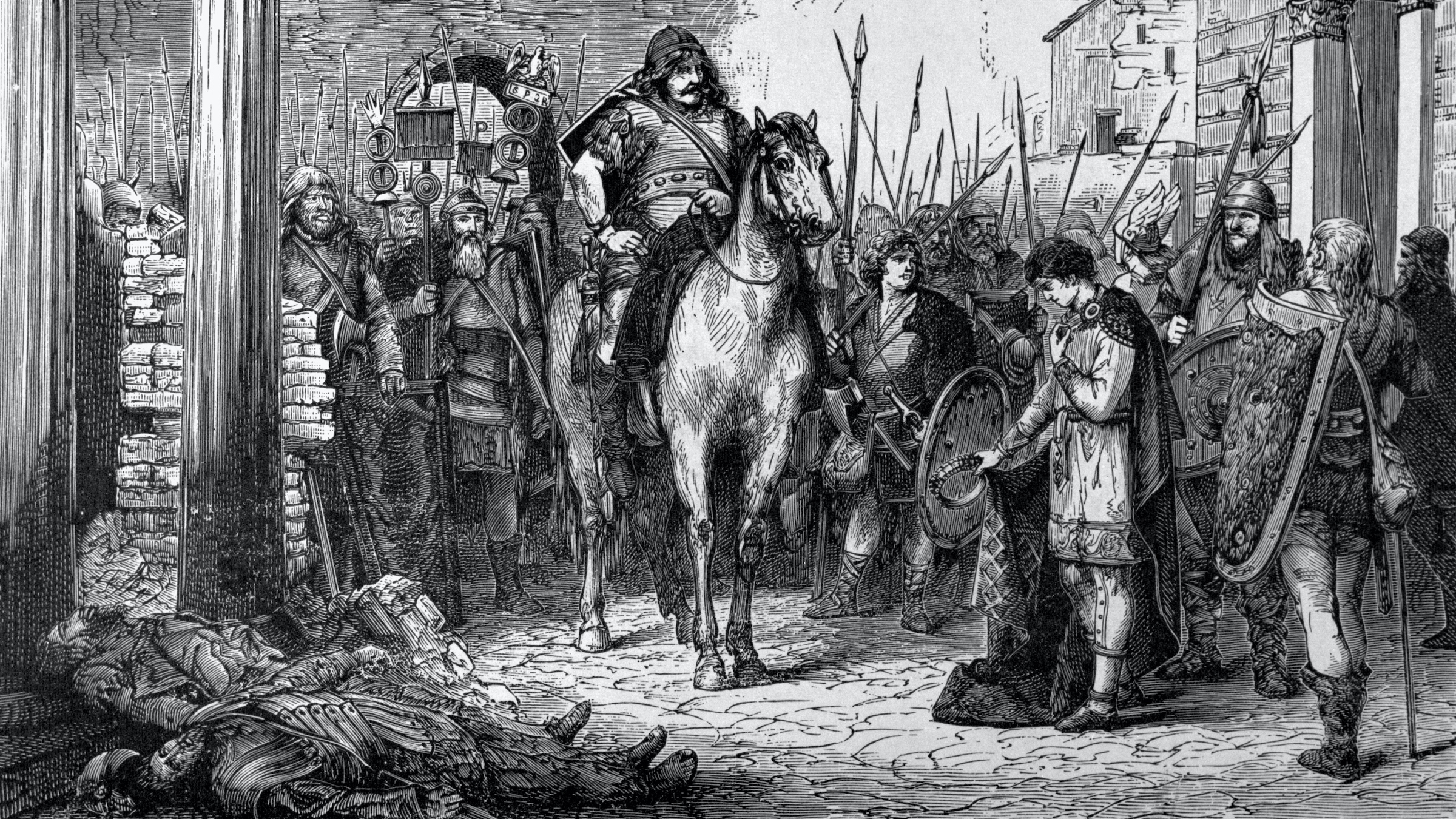
An illustration of Romulus Augustulus (standing on the ground surrounded by people) surrendering to Odoacer, who is riding a horse.

An illustration showing Romulus Augustulus surrendering to Odoacer, the barbarian king of Italy, in A.D. 476. (Image credit: Bettmann/Contributor via Getty Images)

Some historians regard the formal end of the Western Roman Empire as taking place decades later, on Sept. 4, 476, when Odoacer, the first barbarian king of Italy, forced the young emperor Romulus Augustulus to abdicate. Odoacer had been a Roman general of Germanic descent who professed loyalty to the Eastern Roman emperor, and he took Romulus captive at Ravenna after defeating the 16-year-old’s father in battle. Odoacer didn’t kill Romulus, however; because of his youth, he was instead given a pension and sent to live with relatives. (Odoacer ruled from Ravenna until 493, when he was killed by an invading Ostrogoth — Eastern Goth — army under their leader, Theodoric the Great, who established a powerful new kingdom in Italy.)

“It’s kind of an important moment,” Peter Heather (opens in new tab), a historian at King’s College London and author of “The Fall of the Roman Empire: A New History of Rome and the Barbarians (opens in new tab)” (Oxford University Press, 2007), told Live Science. “Odoacer sent the imperial vestments of the West back to Constantinople, along with delegation from the Senate of Rome, and the delegation says, ‘There’s no longer any need for an emperor in the West.'”

By this time, many regions of the Western empire were already effectively independent kingdoms, but “if you’re looking for a symbolic moment, it’s a pretty good one,” Heather said.

Empire in the East

By the fifth century A.D., however, the focus of the empire had shifted east to Constantinople, now Istanbul. Once the Greek city of Byzantium, the city was rebuilt in A.D. 330 by the emperor Constantine the Great, who transferred the imperial capital to his “New Rome.”

“My own view is that the eastern half of the Roman Empire is still the Roman Empire,” Heather said. “It’s not unchanging, but there is a sort of continuity of change, not any great rupture.”

Although Constantinople fell to the Turks in 1453, Heather sees its decline in the Arab invasions from 632 until 661, when they captured Egypt, the Levant, and parts of Anatolia from the Eastern Roman Empire. “The Arabs take about three-quarters of the empire’s revenue and about three-quarters of its territory,” he said. “It’s a totally different kind of entity after the Arab conquest. … it reduces the empire from a global power to a regional power.”

Tom Metcalfe is a freelance journalist and regular Live Science contributor who is based in London in the United Kingdom. Tom writes mainly about science, space, archaeology, the Earth and the oceans. He has also written for the BBC, NBC News, National Geographic, Scientific American, Air & Space, and many others.

Read More
Erasmo Redner

Latest

Zhibao Technology’s Plans to Acquire 3,500 Bitcoin in Nasdaq PIPE Financing Deal

© 2026 China Money Network. All Rights Reserved. Disclaimer: The views, opinions, forecasts, and statements made by our hosts and guests are the personal views of those respective individuals and may or may not be either endorsed or accepted by China Money Network Limited or the companies with which these individuals are employed.

Alphabet beats expectations in second quarter, cloud revenue nearly doubles

Google’s cloud business grew by more than 80 percent, the company said Wednesday, exceeding investor expectations as markets look for signs that the company’s AI investments are paying off. CEO Sundar Pichai said in a statement that the strong quarter was driven in part by growth in its Gemini AI models and AI-powered search queries

In Case You Haven’t Noticed, the Music Industry Is Exploding Everywhere All at Once. But Who Will Power the New ‘Chaos Economy’ Infrastructure?

Photo Credit: Pexels It’s a dizzying time to be in the music industry, with catalog investments, creative outputs, and AI-generated mayhem part of a pedal-to-the-metal explosion. On the ground, that means more companies are battling an avalanche of data overload and disconnected processes, with hair-pulling and stiff drinks part of the daily routine. But we’re

Nasdaq-listed Zhibao Technology to Take 3,500 Bitcoin in Proposed PIPE Financing

Zhibao Technology, a Shanghai-based insurance-technology firm listed on the Nasdaq, said Wednesday it has signed a non-binding term sheet for a stock sale that would be paid for in bitcoin — some 3,500 coins, worth near $220 million at current prices. The deal, a private investment in public equity known as a PIPE, would have

Newsletter

Don't miss

Zhibao Technology’s Plans to Acquire 3,500 Bitcoin in Nasdaq PIPE Financing Deal

© 2026 China Money Network. All Rights Reserved. Disclaimer: The views, opinions, forecasts, and statements made by our hosts and guests are the personal views of those respective individuals and may or may not be either endorsed or accepted by China Money Network Limited or the companies with which these individuals are employed.

Alphabet beats expectations in second quarter, cloud revenue nearly doubles

Google’s cloud business grew by more than 80 percent, the company said Wednesday, exceeding investor expectations as markets look for signs that the company’s AI investments are paying off. CEO Sundar Pichai said in a statement that the strong quarter was driven in part by growth in its Gemini AI models and AI-powered search queries

In Case You Haven’t Noticed, the Music Industry Is Exploding Everywhere All at Once. But Who Will Power the New ‘Chaos Economy’ Infrastructure?

Photo Credit: Pexels It’s a dizzying time to be in the music industry, with catalog investments, creative outputs, and AI-generated mayhem part of a pedal-to-the-metal explosion. On the ground, that means more companies are battling an avalanche of data overload and disconnected processes, with hair-pulling and stiff drinks part of the daily routine. But we’re

Nasdaq-listed Zhibao Technology to Take 3,500 Bitcoin in Proposed PIPE Financing

Zhibao Technology, a Shanghai-based insurance-technology firm listed on the Nasdaq, said Wednesday it has signed a non-binding term sheet for a stock sale that would be paid for in bitcoin — some 3,500 coins, worth near $220 million at current prices. The deal, a private investment in public equity known as a PIPE, would have

Crypto’s US Workforce Is Tiny, But Industry Punches Above Its Weight: Report

The crypto industry may be relatively small in terms of employers — but the economic contribution is big.  That’s according to a new report published by the National Cryptocurrency Association and the Pragmatic Policy Group, which reveals that while only 34,000 people are employed by crypto companies, the industry will contribute $55 billion in 2026

Want Your Business to Be Seen Everywhere? Meet Tonia Ryan, Creator of Fix Your Search

Some people are good at their jobs. Then there is Tonia Ryan, who has turned “getting found online” into something close to magic. She is the creator of Fix Your Search, and if you have ever wondered why some businesses pop up everywhere while others seem invisible...

Grey Business processes $61 million as stablecoins dominate payments

Grey Business enables startups and SMEs to open US Dollar (USD) corporate accounts, send and receive international payments, convert currencies, and transact using stablecoins such as USDC and USDT...

Utah Marketers to Host Free Business Networking Event in Layton on June 24

The custom web design company is hosting free monthly networking events for Northern Utah business leaders, with the next event scheduled for June 24 from 4 to 6 p.m. Utah Marketers is hosting a free local business networking event on June 24 from 4 to 6 p.m. at the company’s Layton office. The event is