

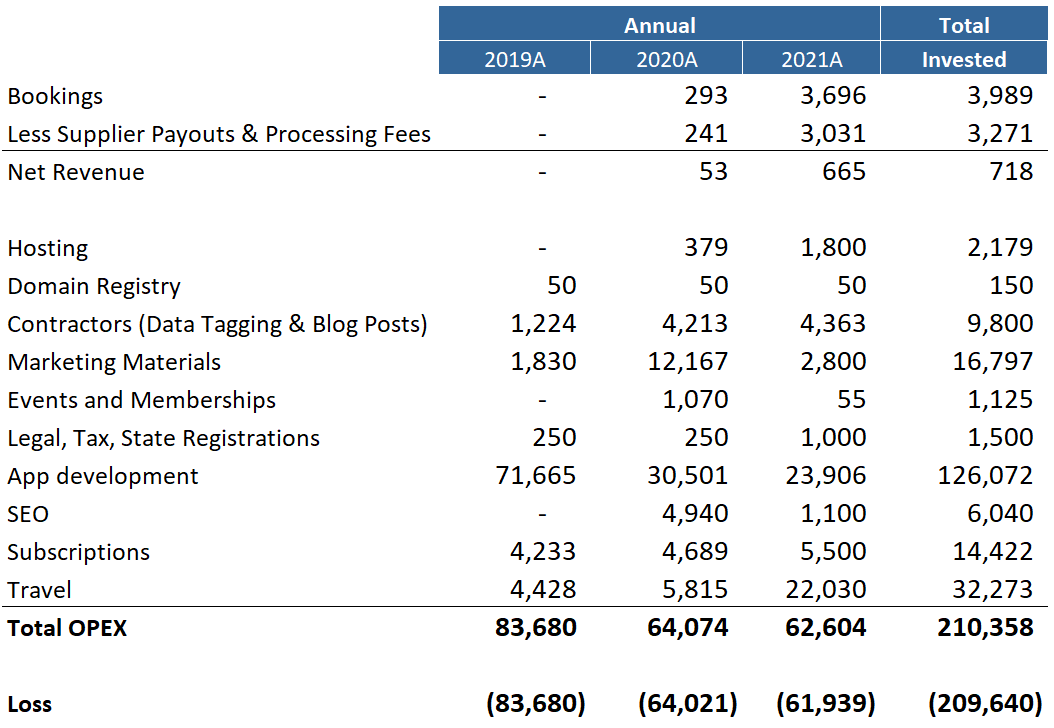
I lost $209,640 of my own money trying to start a business.
Writing about failure sucks.
But here’s the real story:
Context: Me and my wife started a marketplace for last-minute tours and activities.
Think of it as Hotel Tonight x OpenTable x ClassPass. The idea was to bring live connectivity to an industry where 80% of bookings were still done using pen and paper, months ahead of time.
We worked on it for 3 years while holding down full-time jobs, burning the midnight oil on nights and weekends. The initial money came from wedding gifts, the rest from our house fund and paychecks. We moved out of a fancy high-rise and into my parents basement to plow our “rent” money into the third-party development.
During the tail end of COVID, we packed up the truck and moved our lives from the East Coast to Florida, where we could market to year round tourism. We decided to “go West, young man” (well, South) and chase our dreams.
Lesson #1: Differentiate technical risk from execution risk.
There’s a reason everyone has a clever idea for a marketplace – they don’t require you to actually build a standalone, unique product. And the technical barriers to entry are lower than high tech (like cybersecurity).
It appears simple to play middle man, connecting supply / demand in a novel way. However, it’s a long road to aggregate both sides and drive network effects. There are massive execution risks. You have to solve for two sides, not just one.
Lesson #2: Don’t be 100% dependent on someone else’s data.
Partnering with store management systems made it easier to hack the supply side, but dictated our development efforts and unit economics. We had massive platform risk. If any of our partners cut us off, we were screwed. Data couldn’t be our competitive moat, because we didn’t own it.
Lesson #3: You don’t need to build everything at once.
Building a website, Android app, and iOS app before proving product market fit was like burning money. It took us over a year to get to market, sell something, and get real feedback.
You should start small and get one platform right. Especially if you are paying someone else to do the coding. Some international developers are great value and true biz partners, while others are chop shops who will pump and dump. Speaking of that…
Lesson #4: Don’t make everything reliant on code if you can’t code.
There were 1,000 times I felt absolutely helpless, knowing what needed to be done, but not being able to jump in and fix it myself.
I’ll never depend on a 3rd party dev as the main means of production again. We would have been better off finding a technical co-founder rather than outsourcing flexibility and control.
Lesson #5: No one is going to invest in your business if you aren’t willing to quit your day job.
If you aren’t crazy enough to take the plunge, why should they be? Full stop.
Lesson #6: Adding more features is an expensive distraction.
If it isn’t improving your “core job to be done” then don’t spend time on it. Especially if you’ve yet to prove product market fit. Features are shiny objects that give you a false sense of accomplishment, and really pull you off track. Stay the course!
Lesson #7: As a marketplace, you can be either low frequency or low price, but you can’t be both.
Our average purchase was $60 per ticket x 3 tickets, or $180. However, people go on vacation infrequently. And they’d have to remember us again each time. We were in the proverbial dead zone. We had what they call low Lifetime Value to Customer Acquisition Cost.
Lesson #8: Constraints drive focus.
We tried to launch tours in +20 states at once, but quickly found we didn’t have the time or budget to market everywhere. In addition, each market was different on the ground.
We honed in multiple times.
USA --> Southern USA --> Florida --> South West Florida --> Tampa, Florida
Nail it at the (hyper) local level and build a playbook. If you are everywhere at once, you are really nowhere.
Lesson #9: A founder’s #1 job is sales.
I hated cold calling. I hated walking into a scuba shop and nervously asking for the owner. I hated getting rejected. But I couldn’t hide behind a screen and work on strategy. I had to sell.
A product without distribution is nothing.
Lesson #10: Killing your baby is really hard.
It took us longer than it should have to call it quits. We put off the decision for months. Even now, it physically pains me to use the word “quit“. I haven’t written or said it until this point.
Conclusion:
Does losing $200K hurt?
Yes. Absolutely.
But I also look at it as my “real world MBA”.
So what did I get out of it?
It led me to start this newsletter, since I was learning so many business concepts and didn’t want to forget them. And I never would have developed the guts to put myself out there if I hadn’t been shot down by hundreds of tour operators, tourists, hotels (and even family members).
I also learned the level of commitment it takes to bring something from 0 to 1. It’s really, really hard to build something from scratch. And it takes an insane amount of irrational confidence.
And finally, I ended up landing my first CFO role at a venture-backed tech marketplace. Talk about unexpected outcomes… I finally found somewhere to apply my marketplace knowledge. And if I didn’t have this previous entrepreneurial experience, or this newsletter, it wouldn’t have been possible.
There are seasons to life, and if you don’t close one door, you can’t open another.
So that’s the story of how I lost $200K, but came out on the other side smarter and happier. And if something doesn’t scare you, it’s probably not worth doing at all.
Wonder Tools is a free weekly email that helps you discover the most useful sites and apps and see out how to make the most of them. Written by Jeremy Caplan, formerly of Time Magazine, the newsletter has grown quickly and is now syndicated to Fast Company. A well-known reader recently Tweeted “One of the most useful weekly newsletters I get.” Join 18k readers. Get it for free.
“Startups don’t starve, they drown”
-The Mom Test, by Rob Fitzpatrick
Read More
Christeen Block