

This January, Germany’s largest vaccine maker BioNTech announced that it had agreed to acquire Tunisian-born and London-headquartered AI startup InstaDeep for up to £562 million, including a performance-tied £200 million tranche investment.
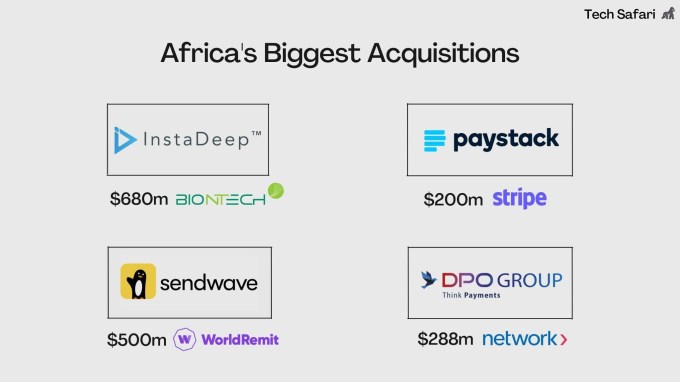
InstaDeep’s deal — subject to regulatory approval and expected to close in the first half of this year — is quite intriguing, for a few reasons. First, when completed (at $682 million, adjusted in U.S. dollar terms), it’ll become the largest acquisition deal involving an African or Africa-focused startup, besting prices bargained for Sendwave, DPO Group and Paystack. Second, unlike the other high-profile acquisitions, InstaDeep isn’t a fintech. And third, although early believers who witnessed InstaDeep’s growth from a local firm to a global startup knew it had enough exit options, they didn’t think the acquisition would happen this fast, said Khaled Ben Jilani, senior partner at AfricInvest, one of InstaDeep’s earlier investors, on a call with TechCrunch.
In 2019, InstaDeep raised an $8.5 million Series A at a $30 million valuation, according to sources familiar with the round, which AfricInvest led with participation from New York–based Endeavor Catalyst and a broad range of business angels in the global AI industry. The investment was AfricInvest’s first involvement in an AI startup, a decision based on InstaDeep’s founders selling a global vision to the Pan-African private equity firm.
“InstaDeep happened to be quite different from other companies in our pipeline as they were actually into deep tech versus applying technology to a certain sector, where basically, you become an operator in that sector. They were developing specific technology that could impact many sectors,” noted Jilani on InstaDeep’s pioneering tech. “And it was also interesting, especially in Africa, where such companies are quite rare. And so when we had discussions with Karim over his vision and strategy, we quickly realized that InstaDeep could transform from an African leader in AI to a global player.”
InstaDeep utilizes advanced machine learning techniques, including deep reinforcement learning in applications within an enterprise environment that cuts across various industries such as biotech, transportation, electronics manufacturing and logistics. Ultimately, this helps companies optimize the decision-making process and improve efficiency.
Karim Beguir and Zohra Slim founded the startup in Tunis in 2014 with “two laptops, $2,000, and a lot of enthusiasm,” CEO Beguir told TechCrunch last year. The bootstrapped company — which didn’t receive outside capital until 2018 — depended on original AI research that Beguir published, which led to the startup being discovered by specialized clients who later became partners and investors, such as DeepMind, Google and its future acquirer BioNTech.
Can InstaDeep’s global success be replicated in Africa?
As InstaDeep’s clientele grew globally, so did its team. The company has 240 staff across Tunis, London, Lagos, Dubai, Berlin, Cape Town, Paris, Boston and San Francisco. Also, InstaDeep’s ambition to become a global company made it move its headquarters from Tunis to London, which some publications have referenced as its home, thus neglecting its African roots.
“InstaDeep is a global company, but in terms of origins and like the company’s early days, there’s no doubt that we’re African,” Beguir told me on the call. “One of the reasons we founded InstaDeep was to show that there was real potential and opportunity for AI in Africa. So we want people to see us as a deep tech African startup gone global, which sends a powerful message of hope for the space.” If anything, InstaDeep has proven that an African company with African talent can successfully serve clients globally while building a talent bridge corresponding to that growth.
On the other side of the table are somewhat naive views that argue InstaDeep’s “Africanity.” Tunisia, due to its inhibiting government policies, is an unfriendly place to operate any startup or access venture capital — excluding InstaDeep, Tunisian startups raised $17 million last year, according to a report by VC firm Partech. As such, most startups have had to domicile abroad to access funding. Also, InstaDeep’s influence in building AI talent on the continent isn’t discussed enough. Last year, the upstart played a notable role in helping to organize and nurture Africa’s AI ecosystem via Deep Learning Indaba and AI Hack, hackathons and events with thousands of AI talents and 400 researchers in attendance. Most importantly, an African startup serving clients outside the continent doesn’t make it less African; in fact, founders should be encouraged to build software and AI businesses that present better exit opportunities than e-commerce, logistics and payments, sectors that international companies only consider when expanding into a new region.
The ripple effect of InstaDeep building global-first is that it has put the Tunisian tech ecosystem and, more broadly, the AI industry in Africa under the radar with the news of its acquisition. Yet, it’s too early to assume that because of that, it’ll suddenly open the sluice of venture capital in Tunisian tech or Africa’s AI market, which currently lags several industries as hotbeds of investments on the continent. There is potential, though, particularly with the applications of the technology in various sectors such as agriculture and manufacturing; startups like South Africa’s Aerobotics and DataProphet have raised significant funding for this — however, patience will be required before any breathtaking activity occurs.
To my question on whether InstaDeep is an outlier, Begiur expressed optimism that more success stories from Africa’s deep tech and AI community would be told sooner rather than later, especially as the venture capital market has turned red-hot for AI-based innovation. When this happens, the CEO says he hopes that founders and investors reinvest back into the space, something InstaDeep and AfricInvest intend to act on moving forward.
“I believe that AI is a huge opportunity for Africa and I’ve been vocal about it. We often see AI as a technology and a competition between developed countries. In reality, AI is essential for Africa’s success in the 21st century, and the reason is that it is the transformational technology of our time; I think you’ll see so many examples these days from GPT and beyond of its disruptive potential,” Beguir, who is half-Tunisian and half-French continued. “But importantly, the barrier to entry to AI is much lower than, let’s say, technologies of the past that were classically associated with legacy companies and strong superpowers. As such, it is a great opportunity for the continent.”
Last January, InstaDeep raised $100 million in Series B, over 12x what it raised in its previous priced round. Such was the proactive interest of new investors, including Alpha Intelligence Capital, CDIB, Google and BioNTech, its new owner with whom it started working with in 2019 and launched a joint AI innovation lab the following year to deploy the latest advances in AI and ML to develop novel medicines for a range of cancers and infectious diseases. Following the investment, InstaDeep was looking to make some acquisitions to ramp up its data collection capabilities to complement its AI systems before BioNTech swooped in with the acquisition offer, virtually leaving most of the growth financing untouched.
“That was crazy. Frankly, we [InstaDeep and early investors like AfricInvest] did not expect that to happen,” expressed Ben Jilani, whose firm may be sitting on a conservative 10x+ exit multiple based on independent calculations. InstaDeep exited at a higher valuation than what it commanded for its Series B, according to Beguir.
According to a statement on the acquisition, BioNTech and InstaDeep have already developed multiple end-to-end AI-based applications trained on public and proprietary datasets across various scientific domains. These include projects to enhance neoantigen selection, ribological sequence optimization for BioNTech’s platforms, and the development of an Early Warning System to detect and monitor high-risk SARS-CoV-2 variants based on their ability to escape immune defenses announced last January.
“With BioNTech, we have developed a partnership over the years and completed many successful projects together. We see great opportunities to build the next generation of immunotherapies and become the leader in biopharma and AI. I believe this is an exciting time, and we will have more to share in coming months,” Beguir said about the acquisition without divulging new information while adding that InstaDeep will use its Series B funding and exit money to scale its teams and capabilities across Africa and globally. “It’s a continuation of what we’ve done in many ways,” he added.
Read More
Tage Kene-Okafor