

The waitress takes away the final plates of our meal as my friends and I continue conversing over our drinks. We’re at a small, but popular, New Mexican restaurant down the street from my house. It’s a hip spot, with exposed incandescent lighting illuminating the eclectic Southwestern décor in sharp contrast to the cold, snowy weather outside.
As the conversation winds down, the waitress returns with the check and a small placard. “If you haven’t been here recently, I wanted to let you know that we attach a 20% Fair Wage and Wellness Fee to all orders. This sheet of paper explains it. It’s… not a tip.” She slides the paper across the table and, somewhat embarrassedly, adds, “If you have any questions, please let me know.”
As the waitress slips away, we all raise our eyebrows. We read the note, which explains that the fee is explicitly not a tip and that it goes to paying the full kitchen staff benefits. It suggests that we still tip our server.
Someone asks, “So… does this mean we should tip 20% on top of the fee?” At the same time, I wonder if we tip based on the amount of the bill or on the post-Wellness Fee amount. Pre-tax or post-tax basis? We all review the prices on the menu suspiciously in light of this mandatory service charge, conveniently revealed after we had already ordered and eaten our meal. Those tacos did seem surprisingly cheap when I ordered them…
It felt like buying a concert ticket on Ticketmaster. You see a show listed at $50, but by the time you’re begrudgingly pulling out your credit card there has been a 10% service fee, a $15 convenience charge, and an electronic ticket fee tacked onto the purchase. Despite being pissed, you buy the ticket anyway because you’ve already made it this far and you want to go to the show, but the ticket is nearly 50% more expensive than the headline price suggested it would be.
This tactic is called drip pricing. Common in the airline, telecom, hotel, and car rental industries, the practice is spreading like a contagion into new verticals. Although drip pricing strategies upset consumers and reduce satisfaction, they represent an effective way for companies to extract more money from a purchaser because people’s purchasing intentions tend to remain constant even as the hidden fees stack onto their bill.
Consumers tend to anchor on the lower sticker price and fail to update their assessment of the value of what they’re buying as the drip pricing fees are incrementally revealed. Drip pricing also makes comparison shopping difficult, if not impossible, since the fees are often only revealed as you near the end of the purchasing process. There is also an ‘endowment effect’, where consumers feel that they’ve already committed to the decision to purchase and so are less likely to change their purchasing decision even as the cost increases.
In the real world: you’re at checkout on Airbnb and suddenly your $119 a night rental turns into almost $200 a night with cleaning fees, taxes, and service fees. You don’t feel like restarting your search, navigating through the menus again, finding a comparable offering, and re-typing your payment information, so even though you feel confident you could find a better deal you stick with your initial option. A mixture of anchoring, consumer lock-in, loss aversion, and increased search costs leads to higher profits for companies at the expense of consumer preference and well-being.

I’m getting a bit carried away here: what spawned this investigation was the proliferation of these charges at restaurants. Why are restaurants pursuing drip pricing, and why now?
The stated reasoning for these charges, as well as their magnitude, differs across restaurants. At my neighborhood New Mexican restaurant, they framed the relatively large 20% charge as a way to provide full health insurance benefits and living wages to all of their employees. At the San Diego airport, I recently saw a nebulous 2% surcharge for “staff recruitment and retention.” Other businesses attach more inspired names to their additional charges: inflation surcharges, supply chain charges, even ‘kitchen appreciation’ charges.
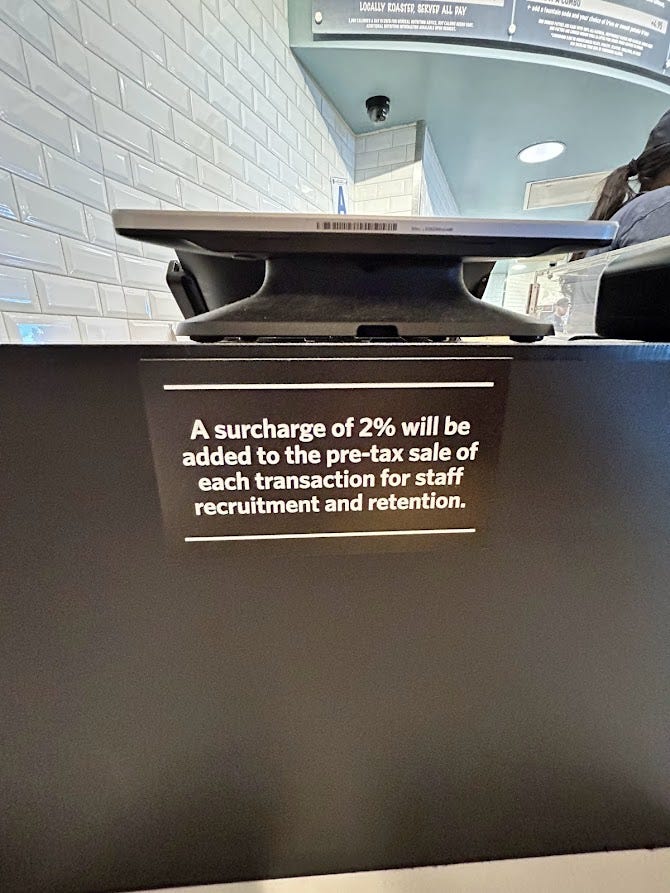
The obvious macroeconomic backdrop to these fees is post-pandemic inflation. As costs have increased for restaurants, drip pricing has provided a mechanism to hide the effects of inflation behind the opacity of fees located in the fine print of the menu or on a sign attached to their register. This way, the restaurants can reduce menu costs (which have never been lower thanks to the invention of digital menus!) and, more importantly, advertise lower prices to would-be customers.
In America, we’ve already internalized the additional costs of eating out due to the ubiquity of tipping culture and taxes, but as more restaurants add service charges that are explicitly not tips, the difference between the sticker price and the amount charged to your credit card is going to grow closer to 1.5x the prices listed on the menu. Frankly, I see that as insane.
A pernicious aspect of drip pricing is that, as it becomes more common, businesses that do not do it will feel pressure to follow suit; competitors engaged in drip pricing will have apparently lower prices when would-be customers are shopping around. If I see an entrée for $25 at one restaurant and $30 at another, but the $25 restaurant has a hidden 20% service charge, the dinner is going to cost the same, but I won’t necessarily know that until I’ve already eaten the meal and see the line item added to my bill. The honest restaurant is at a distinct competitive disadvantage despite providing a superior customer experience.
This situation is a classic collective action problem: restaurants feel the pressure to engage in this practice to stay competitive and avoid sticker price shock, but it leads to customers feeling confused, swindled, and annoyed by the lack of transparency. It turns pricing into a race to the bottom for the customer experience.
A clear way to break out of this trap is to legislate it away: force businesses to be transparent about their pricing by law. Disallow hidden fees and mandatory surcharges by mandating transparency in sticker prices. We should remove the incentive firm have to obfuscate their prices through financial structuring.
After our confused discussion over the bill, my friends and I decided to tip 20%, but we based the tip off of the pre-Fair Wage and Wellness Fee amount. All in, the total cost was nearly 50% higher than the prices listed on the menu. Talk about sticker shock!
As my girlfriend and I walked home that night, I couldn’t help but think: how is this any better than the insanity that is tipping culture? Oh well. One problem at a time.
Read More
Johnathon Redner