

[UPDATED at 11 a.m. ET]
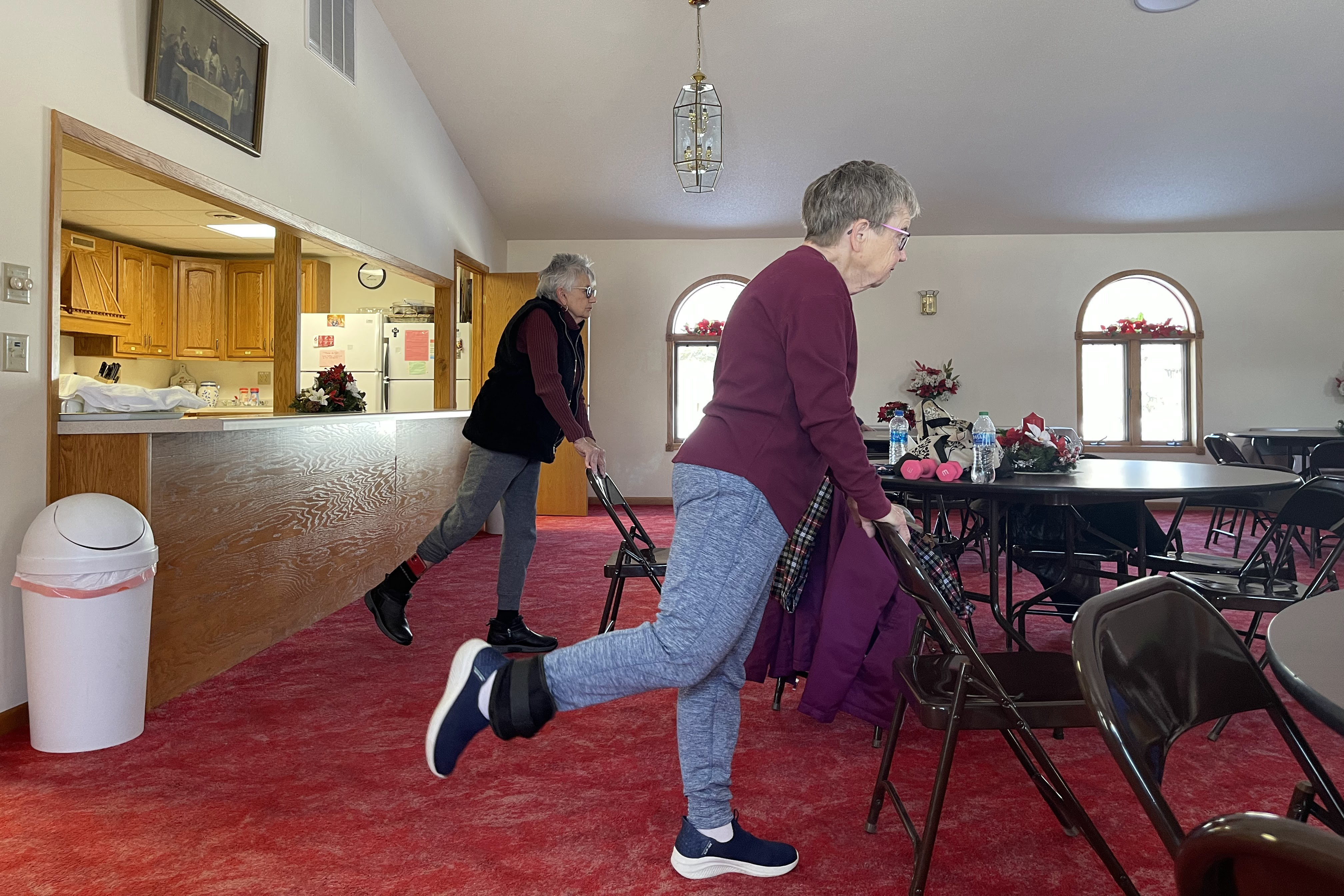
MALMO, Minn. — Eight women, all 73 or older, paced the fellowship hall at Malmo Evangelical Free Church to a rendition of Daniel O’Donnell’s “Rivers of Babylon” as they warmed up for an hourlong fitness class.
The women, who live near or on the eastern shore of Mille Lacs Lake, had a variety of reasons for showing up despite fresh snow and slippery roads. One came to reduce the effects of osteoporosis; another, to maintain mobility after a stroke.
Most brought hand and ankle weights, which they would use in a later portion of the program focused on preventing falls, known as Stay Active and Independent for Life, or SAIL. The class meets twice a week in Malmo, a township of about 300 residents. It is run by Juniper, a statewide network of providers of health promotion classes.
A few years ago, older adults who were interested in taking an evidence-based class like SAIL — meaning a class proved by research to promote health — had only one option: attend in person, if one was offered nearby.
But then the covid-19 pandemic and physical distancing happened. Along with social isolation came the rapid introduction of remote access to everything from work to workouts.
After widespread lockdowns began in March 2020, agencies serving seniors across the U.S. reworked health classes to include virtual options. Isolation has long since ended, but virtual classes remain. For older adults in rural communities who have difficulty getting to exercise facilities, those virtual classes offer opportunities for supervised physical activity that were rare before the pandemic.
And advocates say online classes are here to stay.
“Virtually the whole field knows that offering in-person and remote programming — a full range of programming — is a great way to reach more older adults, to increase access and equity,” said Jennifer Tripken, associate director of the Center of Healthy Aging at the National Council on Aging. “This is where we need to move together.”
Since April 2020, the National Council on Aging has organized monthly conference calls for service providers to discuss how to improve virtual programs or begin offering them.
“We found that remote programming, particularly for rural areas, expanded the reach of programs, offering opportunities for those who have traditionally not participated in in-person programs to now have the ability to tune in, to leverage technology to participate and receive the benefits,” Tripken said.
In 2022, at least 1,547 seniors participated in an online fitness program through Juniper, part of a Minnesota Area Agency on Aging initiative. More than half were from rural areas.
Because of grant funding, participants pay little or nothing.
Juniper’s virtual classes have become a regular activity both for people who live far from class locations and others who because of medical needs can’t attend. Carmen Nomann, 73, frequented in-person exercise classes near her home in Rochester before the pandemic. After suffering a rare allergic reaction to a covid vaccine, she’s had to forgo boosters and limit in-person socializing.
Virtual classes have been “really a great lifeline for keeping me in condition and having interaction,” she said.
Since 2020, Nomann has participated in online tai chi and SAIL, at one point logging on four days a week.
“Now, we would never go away from our online classes,” said Julie Roles, Juniper’s vice president of communications. “We’ve learned from so many people, particularly rural people, that that allows them to participate on a regular basis — and they don’t have to drive 50 miles to get to a class.”
When seniors drive a long way to attend a class with people from outside their communities, “it’s harder to build that sense of ‘I’m supported right here at home,’” she said.
Roles said both virtual and in-person exercise programs address social isolation, which older adults in rural areas are prone to.
Dr. Yvonne Hanley has been teaching an online SAIL class for Juniper since 2021 from her home near Fergus Falls. She had recently retired from dentistry and was looking for a way to help people build strength and maintain their health.
At first, Hanley was skeptical that students in her class would bond, but over time, they did. “I say ‘Good morning’ to each person as they check in,” she said. “And then during class, I try to make it fun.”
AgeOptions, an Illinois agency serving seniors, has seen similar benefits since introducing virtual fitness programs. Officials at the agency said last year that their operations “may have changed forever” in favor of a hybrid model of virtual and in-person classes.
That model allows AgeOptions to maintain exercise programs through Illinois’ brutal winters. Organizers previously limited winter activities to keep older adults from traveling in snow and ice, but now AgeOptions leans on remote classes instead.
“If the pandemic didn’t happen, and we didn’t pivot these programs to virtual, we wouldn’t be able to do that,” said Kathryn Zahm, a manager at AgeOptions. “We would just potentially spend months limiting our programming or limiting the types of programming that we offered. So now we can still continue to offer fall-prevention programs throughout the year because we can offer it in a safe way.”
But the new approach has challenges.
AgeOptions has identified increasing access to technology as a funding priority for the next few years, to ensure seniors can sign on.
The agency found that for many “folks in rural communities it was a challenge not only for them to have the device but to have the bandwidth to be able to do video conference calls,” Zahm said.
Tripken said providers and participants need guidance and support to facilitate access to virtual classes.
“For older adults in particular, that includes ensuring those with vision loss, those with hearing loss, those with low English proficiency” can participate in virtual classes, she said.
Some programs have created accommodations to ease the technology barrier.
Participants in Bingocize — a fall-prevention program licensed by Western Kentucky University that combines exercise and health education with bingo — can use a printed copy of the game card mailed to them by AgeOptions if they lack the proficiency to play on the game’s app. Either way, they’re required to participate on video.
The mail option emerged after Bingocize fielded requests from many senior service organizations trying to figure out how to offer it remotely, said Jason Crandall, the creator and international director of Bingocize.
Crandall designed Bingocize as a face-to-face program and later added the online application to use during in-person classes. Then covid hit.
“All of a sudden, all of these Area Agencies on Aging are scrambling, and they were scrambling trying to figure out, ‘How do we do these evidence-based programs remotely?’” Crandall said.
He said Bingocize was one of the few programs at the time that could quickly pivot to strictly remote programming, though it had never done so before.
“From when the pandemic began to now, we’ve come light-years on how that is done,” he said, “and everybody’s getting more comfortable with it.”
[Correction: This article was revised at 11 a.m. ET on Jan. 17, 2023, to correct the spelling of the name of the creator of the Bingocize program.]
Read More
Christina Saint Louis