

The state of responsible technology
Yet even as respondents agree that responsible technology use is becoming the equal of more traditional business considerations, their explanations of why it is important and what they hope to achieve by adopting it vary widely. For some businesses, responsible technology is a core part of their mission. Others see value in more explicitly financial terms, such as a return on investment, talent acquisition, or improving attractiveness to investors. Yet others seek merely to comply with regulation or to manage risk. Whether and how these disparate efforts and motivations will bring about substantial cultural shifts in how organizations adopt and deploy new technology remains to be seen.
What can be concluded is that responsible technology now goes beyond a hypothetical or a buzzword—it has become a concrete business consideration across industries. Executives are increasingly considering how responsible tech policies may impact brand perception among customers, investors, vendors, and partners. Organizations are thinking more seriously about how their employees, both current and future, view their use and creation of technology. And forward-looking business leaders, at both small and large companies, expect that responsible technology, and practices related to environmental sustainability in particular, will continue to grow in importance.
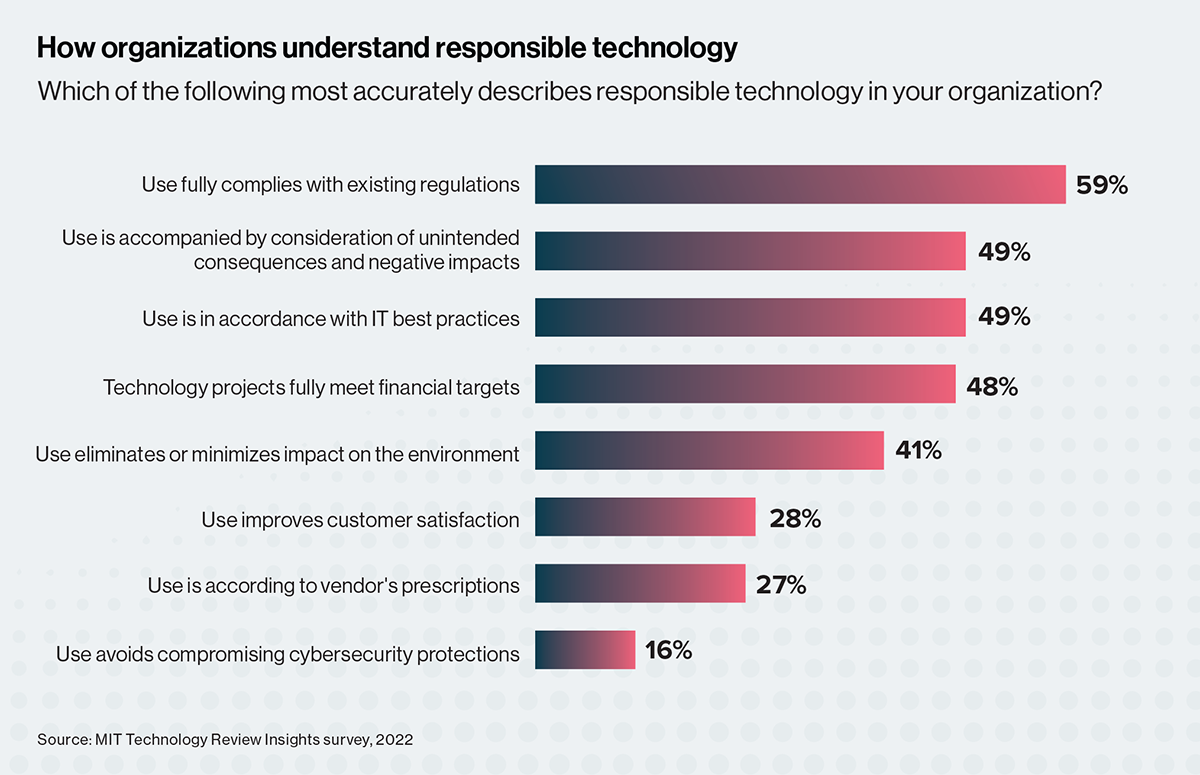
Here are several other key findings:
• Organizations expect responsible tech investments to pay off in boosted brand reputation and customer and employee retention. When asked about tangible business benefits of adopting responsible technology, the top three responses were better customer acquisition/retention (47%), improved brand perception (46%), and prevention of negative unintended consequences and associated brand risk (44%). Closely following these top three were attracting and retaining top talent (43%) and improving sustainability (43%).
• Large companies take initiative, while smaller companies react. Drivers for responsible tech policies come from diverse internal and external sources. Large companies were more likely to say they were motivated by desire to attract investors and partners (53%) and to align with their own mission and values (44%), while smaller companies were more likely to cite a desire to improve perception of their organization (54%) and to strengthen employee retention (45%).
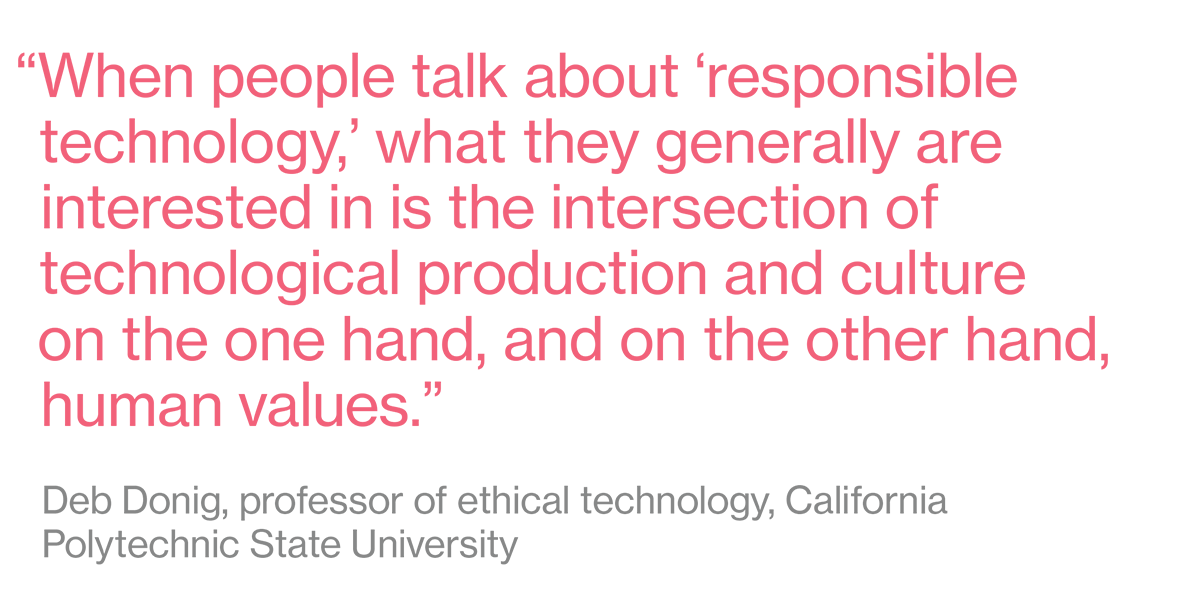
• No consensus on which responsible practices should take priority. Organizations name a wide range of focuses for their responsible technology practices, with inclusive design, data privacy, environmental impact, elimination of AI bias, and workforce diversification each in the top three for about half of respondents. User privacy and surveillance was seen as less important than all other options offered, with only 35% of respondents ranking it among their organization’s top three focuses.
• Senior leadership must get on board to make impactful policies a reality. The most cited hurdles to adoption of responsible technology are a lack of senior management awareness (52%), organizational resistance to change (46%), and internal competing priorities (46%).
• Organizations are both apprehensive about and appreciative of regulation surrounding responsible technology. Nearly one-quarter of respondents (23%) name adherence to existing laws, such as GDPR, or the anticipation of pending (and potentially farther-reaching) regulation as a top motivation for adopting responsible tech practices, though this figure varies widely by industry and geography. While some business leaders express trepidation about pending regulation, others cite it as important industry guidance.
This content was produced by Insights, the custom content arm of MIT Technology Review. It was not written by MIT Technology Review’s editorial staff.
Read More
MIT Technology Review Insights