


This scene was horrific for both its regularity and its exceptionality. Matt Gutman of ABC tweeted as much: “The scariest part of this is that the hit was in fact not scary. It looked terrifyingly ordinary.” The ordinariness of men running into each other at full speed represents a normalized—even rationalized—violence that is routine to this American game.
This ordinary violence has always riddled the sport and it affects all players. But Black players are disproportionately affected. While Black men are severely underrepresented in positions of power across football organizations, such as coaching and management, they are overrepresented on the gridiron. Non-white players account for 70 percent of the NFL; nearly half of all Division I college football players are Black. Further, through a process called racial stacking, coaches racially segregate athletes by playing position. These demographic discrepancies place Black athletes at a higher risk during play.
As a cultural anthropologist, I’ve spent the last decade learning how Black college football players navigate the exploitation, racism, and anti-Blackness that are fundamental to its current system. I know it’s not new to highlight the inherent violence of American football. This sport requires exceptional athletes, who are otherwise ordinary men, to perform extraordinary feats on the field. We liken these men to gladiators and warriors. The leagues, organizations, teams, coaches, spectators, and fans who benefit from their performance expect them to tough it out when they get hurt and applaud them when they play through these injuries.
Football is a spectacle where excessive violence is mundane, because hits that cause injuries are a constant occurrence, and spectators are desensitized to it. Consumers of the sport assume players will withstand any bodily affront, so they are shocked when a player’s physical limits are exceeded, often on very public stages. People with a vested interest in professional football rationalize excessive violence in this structured space, as well as the ones that encompass college, high school and peewee play, all because they assume that rules, equipment, and regulations exist to prevent death. But this is false protection. While this form of entertainment has been normalized, Hamlin’s injury demonstrates that ordinary violence has potentially deadly consequences, and highlights how Black men’s athletic labor sustains this brutal system.
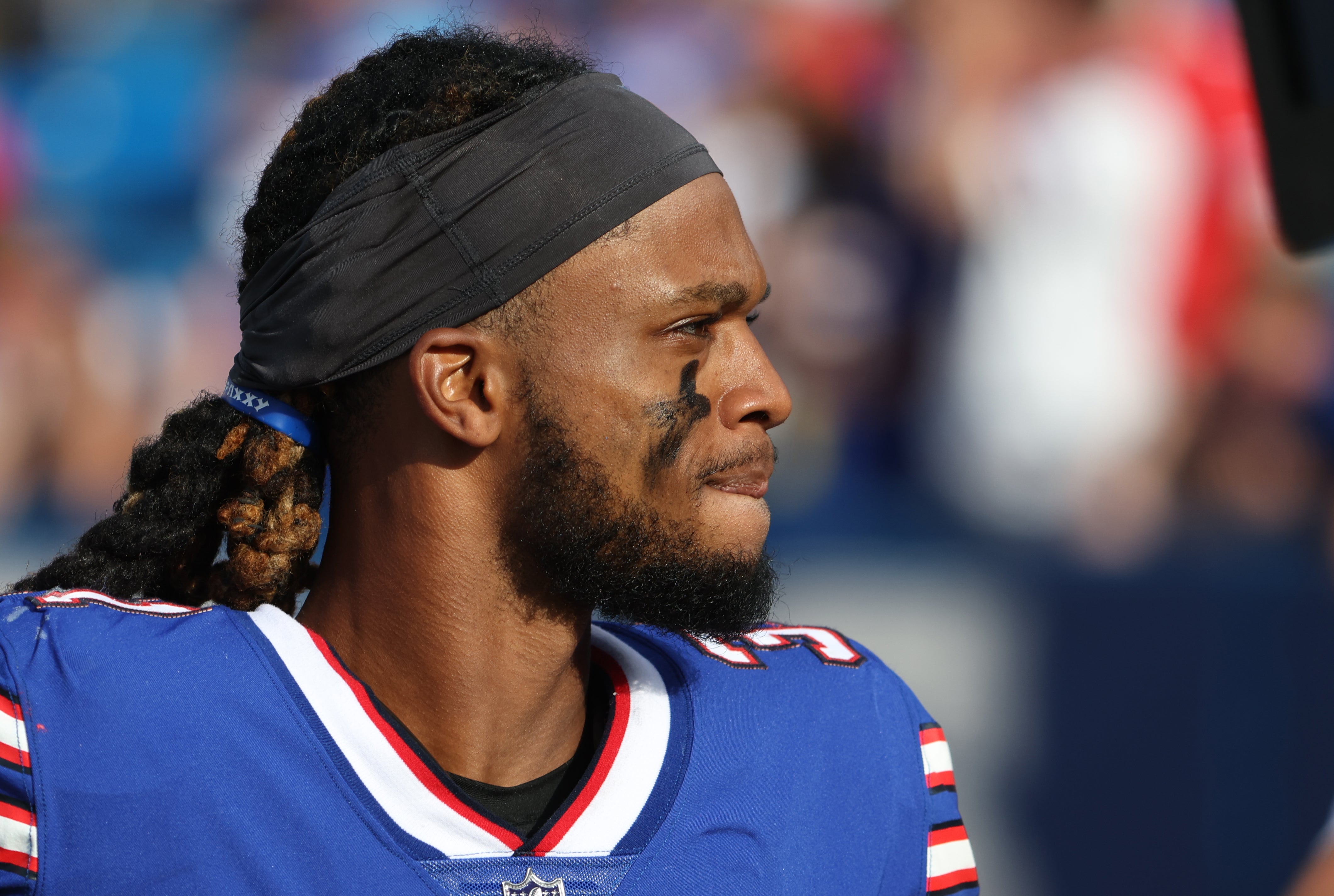
On these playing fields, ones that sociologist Billy Hawkins would argue are never theoretically far from plantation fields, financial stakeholders value Black bodies for their productive potential and physical prowess. The league encourages and facilitates rigorous training and disciplining so players can execute seemingly impossible corporeal demands, all in the service of entertainment, money-making, and insatiable fandom. In the words of sociologist and activist Harry Edwards, “like a piece of equipment, the black athlete is used.” While I am not aware of research that compares the rate of injury between Black and white football players, heatstrokes, ACL and labrum tears, ankle sprains, bone breaks, and concussions are just a few of the consequences of how these bodies are used.
The NFL gains both culturally and financially from Black athletic performance. It is the most popular sports league in the United States andthe most valuable professional sports league in the world. It is also a league that has exploited its Black players for decades. League officials admitted to using race norming—the assumption that Black players have lower baseline cognitive function than white players and suffer less from concussion—in settlements for concussion-related injuries. A former head coach, Brian Flores, has sued the league for racial discrimination in hiring. The NFL’s success and popularity should never be disentangled from its persistent anti-Black practices.
Despite the dismissive arguments of critics that high salaries are payment enough for the injuries that NFL players will likely experience, athletes at other levels don’t have this luxury. Public health scholar Kathleen Bachynski details the risks that have always existed in youth tackle football—but professional play cannot be disconnected from college play since this is where professional talent is cultivated. The college system thrives on unpaid athletes’ labor through a power dynamic that sociologist Erin Hatton terms “status coercion,” as coaches manipulate and exploit players’ work to extract value that ultimately leads to revenue for almost every entity involved, except for players themselves. College players suffer the same injuries as professionals, some of which end careers before they even begin. Yet, there is often little support to help players imagine themselves outside of their athletic identities and to cultivate alternative careers.
The most recent and exaggerated example occurred in fall 2020, during the first season of play during the COVID-19 pandemic. Beginning in March 2020, there were almost no students on campus, classes shifted to virtual formats, and social distancing became common practice. However, teams and conferences decided football play would continue. Players in all five major Division I conferences risked their health with an unpredictable and sometimes deadly virus to play a high-contact sport in almost empty stadiums to satisfy their universities, as well as television fans and the broadcasters who capitalize off their viewership. If those players hadn’t taken the field, athletic departments could’ve lost at least $4.1 billion in revenue.
In a way that is reminiscent of Black feminist scholar Hortense Spillers’ theorization of flesh, these situations demonstrate how organizations, administrators and fans dismiss each player’s personhood, strip them of their humanity and reduce them to mere bodies. No football athlete deserves this treatment. They should not be expected to play after enduring, experiencing and witnessing bodily traumas. Further, to dismiss the almost certain breaking down of their bodies as just part of the game is a process of objectification and commodification that prioritizes the player over the person in a way that Black feminist scholar bell hooks says calls to mind “the history of slavery and the plantation economy.” The anti-Blackness of the system is inescapable.
Despite the severity of Hamlin’s injury, the current NFL season will continue. The game between the Bills and the Bengals has officially been canceled, and the playoffs will be modified, but predictably, the Super Bowl in February will be followed by the scouting combine in March, the draft in April, and team training camps during the summer, all to prepare for the season to begin again in the fall. But we can’t forget that without players themselves, the game cannot persist. The elaborate infrastructure of the entire system relies upon their continued participation. If we expect these quotidian gladiators to return to the field, structural shifts must occur so they are actually cared for in a way that respects their humanity, as men who just happen to play the game of football exceptionally well.
This is an opinion and analysis article, and the views expressed by the author or authors are not necessarily those of Scientific American.
ABOUT THE AUTHOR(S)
Tracie Canada is an assistant professor of cultural anthropology at Duke University. Her research uses sport to theorize race, kinship, care, gender and the performing body, and she is currently working on a book project about the experiences of Black college football players. She holds a Ph.D. from the University of Virginia. Follow Tracie Canada on Twitter
Read More
Tracie Canada