

The ruling is about whether trans people have the same rights as everybody else—and the court said they don’t.
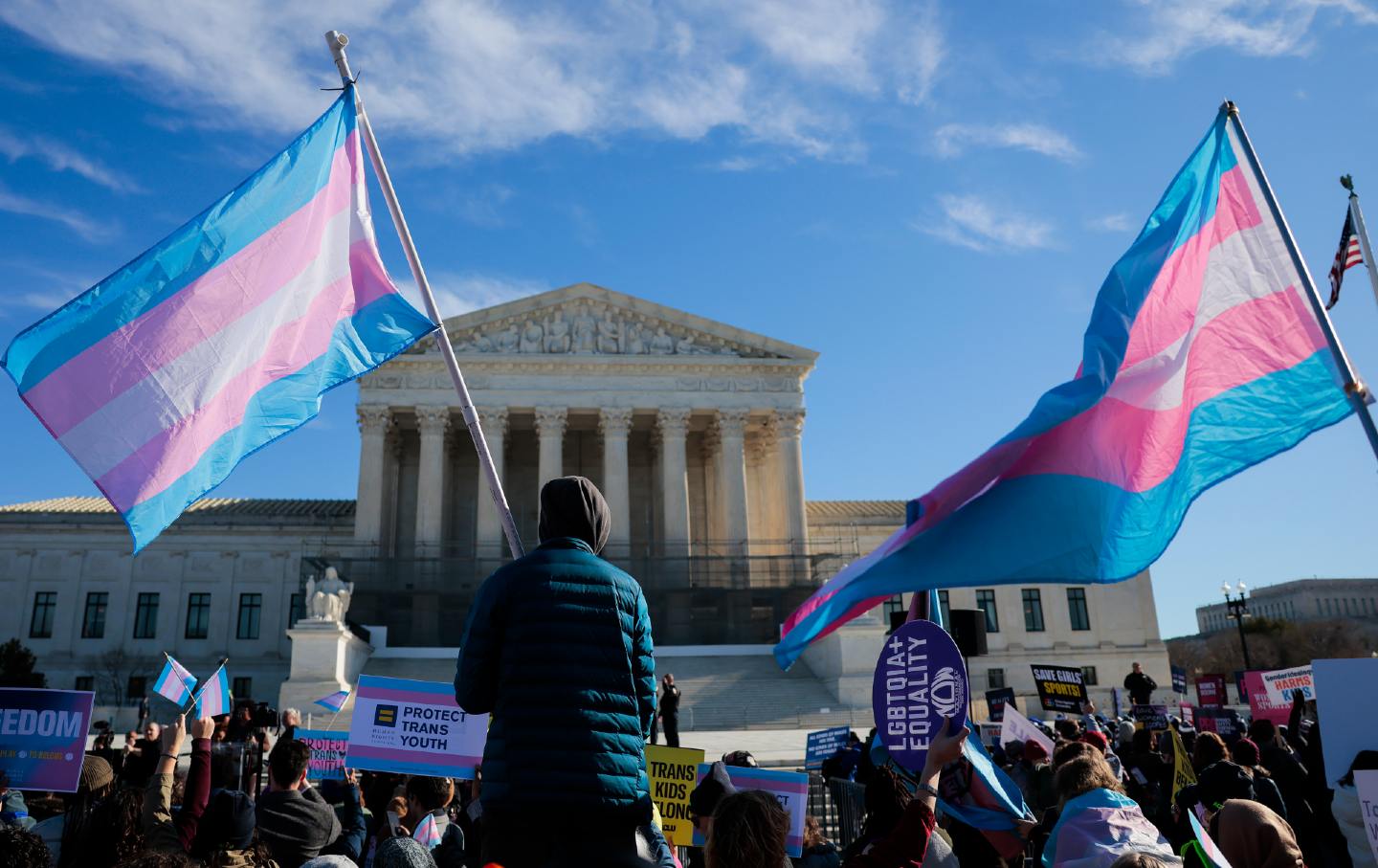
Supporters of transgender athletes competing in women’s sports gather outside the Supreme Court.
(Heather Diehl / Getty Images)
I’ve come to understand that advocating for the fundamental humanity, dignity, and equality of transgender people, especially transgender women, is a controversial stance. I realize that there are a lot of people who otherwise support legal and social equality but think that there must be some way to carve transgender people out of our society and place them off to the side, with a diminished suite of rights and privileges.
These people are wrong. Bigotry must be fought everywhere and at all times. When that bigotry is enshrined in Supreme Court opinions, and thus grafted onto the Constitution, it must be opposed to the very last.
This is the situation we find ourselves in, again, after the Supreme Court’s decision in West Virginia v. B.P.J. The case revolved around laws in a number of red states that prohibit trans women and girls from participating in women’s sports. The court ruled, 6–3, along party lines, that the trans plaintiffs opposing these bans have no claim under the Equal Protection Clause of the 14th Amendment. The court ruled 9–0 that the trans plaintiffs have no claim under Title IX of the Civil Rights Act, which is supposed to prohibit discrimination on the basis of sex.
Put another way, the court ruled that transgender women and girls have no constitutional right to equality. It is a disgusting ruling.
And it’s not just about sports. It’s about whether transgender women and girls have the same rights as everybody else. It’s about whether they have the same rights as cis people, and about whether they have the same rights as transgender men. And the court said “no.”
The loss on the Title IX claim is shocking and wrong, but at least I can try to explain it. Title IX prohibits discrimination on the basis of sex, but it allows for there to be different treatment of the sexes. That’s why Title IX allows (and one could argue requires) schools to provide different sports teams for boys and girls. Title IX protects the idea of an “all girls” kickball team or a women’s hockey league.
Current Issue
Once you make that distinction, it has to be up to somebody to determine how to uphold the distinction. In that context, Title IX leaves it up to the schools and sports leagues and states to determine who fits in what category, when only binary categories are available. In West Virginia, they’ve decided that sex at birth is the critical determination, and the Supreme Court unanimously agreed that West Virginia is allowed to make that call.
Again, I think the court is wrong here. Prohibiting trans women from participating in sports is discrimination on the basis of gender norms, something that is also not allowed under Title IX. You can’t prohibit boys from playing football because they don’t yet have facial hair. You can’t prohibit girls from playing hockey because they’re not blonde.
At the very least, if we’re going to argue that Title IX allows for discrimination against transgender athletes, I’d argue that it must then require the creation of nonbinary sports teams, so that everyone has a place to play.
And, for any TERFs in the audience: You don’t need to discriminate against transgender women and girls to protect women’s sports. Aside from the fact that we’re talking about a minuscule number of would-be participants, homogeneity of size, speed, and strength is simply not a requirement for any sporting activity whatsoever. At varsity football practice, when I was 14 and a freshman in high school, I got tackled by a 19-year-old (a senior who had been held back a year) so hard that I can remember it like other people remember getting into a car crash. Was I able to call for a “hormone check” on my attacker? No. I had to wait for the scientists to rebuild my chest cavity and take the ball again on my next series. It’s called “sports.” The idea that girls need to be protected from athletic differences, but not boys, is fundamentally patriarchal and sexist.
This differential treatment of trans girls and women is the heart of the equal-protection problem with these transgender bans. Cis girls and boys are allowed to compete, and they can do so on the team that matches their gender identity. Trans boys are also allowed to compete, and do so on the team that matches their gender identity; they can compete in women’s or men’s sports, depending on their preference. But trans girls are not.
The Equal Protection Clause should prevent this rank discrimination. It doesn’t need to give trans women the same outcomes as trans men or cis women, but it should guarantee that they have the same opportunity for participation. But the Supreme Court ruled, 6–3, that trans plaintiffs had no claim under the 14th Amendment.
This I cannot explain. By denying trans women their access to the Equal Protection Clause, the court has created a second, lesser class of citizenship. The court is telling an entire group of people that they don’t have as many constitutional rights as other groups of people, and thus that it is legal to discriminate against them.
That kind of legalized discrimination does not stay on the athletic field.
I spoke to NYU Law professor Melissa Murray about this ruling. She said that it will become the basis of discrimination against trans people across a host of issues. “The administration,” she said, “is going to saddle this ruling and ride it like Seabiscut to prosecute their view that the marginalization and inequality of trans people is necessary for sex equality writ large.”
Murray warned that we’ve already seen the model that Republicans and the Trump administration will use: the case that overruled affirmative action, Students for Fair Admissions v. Harvard. That ruling, Murray said, seemed to only affect a narrow issue—the specific use of affirmative action for college admissions—but the Trump administration has used it to justify discrimination on a much wider scale, ending so-called DEI programs across the federal government; reaching into any number of private institutions to disrupt their hiring practices; and, perhaps most important, cutting off funding for institutions and programs that don’t share the administration’s bigoted views.
Murray predicts that the same thing will happen with trans rights. The decision that trans women have no equal-protection rights on the field will be extended to the workplace and every manner of government or government-sponsored institution.
Popular
“swipe left below to view more authors”Swipe →
And this metastasizing bigotry will not stop in red states. B.P.J. was about whether red states are allowed to discriminate against trans people. The next case will be about whether blue states are required to discriminate against trans people, as they will surely be ordered to do by Trump and Stephen Miller—“to protect women and girls,” they’ll say. I can imagine a day when the Supreme Court orders states to adopt the same kind of bigotry the court merely allows.
Amazingly, despite all this—despite consigning an entire group of people to second-class status—alleged attempted rapist Brett Kavanaugh is getting credit in some circles for being “nice.” Kavanaugh authored the majority opinion in this case, and he took pains to say that transgender people should not be harassed and bullied simply for existing. His comments stand in contrast to his Republican colleagues, especially Justice Clarence Thomas, who appears to have written an entire concurring opinion just to put some hardcore transphobia into the record.
But I don’t think Kavanaugh deserves any credit for managing to denigrate trans people without using denigrating words. I don’t think being a nice bigot absolves you of being a bigot.
Transgender people deserve the same legal, constitutional, and human rights as anybody else. Any position contrary to that is unacceptable.
Elie Mystal
Elie Mystal is The Nation’s justice correspondent and a columnist. He is also an Alfred Knobler Fellow at the Type Media Center. He is the author of two books: the New York Times bestseller Allow Me to Retort: A Black Guy’s Guide to the Constitution and Bad Law: Ten Popular Laws That Are Ruining America, both published by The New Press. You can subscribe to his Nation newsletter Elie v. U.S. here.
Elie Mystal
Read More