

The Breitbart Business Digest Weekly Wrap: Trashing New York City for Fun and Profit
Welcome back to Friday! This is your weekly rundown of news and views from the world of business, economics, and finance in this 250th year of our shining Republic. No special-occasion trash bins were harmed in the creation of this newsletter.
This week, a J.P. Morgan executive got canned for stealing a garbage can painted in the colors of the New York Knicks, inflation trashed hopes of a rate cut from Warsh’s Fed this year, New York City’s rentocrat royalty got an even cushier deal from its socialist mayor, and we honored the capitalist who helped Americans win our independence.
Let’s go!
Trash Can DEI Banker Loses Her Job
A Knicks fan celebrated the New York City team’s NBA championship by emptying a garbage can painted in the team’s blue and orange colors onto the street and then marching off with the can. A video of her committing this combination of littering, vandalism, and theft shortly after the conclusion of the Knicks victory parade went viral, presumably because people were astonished at the brazenness of her anti-social actions.
As it turns out, she is an executive at J.P. Morgan Chase. Or, rather, she was. “Angie Báez, 40, was promoted to executive director of community and industry engagement for card and connected commerce at JPMorgan Chase more than a year ago,” Lydia Moynihan reported for the New York Post. The bank itself referred to this, at least behind the scenes, as a DEI role.
When the video surfaced, J.P. Morgan investigated and fired her. As it turns out, engaging in theft in public is outside the realm of acceptable conduct even for a credit card executive. You can kind of see their point. A bank asks its customers to entrust it with their money. Employing a notorious thief is not a good way to win trust. If she’ll trash the streets and steal a garbage can in plain view on a crowded street and on camera, just imagine what she might do when she thinks no one is watching.
As one New York banker told us: “She’s clearly not cut out for finance. Everyone on Wall Street knows never to commit crimes in front of witnesses.”
Monynihan writes that this can be traced to the DEI ideology that created her job in the first place:
Abdicating personal responsibility is baked into the moral framework of the institutionalized DEI that Baez has spent her career promoting — at Saks Fifth Avenue, the Infatuation and most recently JPMorgan Chase.
In the DEI moral hierarchy, people are no longer judged primarily by what they do, but by where they sit in the oppression pyramid. Under this system, victimhood, grievances, and being oppressed or marginalized are considered attributes, while it is always a nebulous “system” — run by elites — that is to blame.
The problem is structural racism, systemic bigotry, widespread patriarchy. But the movement is so focused on blaming every failure as systemic, it directs all blame outward rather than inward.
Why improve your own behavior if “the system” is rigged and you’re a permanent victim of structural inequity? Why respect public property if property itself is a tool of the “oppressing class”?
It’s very likely that Báez was being paid around $300,000 for her role directing “community and industry engagement.” By our estimate, this makes that Knicks painted can one of the most expensive garbage receptacles in history.
Inflation Gets a Four-Handle and the Dream of a Warsh Fed Cut Dies
The Department of Commerce said on Thursday that the personal consumption expenditures price index was up 4.1 percent in May from a year ago. This is the index that the Fed officially uses to measure its price stability goal of two percent inflation. A huge part of that is traceable to high gasoline prices in May, when the national average rose above $4.50 a gallon. And gas prices have fallen to around $3.90 this month. But no matter what the particular cause, there’s no real chance that the Fed is going to cut rates in proximity to an inflation reading more than twice the target.
Also weighing against a rate cut is the fact that the economy is doing fine. Better than fine. We’ve been adding an average of 188,000 employees to payrolls each month over the past three months, which is technically infinitely more than the zero breakeven rate required to keep the labor market humming. Layoffs seem to exist only in financial media headlines and Silicon Valley but nowhere else. Last week’s jobless claims, a proxy for layoffs, came in at 215,000, which is close to rock bottom. Core capital goods orders are up 8.3 percent year to date, and household spending rose 0.7 percent in nominal terms in May. There’s just no pressing need for a more accommodative monetary policy at the moment.
There are only four more Fed meetings between now and the end of year. The next one is at the end of July, at which point we will have one more month’s worth of inflation data. Even if the next consumer price index comes in negative on a month-to-month basis, that’s not going to move the Fed to a cut. The fed funds swaps market is now giving around a 30 percent chance of a hike at that meeting. The swaps implied odds are better than even that we’ll have at least one hike by the September meeting, with around a one-in-five chance of another hike by October and a one-in-three chance of two hikes by December. Bank of America’s analysts are penciling in three hikes.
We’ll take the under. If inflation turns out to be much more persistent than current indicators suggest, a Fed hike would not be out of the question. But we think it would take several months of high inflation even while gasoline prices drop to move the Warsh Fed into hiking mode. And that seems unlikely. The Dallas Fed’s Trimmed Mean PCE is at 2.4 percent over twelve months and 2.5 percent in the 6-month annualized window. That’s elevated but not alarming.
The Manchurian Victory and Mamdani’s Rent Freeze
It is all too fitting that the rent control policies of the People’s Republic of New York City are set by a committee with the innocuous name of The Rent Guidelines Board. Who could be opposed to the government providing a helpful guideline?
Of course, the guidelines are not guidelines at all. They are legally binding orders that directly control the rent in 40 percent of apartments in New York City. They are guidelines in the same way that China’s Vocational Education and Training Centers provide vocational training to Turkic Muslims who are detained, tortured, and enslaved within them.
This week, the city’s rent board announced a mandatory guideline of no rent increases at all for every single one-and-two-year lease apartment within its mandate. Zero. This is the first time rent has been frozen at zero for one and two year leases.
“This is a historic victory for New York City tenants,” New York City Mayor Zohran Mamdani said in a statement after the board approved the freeze. Mamdani famously campaigned on freezing rents.
Not quite. This is a victory for New York City tenants like Japan’s conquest of Manchuria was a victory for Asians. It’s a great deal if you are a rentocrat controlling one of these apartments but terrible for the tenants in the rest of the city—and nothing short of theft from the landlords who are forced to accept less rent than the market would bear. Rent stabilization constricts supply and liquidity in the market, driving up the “market prices” for everyone else. It also tends to degrade the quality of housing in New York City by reducing landlord revenue that could be used for maintenance and upkeep.
But what about the social justice of it all? Bizarrely, stabilization is not reserved for the poor renters or cramped railroad walkups. Thirty percent of residents in rent-stabilized apartments earn more than $100,000. About 40 percent of stabilized apartments have two or more bedrooms. By our calculations based on official NYC housing data from 2023 (the latest available), the average stabilized two-bedroom apartment rents for about $1,781 a month, compared with $2,572 for a two-bedroom market-rate apartment. That’s a gap of nearly $10,000 a year or a more than 44 percent discount for the stabilized rentocracy.
The filmmaker Nora Ephron famously lived in an eight-room apartment at the Apthorp, a palatial building at Broadway and West 79th Street, paying just $1,500 a month (after she had bribed the former occupant with $24,000 to hand it over to her). She was outraged when the city finally changed the rules, and the market priced the apartment at $10,000. In a sense, her outrage was well-placed. She lost her stabilization privileges back in 2006 when the law allowed landlords to charge market rents to tenants earning more than $250,000. These days there’s no high-income tenant exit plans for landlords. Angie Báez could be living in a rent stabilized apartment, paying 40 percent under market rent, while taking down $300,000 from J.P. Morgan Chase.
And all that blather about rent stabilization helping preserve the historic character of neighborhoods? Forget about it. Forty-four percent of rent-stabilized dwellers are foreign-born.
Rent stabilization is the opposite of justice. It’s a lottery and often an unearned inheritance, with apartments passed down from generation to generation because only a fool would part with an apartment that is priced so far under its value. The residents are apartment royalty, minus any sense of noblesse oblige toward the less fortunate market rent payers or the legal owners of the apartments.
Haym We Hardly Knew Ye
This week, in lieu of our usual history dispatch, we’re pointing you to our America 250 piece on Haym Salomon.
Salomon was a Polish-born Jewish immigrant who, before he became indispensable, racked up a résumé that reads like an action movie: twice arrested by the British, once condemned to death, and busted out of a New York prison via what one account delicately calls “a considerable bribe in gold.” (Two of his arrests came suspiciously close to catastrophic fires. We make no accusations. We merely note the timeline.)
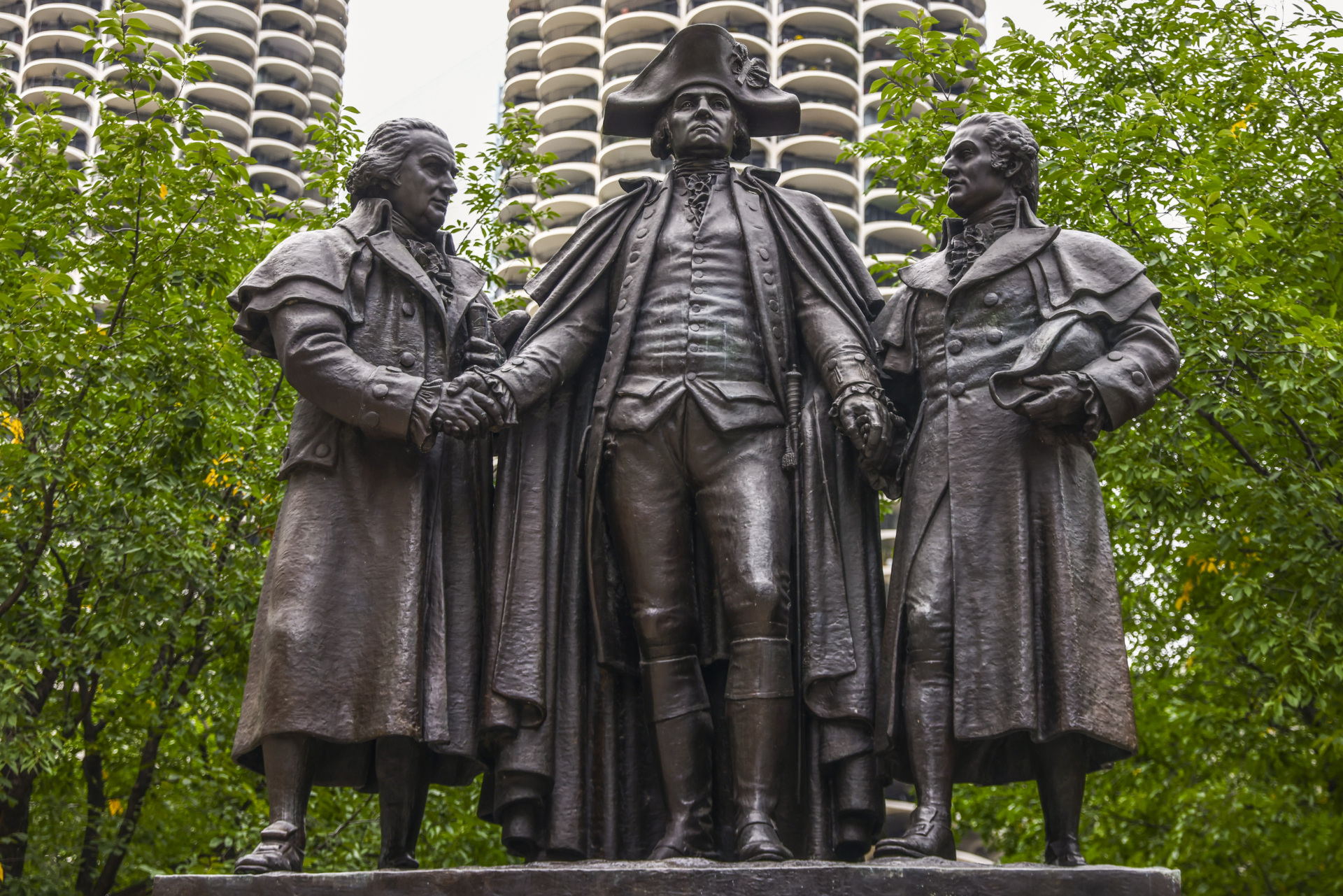
The Heald Square Monument in Chicago, Illinois, depicting General George Washington (center) and the two principal financiers of the American Revolution, Robert Morris (left) and Haym Salomon (right). (Beata Zawrzel/NurPhoto via Getty Images)
He fled to Philadelphia, rebuilt from nothing, and became Robert Morris’s go-to broker, and played a pivotal role in raising money to fund our revolution. His commission? Half of one percent, when everyone else was charging two to five. He then personally bankrolled Madison, Jefferson, von Steuben, Monroe, and half the Continental brain trust, mostly refusing repayment.
Revolutions aren’t won by muskets alone. It helps to have a guy who is really good at keeping the ledger straight.
John Carney
Read More