

Wes Roth opens the video by announcing that Grok 4.5 has officially gone live to the public after strong internal beta testing at SpaceX and Tesla. He explains that the model is positioned as an Opus-class system but stands out for being significantly faster, more token-efficient, and cheaper to run. The introduction highlights how Grok 4.5 was trained with supplemental Cursor coding data, giving it strong advantages in real-world engineering and agentic tasks.
3D sailing game
Wes prompts Grok 4.5 to generate a fully playable 3D sailing game, likely using Three.js or a similar web-based framework. Grok produces functional code remarkably quickly, resulting in a smooth, interactive sailing simulation with wind, boat physics, and controls. Wes compares the output directly to attempts with Claude and OpenAI models, noting that Grok’s version ran without major bugs on the first or second try. The segment shows the game in action, with Wes navigating the boat and highlighting responsive controls and visual quality. Grok 4.5 is able to understand spatial reasoning and generate working 3D game logic that competitors struggled to match.
TES RPG game
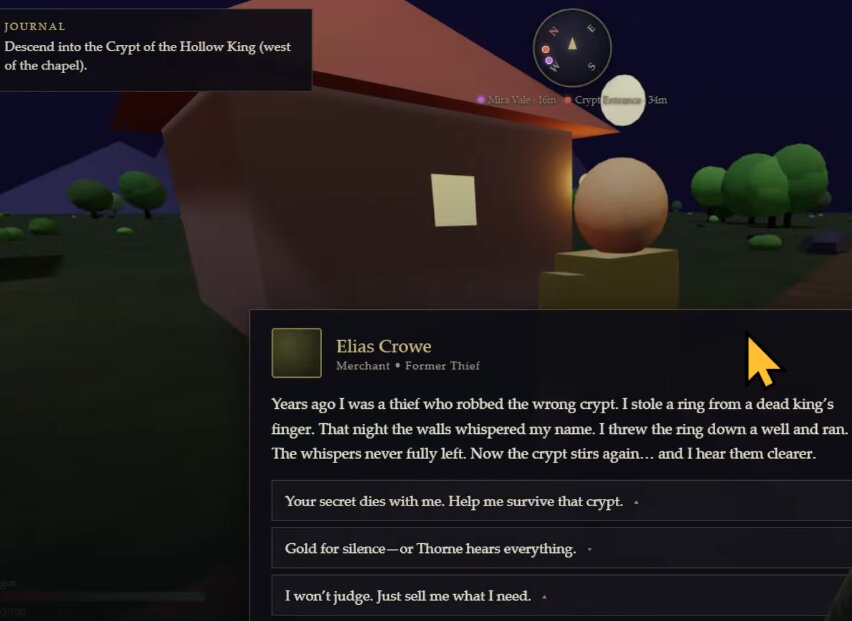
Wes challenges the models with creating a The Elder Scrolls-style RPG experience, including character creation, quests, dialogue, and exploration elements. Grok 4.5 generates a rich, coherent text-based RPG with immersive lore, branching choices, and consistent world-building that feels true to the TES universe. The generated game includes detailed NPC interactions, inventory management, and quest structures that maintain narrative coherence across multiple turns. Wes tests the RPG by playing through several scenarios and notes how Grok handled complex state tracking and creative storytelling better than the competing models. The section demonstrates Grok’s strength in long-context creative coding and game design tasks.
Other test, SVGs etc.
Wes runs several additional quick tests, including generating complex and detailed SVG vector graphics. Grok produces clean, intricate, and scalable SVG code for various illustrations and animations on demand. Other tests cover miscellaneous creative and coding challenges that showcase versatility in different output formats. Wes compares the speed and quality of these outputs against Claude and OpenAI models, noting fewer errors and more polished results from Grok. The segment reinforces Grok 4.5’s broad capability across visual, structural, and code-generation tasks.
Cursors role in Grok
Cursor (the AI-powered code editor) had a big role in Grok 4.5’s development and performance. Supplemental training with Cursor data helped the model excel at real-world coding workflows, large codebases, and iterative editing. The section shows practical examples of using Grok 4.5 inside Cursor for agentic coding tasks.
Wes highlights how this integration makes Grok particularly effective for developers who rely on cursor-based AI assistance. He contrasts this specialized training with other models that lack similar deep integration with coding tools.
The Ultimate test…
Wes presents a complex, multi-step “ultimate test” designed to push the models’ limits in reasoning, code generation, and consistency.
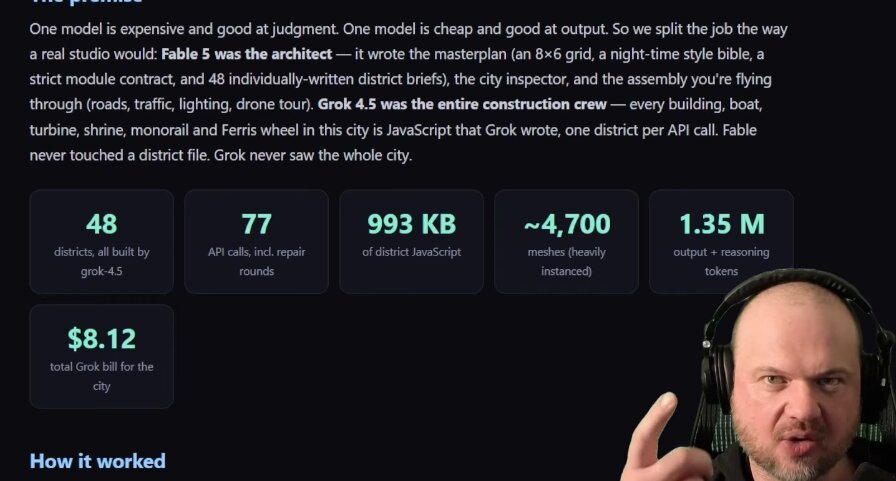
He used Anthropic Fable to design a complex 48 zone video game and then had SpaceXAI Grok 4.5 build it.
Grok 4.5 handles the challenging prompt with impressive coherence, producing a working solution where other models produced broken code or lost context. The test likely involves combining elements from previous tasks or a particularly difficult engineering/creative challenge. Wes walks through the results step-by-step, showing how Grok maintained quality and functionality throughout. This segment serves as the climax to demonstrate Grok’s superior performance under pressure.

What this means…
What does Grok 4.5’s strong showing implies for the AI landscape? Grok has closed the gap with or surpassed leading models in practical coding, game generation, and creative tasks while being faster and cheaper. It has real-world usefulness, speed, and cost-efficiency may matter more than raw benchmark scores for many users. Wes notes Grok 4.5’s training advantages (especially with Cursor) give it an edge for developers and engineers. This release intensifies competition and what to expect from future xAI models.

Brian Wang is a Futurist Thought Leader and a popular Science blogger with 1 million readers per month. His blog Nextbigfuture.com is ranked #1 Science News Blog. It covers many disruptive technology and trends including Space, Robotics, Artificial Intelligence, Medicine, Anti-aging Biotechnology, and Nanotechnology.
Known for identifying cutting edge technologies, he is currently a Co-Founder of a startup and fundraiser for high potential early-stage companies. He is the Head of Research for Allocations for deep technology investments and an Angel Investor at Space Angels.
A frequent speaker at corporations, he has been a TEDx speaker, a Singularity University speaker and guest at numerous interviews for radio and podcasts. He is open to public speaking and advising engagements.