

Physicists Discover a Strange New Kind of One-Dimensional Particle

Higgs Boson Particle Physics
New research suggests that in reduced dimensions, particles can defy the usual boson–fermion divide by exhibiting tunable, intermediate quantum properties. These findings hint at previously unexplored forms of matter and set the stage for experiments probing the deeper structure of the quantum world. Credit: Shutterstock

Researchers have, for the first time, described the properties of one-dimensional anyons and outlined how these particles can be observed using existing experimental setups.

Physicists have traditionally classified all elementary particles in our three-dimensional universe into two groups: bosons and fermions. Bosons typically include force-carrying particles such as photons, while fermions make up matter, including electrons, protons, and neutrons.

In lower-dimensional systems, however, this clear distinction begins to break down. Since the 1970s, scientists have predicted the existence of a third category of particles that fall between bosons and fermions, known as anyons. These particles were first observed experimentally in 2020 in ultra-thin, strongly magnetized semiconductor systems.

Building on that work, researchers from the Okinawa Institute of Science and Technology (OIST) and the University of Oklahoma have now identified a one-dimensional system where anyons can exist and analyzed their theoretical properties.
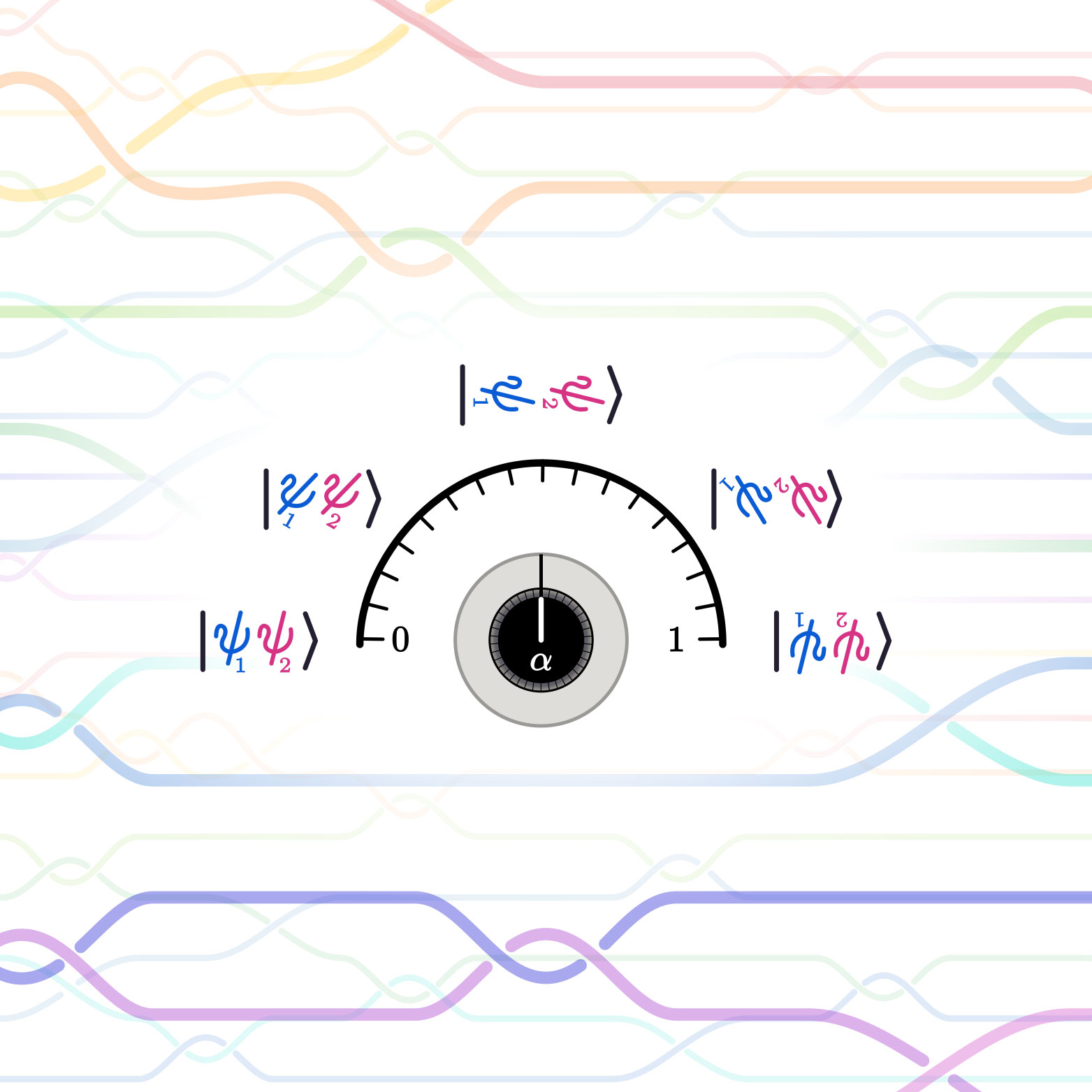
Graphic Illustration of Quantum Particle Exchange Symmetry
Graphic illustration of the papers’ findings. A knob labelled with α can be dialed between 0 and 1, showing how it affects the symmetry of two particles during an exchange operation, shown as two Ψs inside mathematical bra-ket notation. Credit: Jack Featherstone

Advances in controlling individual particles in ultracold atomic systems have made it possible to explore these ideas experimentally. “Every particle in our universe seems to fit strictly into two categories: bosonic or fermionic. Why are there no others?” asks Professor Thomas Busch of the Quantum Systems Unit at OIST. “With these works, we’ve now opened the door to improving our understanding of the fundamental properties of the quantum world and it’s very exciting to see where theoretical and experimental physics take us from here.”

Breaking the boson/fermion binary

The traditional classification depends on how identical particles behave when they exchange positions. In three-dimensional space, experiments show only two possible outcomes: either the system remains unchanged, as with bosons, or it changes sign, as with fermions.

This behavior is rooted in the quantum principle of indistinguishability. Unlike classical objects, identical quantum particles cannot be labeled or distinguished from one another. When two such particles swap positions, the system must remain physically the same. As Raúl Hidalgo-Sacoto, a PhD student in the OIST unit, explains: “Because this exchange is equivalent to doing nothing, the mathematical statistics governing the event, known as the exchange factor, must obey a simple rule: the square of the exchange factor must be equal to 1. The only two numbers that satisfy this rule are +1 and -1. That’s why all particles must be, respectively, bosons, for which the factor is 1, or fermions, for which the factor is -1.”

This distinction leads to very different physical behaviors. Bosons tend to act collectively, as seen in lasers or Bose-Einstein condensates, where particles share the same state. Fermions, in contrast, cannot occupy the same state, a property that underlies the structure of atoms and the periodic table.
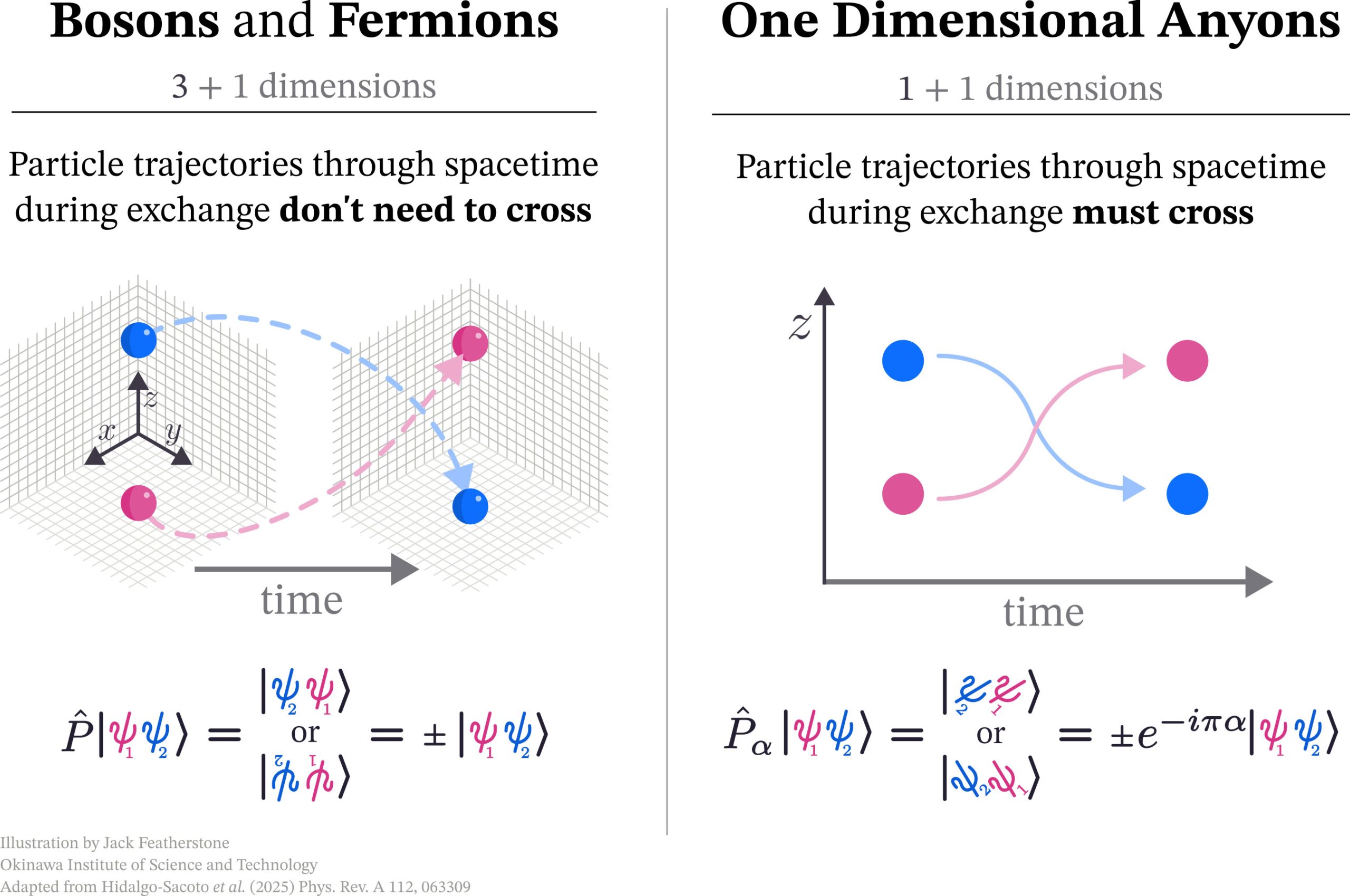
Graphic Illustration of Bosons Fermions and Anyons
In three dimensions (plus one time dimension), particles do not cross paths (or braid) when exchanging places, as their trajectories through time can easily be unwound – this is topologically equivalent to doing nothing. As such, the exchange operator, denoted here as P̂, is either plus or minus the original state (or wavefunction, ψ); a boson or a fermion respectively. In 1D, there is no room for the trajectories to wiggle around one another through time — they must cross, and as such the exchange operator depends on the twists and turns of the path, here operationalized as α. Excitingly, the researchers have found the experimental recipe for directly influencing α, allowing researchers control over how bosonic or fermionic the 1D particle is. Credit: Jack Featherstone

In lower dimensions, the situation changes. Particles have fewer ways to move around each other, and exchanges become tied to their paths through space and time. This means the system can no longer return to an identical state after particles swap. Hidalgo-Sacoto explains: “In lower dimensions, this exchange is no longer topologically equivalent to doing nothing. To satisfy the law of indistinguishability, we need exchange factors over a continuous range to account for the exchange, dependent on the exact twists and turns of the paths.”

This allows for a new class of particles with exchange factors that are not limited to +1 or -1. These particles are called anyons.

A recipe for adjustable anyons

In their recent work, Hidalgo-Sacoto and colleagues demonstrate that in one-dimensional systems, this expanded range of behavior persists and can even be tuned. In one dimension, particles cannot move around each other and must instead pass through one another, which changes how their exchange is defined.

The researchers show that the exchange factor in this case is directly linked to the strength of interactions between particles at short distances. This relationship allows scientists to adjust the exchange behavior in a controlled way, opening up new possibilities for experiments.

“We’ve identified not only the possibility of the existence of one-dimensional anyons, but we’ve also shown how their exchange statistics can be mapped, and, excitingly, how their nature can be observed through their momentum distribution,” summarizes Prof. Busch. “The experimental setups necessary for making these observations already exist. We’re thrilled to see what future discoveries are made in this area, and what it can tell us about the fundamental physics of our universe.”

References: “Universal momentum tail of identical one-dimensional anyons with two-body interactions” by Raúl Hidalgo-Sacoto, Thomas Busch and D. Blume, 11 December 2025, Physical Review A.
DOI: 10.1103/zf6z-2jjs

“Two identical one-dimensional anyons with zero-range interactions: Exchange statistics, scattering theory, and anyon-anyon mapping” by Raúl Hidalgo-Sacoto, Thomas Busch and D. Blume, 11 December 2025, Physical Review A.
DOI: 10.1103/h2vs-ll9d

Funding: Okinawa Institute of Science and Technology Graduate University, U.S. National Science Foundation

Never miss a breakthrough: Join the SciTechDaily newsletter.
Follow us on Google and Google News.

Okinawa Institute of Science and Technology (OIST) Graduate University
Read More

Latest

China’s Biren raises $892M to build GPUs that can take on Nvidia at home

Nvidia can barely sell its best chips in China. A crop of local challengers is racing to fill the gap. One of them just raised nearly $900m to speed up. Shanghai Biren Technology is selling HK$7 billion (about $892.5m) of new shares to boost GPU production. That is according to the South China Morning Post.

Mark Zuckerberg’s Meta AI Predicts Unbelievable Bitcoin Price by the End of 2026

Author Ahmed Barakat Author Ahmed Barakat Part of the Team Since Aug 2025 About Author Ahmed Balaha is a journalist and copywriter based in Georgia with a growing focus on blockchain technology, DeFi, AI, privacy, digital assets, and fintech innovation. Fact Checked by CryptoNews Editorial Team Author CryptoNews Editorial Team Part of the Team Since

Bitcoin Price Prediction: BTC Just Hit $81,000 for the First Time Since January But the Next 72 Hours May Decide Everything

Bitcoin Price Prediction: BTC Just Hit $81,000 for the First Time Since January But the Next 72 Hours May Decide Everything Author Ahmed Barakat Author Ahmed Barakat Part of the Team Since Aug 2025 About Author Ahmed Balaha is a journalist and copywriter based in Georgia with a growing focus on blockchain technology, DeFi, AI

Bitcoin Price Prediction: South Carolina Moves Against CBDCs With Zero-Tax BTC Bill

Author Ahmed Barakat Author Ahmed Barakat Part of the Team Since Aug 2025 About Author Ahmed Balaha is a journalist and copywriter based in Georgia with a growing focus on blockchain technology, DeFi, AI, privacy, digital assets, and fintech innovation. Fact Checked by CryptoNews Editorial Team Author CryptoNews Editorial Team Part of the Team Since

Newsletter

Don't miss

China’s Biren raises $892M to build GPUs that can take on Nvidia at home

Nvidia can barely sell its best chips in China. A crop of local challengers is racing to fill the gap. One of them just raised nearly $900m to speed up. Shanghai Biren Technology is selling HK$7 billion (about $892.5m) of new shares to boost GPU production. That is according to the South China Morning Post.

Mark Zuckerberg’s Meta AI Predicts Unbelievable Bitcoin Price by the End of 2026

Author Ahmed Barakat Author Ahmed Barakat Part of the Team Since Aug 2025 About Author Ahmed Balaha is a journalist and copywriter based in Georgia with a growing focus on blockchain technology, DeFi, AI, privacy, digital assets, and fintech innovation. Fact Checked by CryptoNews Editorial Team Author CryptoNews Editorial Team Part of the Team Since

Bitcoin Price Prediction: BTC Just Hit $81,000 for the First Time Since January But the Next 72 Hours May Decide Everything

Bitcoin Price Prediction: BTC Just Hit $81,000 for the First Time Since January But the Next 72 Hours May Decide Everything Author Ahmed Barakat Author Ahmed Barakat Part of the Team Since Aug 2025 About Author Ahmed Balaha is a journalist and copywriter based in Georgia with a growing focus on blockchain technology, DeFi, AI

Bitcoin Price Prediction: South Carolina Moves Against CBDCs With Zero-Tax BTC Bill

Author Ahmed Barakat Author Ahmed Barakat Part of the Team Since Aug 2025 About Author Ahmed Balaha is a journalist and copywriter based in Georgia with a growing focus on blockchain technology, DeFi, AI, privacy, digital assets, and fintech innovation. Fact Checked by CryptoNews Editorial Team Author CryptoNews Editorial Team Part of the Team Since

Altcoins Post Double-Digit Gains as Bitcoin Targets $63K Support; LiquidChain Presale Nears $900,000

Author Ahmed Barakat Author Ahmed Barakat Part of the Team Since Aug 2025 About Author Ahmed Balaha is a journalist and copywriter based in Georgia with a growing focus on blockchain technology, DeFi, AI, privacy, digital assets, and fintech innovation. Fact Checked by CryptoNews Editorial Team Author CryptoNews Editorial Team Part of the Team Since

Business seminar in Munich highlights Hong Kong’s strategic roles amidst global shifts (with photos)

Business seminar in Munich highlights Hong Kong's strategic roles amidst global shifts (with photos) ******************************************************************************************      The Hong Kong Economic and Trade Office, Berlin (HKETO Berlin), promoted Hong Kong's unique advantages and strategic roles at the seminar "Hong Kong's strategic role amidst geopolitical tensions" on June 18 (Munich time) in Munich, Germany.             Senior executives, investors

AI for business services: From job fears to productivity

AI for business services: From job fears to productivity

Business Insurance-AZ Achieves Record Response Times for 2026 Arizona Construction Bids

Business Insurance-AZ achieves milestone response speeds for commercial construction bids across Arizona, accelerating documentation delivery to keep local projects moving forward without delay. Phoenix, AZ, June 06-2026, ZEX PR WIRE — Business Insurance-AZ has achieved record-breaking processing speeds and response times for commercial construction bids throughout Arizona, directly supporting the state’s massive infrastructure and advanced manufacturing boom