

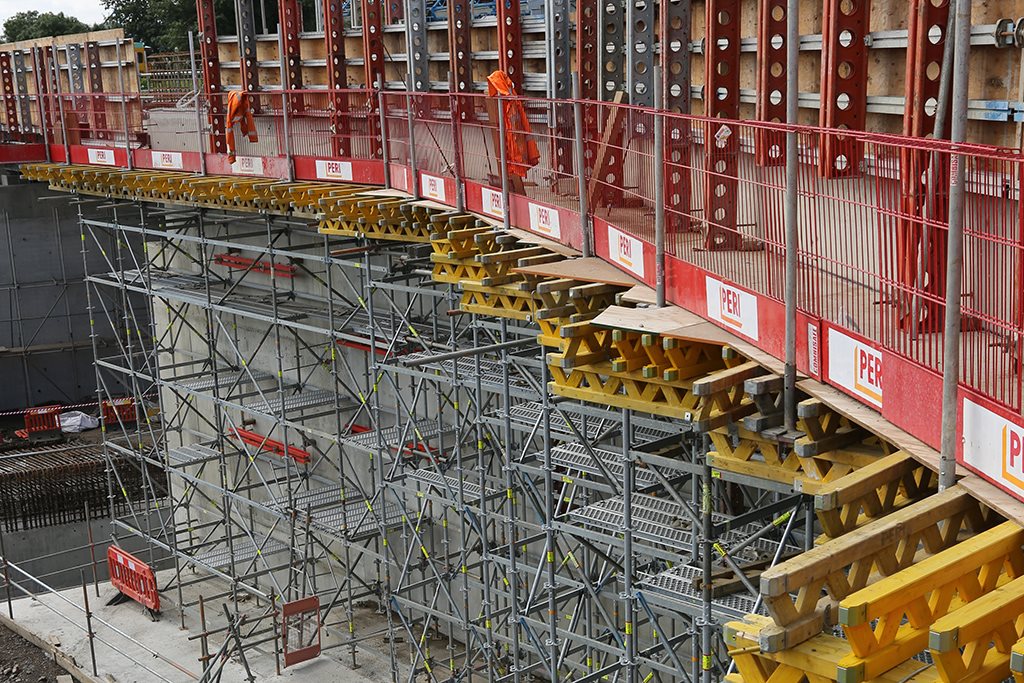
The job marked the first major use of Peri Up on a civils project
An industry association has warned of “increasing fragility” in the delivery of major infrastructure programmes, after the UK civil engineering sector recorded its first fall in workloads since the Covid pandemic.
Overall workloads declined by 1 per cent on balance in the third quarter (Q3) of 2025 compared to the previous three months, marking the first negative figure since Q3 2020, according to the Civil Engineering Contractors Association’s (CECA’s) latest survey.
The fall ends a sustained period of post-Covid growth and comes despite resilience in the nuclear and water sectors, where workloads rose by 30 per cent and 23 per cent respectively.
But firms reported declining activity in rail, trunk roads and preliminary works, with some schemes in these categories having seen continued contraction for more than three years.
Meanwhile, 95 per cent of respondents said costs had continued to rise over the past 12 months, while one in five cited issues securing skilled labour.
The CECA Q3 Workload Trends survey, published today (17 December), showed order books had grown by just 5 per cent compared with Q2.
Workforce constraints and inflation were described by CECA as ongoing pressure points.
Despite this, sentiment remained broadly optimistic. More than half of firms expect workloads to rise in 2026, with expected new work orders up 55 per cent on balance and anticipated repair and maintenance up 23 per cent.
CECA director of policy and public affairs Ben Goodwin said the decline in workloads pointed to “increasing fragility” in delivery.
He said: “The underlying message from CECA members is not that demand has disappeared – it’s that delivery is becoming less consistent, particularly in transport, and that uncertainty is starting to bite.”
Goodwin said the sector remained “ready to deliver”, but warned that government must match long-term ambitions with clearer commitments and faster decision-making.
“If we want to accelerate delivery, we need a pipeline that is not only ambitious, but credible, funded, and structured in a way that makes it investable — for clients, for the supply chain, and for the workforce,” he said.
CECA has recently contributed to consultations on streamlining infrastructure planning and identifying new financing models.
But Goodwin urged the government to prioritise “pace and certainty on the ground” in 2026 to prevent a broader slowdown.
Source: CECA announcement
Read More
Ben Vogel