

BIOGRAPHY
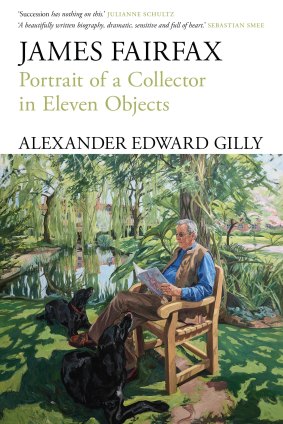
James Fairfax: Portrait of a Collector in Eleven Objects
Alexander Edward Gilly
NewSouth $49.99
The very rich, wrote F. Scott Fitzgerald, are different from you and me. James Fairfax, the subject of this fascinating biography written by his nephew, was the eldest son of Sir Warwick Fairfax and therefore destined at birth to lead the family company.
James, who died in 2017 at the age of 83, moved in the same social circles as Patrick White, and might well have been a character in one of White’s novels depicting the Anglo-Australian ascendancy in slow decline.
Even among the so-called Old Families that established pastoral, business and social dominance in colonial Australia, few could match the Fairfax dynasty in wealth, influence and longevity.
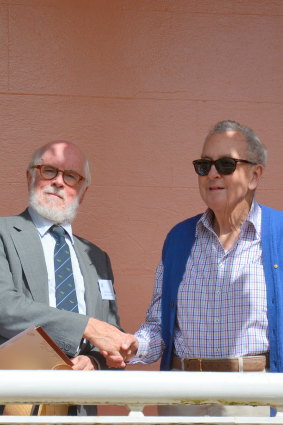
James Fairfax (right) with Dr Clive Lucas, president of the National Trust (NSW), at Retford House, which Fairfax bequeathed to the Trust.Credit:
James was a boarder at Geelong Grammar, where he met sons of the Murdoch and Packer newspaper families before following previous Fairfax scions to Balliol College, Oxford, and Harvard. He was welcomed at Balliol despite the fact he had just failed his first-year exams at the University of Sydney.
Much of his early life consisted of large houses and being chauffeured around in a Rolls-Royce. His father, meanwhile, took a Rolls-Royce on holiday as excess baggage aboard a cruise liner sailing to the Greek islands.
For more than a century, the Fairfax family was enriched by the “rivers of gold” that flowed through The Sydney Morning Herald and The Age. Before the internet, there was a time when the Saturday classified ads section of these papers had the thickness of a folded blanket. Back in the 1850s, there was a move to set up a hereditary nobility in Australia, which detractors labelled the Bunyip Aristocracy. The Fairfax family was not aristocratic per se, though their attitude was patrician, not least in the way they collected and commissioned expensive art.
An aesthete by inclination, James was the last patrilineal Fairfax to successfully manage the family company, which had remained within family control even after a float in the 1950s. In the late 1980s, James’ younger half-brother “Young” Warwick Fairfax launched a disastrous reprivatisation attempt allegedly fomented by his mother, Lady Mary.
Young Warwick figured in the Fairfax company affairs because James did not father a son; James never married and chose not to disclose his homosexuality publicly in an era of real fear that this might be used against him. Unlike his imperious father, Sir Warwick, James was a non-interventionist newspaper proprietor who preferred to collect art and renovate his Bowral mansion, Retford Park, an estate that includes a mural by Donald Friend and a pavilion by Guilford Bell.
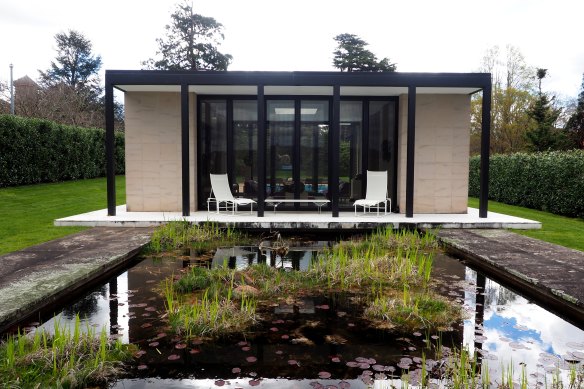
The Pavilion at James Fairfax’s former residence, Retford Park, in Bowral.Credit:
The pavilion, which was intended to be perfectly proportioned and positioned, is one of the 11 art objects associated with James that Gilly features in this book, along with old master paintings and drawings, a public sculpture by Robert Klippel located in Circular Quay that Fairfax gave to the public, a Chinese imperial robe and a family-heirloom grandfather clock that still stands in Retford Park.
Alexander Edward Gilly interviewed Fairfax before his death and has produced a discreet and affectionate portrait of his uncle. One way the author makes this biography rise above hagiography is by selecting 11 objects associated with James Fairfax, and interweaving the stories behind them into the life narrative. This beautifully produced book has many fine illustrations that include portraits of James by John Wonnacott and Bryan Westwood.
James Fairfax had tastes that ranged widely for a collector of his generation and background, encompassing Asian and contemporary Australian art. In European art, writes Gilly, James had a particular liking for Rococo artists such as Boucher and Fragonard. Rococo was the final, decadent flourishing of the Ancien Regime before the French Revolution abolished the divine right of kings and the entrenched privileges of the ruling class. No longer would French people tolerate art being the exclusive indulgence of taxpayer-funded aristocrats.
Loading
In his will, James Fairfax, who at Oxford was a founding member of the Ancien Regime dining club at Balliol, bequeathed Retford Park to the National Trust, and throughout his life he was a generous benefactor to the Art Gallery of NSW among others.
He inherited vast wealth, and shared a large portion of it – through his art collecting and philanthropic activities – with the Australian public.
The Booklist is a weekly newsletter for book lovers from Jason Steger. Get it delivered every Friday.
Most Viewed in Culture
Loading