
NASA’s InSight Lander Fades Into Mars Dust: Final Images Unveiled

HiRISE Studies Dust on InSight
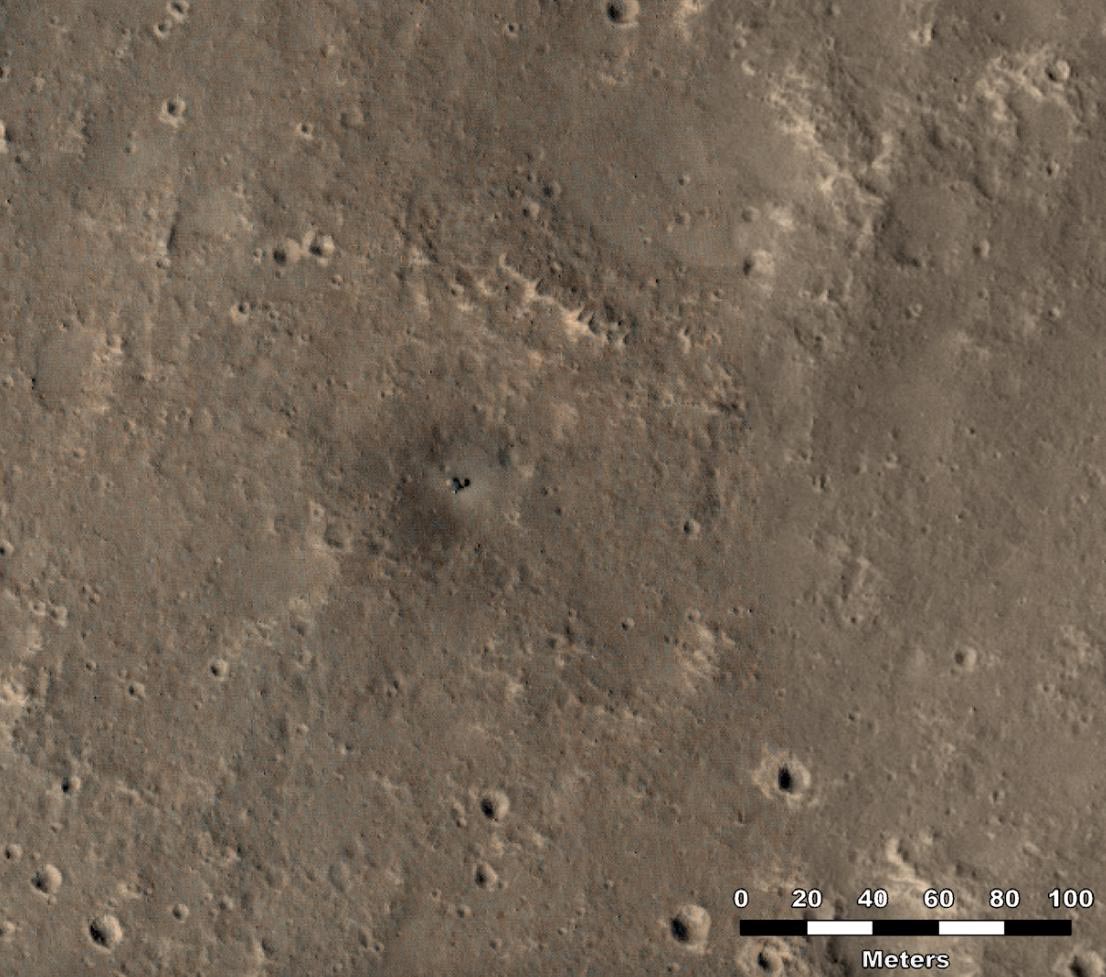
Seen at the center of this image, NASA’s retired InSight Mars lander was captured by the agency’s Mars Reconnaissance Orbiter using its High-Resolution Imaging Science Experiment (HiRISE) camera on October 23, 2024. Credit: NASA/JPL-Caltech/University of Arizona

MRO) recently captured an image of the retired InSight lander, showing the thick layer of dust that has settled on its solar panels. Taken on October 23 by MRO’s High-Resolution Imaging Science Experiment (HiRISE) camera, the photo reveals that InSight’s solar panels now share the reddish-brown hue of the Martian surface.

Since landing in November 2018, InSight became the first mission to detect marsquakes, uncovering valuable insights about the planet’s crust, mantle, and core. Over its four-year mission, engineers at NASA’s Jet Propulsion Laboratory (extended mission. But engineers continued listening for radio signals from the lander in case wind cleared enough dust from the spacecraft’s solar panels for its batteries to recharge. Having detected no changes over the past two years, NASA will stop listening for InSight at the end of this year.

Scientists requested the recent HiRISE image as a farewell to InSight, as well as to monitor how its landing site has changed over time.

“Even though we’re no longer hearing from InSight, it’s still teaching us about Mars,” said science team member Ingrid Daubar of Brown University in Providence, Rhode Island. “By monitoring how much dust collects on the surface — and how much gets vacuumed away by wind and dust devils — we learn more about the wind, dust cycle, and other processes that shape the planet.”


NASA’s InSight Mars lander acquires the same reddish-brown hue as the rest of the planet in a set of images from 2018 to 2024 that were captured by the agency’s Mars Reconnaissance Orbiter using its High-Resolution Imagine Science Experiment (HiRISE) camera. Credit: NASA/JPL-Caltech/University of Arizona

Tracking Dust Devils and Craters

Dust is a driving force across Mars, shaping both the atmosphere and landscape. Studying it helps scientists understand the planet and engineers prepare for future missions (solar-powered and otherwise), since dust can get into sensitive mechanical parts.

When InSight was still active, scientists matched MRO images of dust devil tracks (see below) winding across the landscape with data from the lander’s wind sensors, finding these whirling weather phenomena subside in the winter and pick up again in the summer.

Mars Dust Devil Dance
Dune fields in the high southern latitudes of Mars tell a mostly similar story during local summer. The dark dunes grow warmer than the surrounding bright plains because they absorb more sunlight. Dust devils form over the warm dunes but then dance out over the plains, spinning and performing pirouettes and leaving conspicuous dark tracks as bright dust is lifted from the surface. Loops in the tracks can often be used to discern the direction traveled by the dust devils, where in some cases, one track clearly overprints the other. Credit: NASA/JPL-Caltech/University of Arizona

The imagery also helped with the study of meteoroid impacts on the Martian surface. The more craters a region has, the older the surface there is. (This isn’t the case with Earth’s surface, which is constantly recycled as tectonic plates slide over one another.) The marks around these craters fade with time. Understanding how fast dust covers them helps to ascertain a crater’s age.

Fading Craters and Blasts: Mars Through Time

Another way to estimate how quickly craters fade has been studying the ring of blast marks left by InSight’s retrorocket thrusters during landing. Much more prominent in 2018, those dark marks are now returning to the red-brown color of the surrounding terrain.

HiRISE has captured many other spacecraft images, including those of NASA’s Perseverance and Curiosity rovers, which are still exploring Mars, as well as inactive missions, like the Spirit and Opportunity rovers and the Phoenix lander.

“It feels a little bittersweet to look at InSight now. It was a successful mission that produced lots of great science. Of course, it would have been nice if it kept going forever, but we knew that wouldn’t happen,” Daubar said.
NASA MRO HiRISE InSight Mars Lander
Seen at the center of this image, NASA’s retired InSight Mars lander was captured by the agency’s Mars Reconnaissance Orbiter using its High-Resolution Imaging Science Experiment (HiRISE) camera on October 23, 2024. Credit: NASA/JPL-Caltech/University of Arizona

More About MRO and InSight

The Mars Reconnaissance Orbiter (MRO) and InSight missions represent major milestones in NASA’s exploration of Mars, each contributing uniquely to our understanding of the Red Planet.

The MRO, managed by NASA’s Jet Propulsion Laboratory (JPL), is a multi-functional spacecraft designed to study Mars from orbit. Its High-Resolution Imaging Science Experiment (HiRISE) camera, operated by the University of Arizona and built by Ball Aerospace & Technologies Corp., provides detailed images of the Martian surface, enabling the study of geological features and the monitoring of changes over time. Since its launch, the MRO has played a critical role in scouting landing sites for other missions and supporting active surface explorers.

The InSight mission, part of NASA’s Discovery Program, focused on studying Mars’ interior structure to better understand the planet’s geological history. Managed by JPL and built by Lockheed Martin Space, the mission featured significant international collaboration. France’s CNES led the development of the Seismic Experiment for Interior Structure (SEIS) instrument, with contributions from institutions in Germany, Switzerland, the UK, and the US. Germany’s DLR provided the Heat Flow and Physical Properties Package (HP3), with input from partners in Poland and Spain. Spain’s CAB also contributed temperature and wind sensors. Launched in 2018, InSight made groundbreaking discoveries, including the detection of marsquakes, before concluding its mission in 2022.

Together, MRO and InSight exemplify the power of international partnerships and cutting-edge technology in advancing our understanding of Mars and laying the groundwork for future exploration.

Jet Propulsion Laboratory
Read More

Latest

Roundtables: Will AI really kill us all?

The latest iteration of a legacy Founded at the Massachusetts Institute of Technology in 1899, MIT Technology Review is a world-renowned, independent media company whose insight, analysis, reviews, interviews and live events explain the newest technologies and their commercial, social and political impact. Advertise with MIT Technology Review Elevate your brand to the forefront of

Meet the under-35s shaping the future of biotech

Every year, MIT Technology Review puts together a list of some of the brightest and best young minds working across science and technology. Our 35 Innovators Under 35 are the ones to watch—people whose research and technical work stands to shape the future of their fields. This year, the list includes nine people who are

Why Samsung’s new ultra smartphone doesn’t deserve its name

Despite the new titanium hinge, the Fold8 Ultra only achieves an IP48 rating and thus remains vulnerable to small dust particles. For an Ultra model, a dust-tight housing would have been desirable to avoid restrictions on use, for example, at the beach. Another everyday drawback for Fold users is the rear camera system. Compared directly

As war grinds on, Ukrainian climbers build a new outdoor culture inspired by Yosemite

Music Atop a steep granite cliff overlooking a river...

Newsletter

Don't miss

Roundtables: Will AI really kill us all?

The latest iteration of a legacy Founded at the Massachusetts Institute of Technology in 1899, MIT Technology Review is a world-renowned, independent media company whose insight, analysis, reviews, interviews and live events explain the newest technologies and their commercial, social and political impact. Advertise with MIT Technology Review Elevate your brand to the forefront of

Meet the under-35s shaping the future of biotech

Every year, MIT Technology Review puts together a list of some of the brightest and best young minds working across science and technology. Our 35 Innovators Under 35 are the ones to watch—people whose research and technical work stands to shape the future of their fields. This year, the list includes nine people who are

Why Samsung’s new ultra smartphone doesn’t deserve its name

Despite the new titanium hinge, the Fold8 Ultra only achieves an IP48 rating and thus remains vulnerable to small dust particles. For an Ultra model, a dust-tight housing would have been desirable to avoid restrictions on use, for example, at the beach. Another everyday drawback for Fold users is the rear camera system. Compared directly

As war grinds on, Ukrainian climbers build a new outdoor culture inspired by Yosemite

Music Atop a steep granite cliff overlooking a river...

8 Nigerian music dream collaborations we can only imagine

MusicYou don't have permission to access this resource. Read...

What small business owners say they’d do differently, in hindsight

Working 60+ hours a week makes owners twelve times more likely to say their business is hurting their personal life. Australian small business owners are working through illness, skipping holidays and struggling to step away from their businesses, according to new research from insurer BizCover. The survey of 1,500 BizCover small business customers found more

Bright young business brains bring ideas to life

Friday 17 July, 2026 Young Cumbrian entrepreneurs showed off their innovative business ideas, from AI virtual assistants to African food, at two celebration events this week. Fifteen young people from Furness and West Cumbria aged 14 to 25 were selected to take part in the Positive Enterprise programme back in January...

No, no, no — business travel is not dead. It’s still moving, and rather well at that

Par Bruno COURTIN Published on 7 Aug 2026 - Updated on 7 Aug 2026 3 min reading time According to forecasts from GBTA, the world's leading organisation representing business travel stakeholders, global business travel spending is set to hit a record $1.71 trillion in 2026, while the number of trips is expected to reach 1.84