

Our growing reliance on technology at home and in the workplace has raised the profile of e-waste. This consists of discarded electrical devices including laptops, smartphones, televisions, computer servers, washing machines, medical equipment, games consoles and much more.
The amount of e-waste produced this decade could reach as much as 5 million metric tonnes, according to recent research published in Nature. This is around 1,000 times more e-waste than was produced in 2023.
According to the study, the boom in artificial intelligence will significantly contribute to this e-waste problem, because AI requires lots of computing power and storage. It will, among other things, lead to more turnover of computer servers used in the data centres that support the extra computational needs of AI systems.
This rising tide of e-waste, coupled with the limited lifetimes of hi-tech devices, could affect global sustainability goals.
E-waste contain toxic and hazardous substances such as mercury, which can pose serious risks to human health and the environment. E-waste is among the fastest-growing types of solid waste globally: more than 5 billion mobile phones are thrown away each year, according to the Waste Electrical and Electronic Equipment forum.
In 2022, e-waste reached a record 62 million tonnes – an 82% increase since 2010 – and accounted for 70% of total global waste. However, less than 20% is formally recycled.
Data centres and transmission networks are responsible for more than 1% of global energy use, and 0.6% of global carbon emissions. According to a recent McKinsey report, by 2030, the power consumption of AI applications in the US will rise from 4% to 12% of the total power demand today.
Meeting these demands could require investments exceeding US$500 billion (£395 billion) for data centre infrastructure. It is already forcing big tech companies to find novel solutions to satisfy this hunger for energy, such as purchasing electricity from nuclear power providers.
The environmental impacts of e-waste are considerable. The toxic chemicals in electronic and electrical hardware can contaminate soil and water. In some parts of the world, e-waste is burned to extract valuable materials, generating air pollution. Even the processes to formally recycle materials pose challenges because of the hazardous materials in waste.
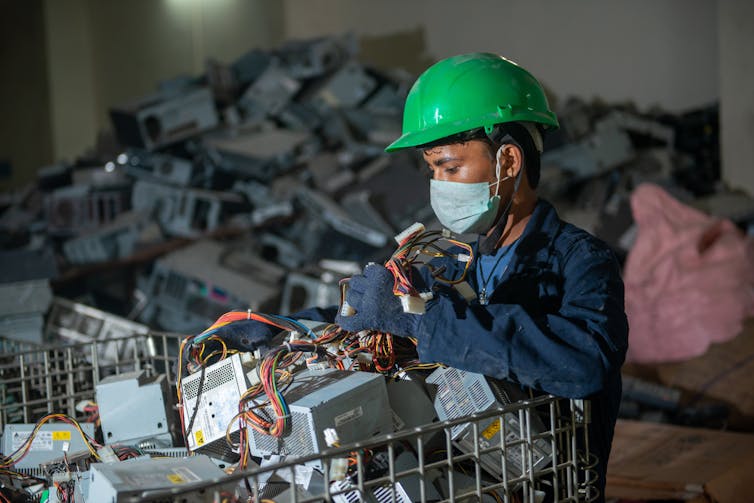
PradeepGaurs / Shutterstock
Some factors underlying the rise in e-waste, such as growing energy consumption in data centres, could also hamper efforts to reduce carbon emissions. The rising tide of waste itself could set back progress on sustainability goals, especially those seeking to balance economic development with protecting the environment.
There’s particular concern over the effects of e-waste on human health. Discarded devices can contain cancer-causing chemicals such as PAHs (polycyclic aromatic hydrocarbons). Exposure to e-waste has also been linked to low birthweight and reproductive problems in adults. Children are particularly vulnerable, because their development can be affected by toxic substances in the environment.
The economic impacts of e-waste are also significant. The costs of cleaning it up will rise, and because comparatively little e-waste undergoes formal recycling, it can lead to the loss of economically valuable resources such as gold, platinum and other critical materials used in technology.
Sources and trends
The Nature study on the effects of AI on e-waste used “material flow analysis” to project the growth in demand for hardware. The researchers came up with four scenarios to predict the future growth of e-waste: “limited”, “conservative”, “moderate” and “aggressive”.
A three-year lifespan was assumed for computer servers in data centres, based on historical information. The amount of e-waste was calculated by estimating the numbers of servers being discarded each year. This enabled the projection of cumulative volumes of e-waste for each scenario up to 2030. The results suggest that between 1.2 and 5.0 million tonnes of waste will have been produced between 2020 and 2030.
The substantial increase in waste technology underscores the need for intervention strategies. The study backs circular economy approaches to tackle the problem – a model of production and consumption that keeps materials and products in use, preventing them turning into waste.
This could involve extending server lifespans, re-using components, optimising AI operations through advanced algorithms (to reduce the computational power needed), and improving the efficiency of computer chips. The study estimates such solutions could reduce e-waste by between 16% and 86%, depending on how they are applied.
Integrating green design into electronic products could also benefit the environment. This could include installing more biodegradable parts into hardware, substituting toxic components with less harmful ones, and improving the lifespans of products.
Raising awareness among the public is also vital. We will need to switch from a culture of “use it and throw it away” to one where we think twice about whether we actually need new technology.
Donating devices to others when we are finished with them, and encouraging the use of certified e-waste recycling centres, where this technology should be disposed, can also help. Local and national governments play essential roles in managing e-waste by creating policies, regulations and strategies to reduce its environmental impact and promote sustainable practices.
Governments are tasked with setting standards for e-waste collection and recycling. These help ensure that e-waste is disposed of safely and efficiently. The development of recycling technologies is an area where government investment is crucial, as innovative solutions can improve safety and efficiency.
Some e-waste will always exist, as technological advancement is crucial to improving our quality of life. But doing everything possible to reduce how much we generate, and mitigating the impact of the e-waste that is produced, will be vital for protecting the environment, the economy and our health.
Alina Maria Vaduva, Director of the Business Advice Centre for Post Graduate Students at UEL, Ambassador of the Centre for Innovation, Management and Enterprise, University of East London and Kirk Chang, Professor of Management and Technology, University of East London
This article is republished from The Conversation under a Creative Commons license. Read the original article.
Read More
The Conversation