

The quality-of-care results seem highest in the specialties that use telehealth most. Endocrinologists, for instance, like it because their patients get lab work done separately and then discuss results with doctors virtually; surgeons are using it to confer with patients before and after procedures.
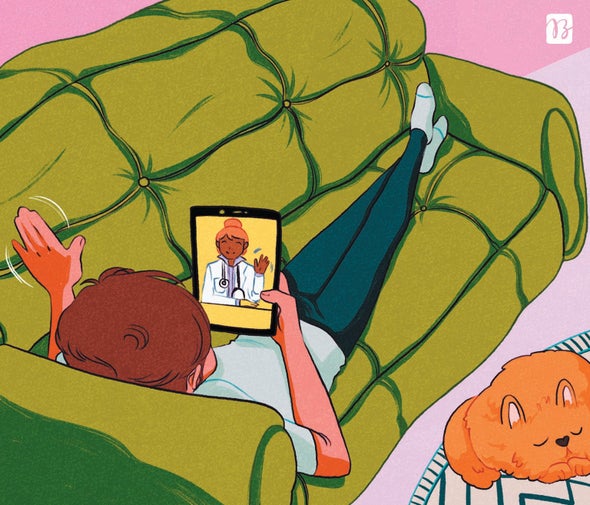
Patient satisfaction with these visits is good, according to reports from large health-care systems. People say they like the convenience of virtual care—there is no travel, no parking, no child or pet care to arrange. Sanford Health, which serves a widespread rural population from its base in Sioux Falls, S.D., estimates its patients who used virtual care were spared two and a half million miles of driving in 2022.
In some cases, technology is providing clinicians with better insights into those they care for. Jeremy Cauwels, chief physician at Sanford, says an endocrinologist in his organization now carves out several hours a week for video visits with diabetes patients after discovering how much information about diet and habits he could glean from observing them at home.
People vary in how much of their home life they are willing to show, of course. Whereas some patients would never turn a camera on in the living room, others cheerfully display the insides of their medicine cabinets or refrigerators. “We’re getting a window into the patient’s lived environment that we never had before,” Rosengaus says. “That harkens back to the days of doctors and house calls.”
Virtual visits do not work for everything and everyone. In the large 2022 telehealth study, in-office patients were more likely to receive and adhere to some medications, such as statins for cardiovascular disease. Starting “a lifelong medication” is a big decision that may be best suited to an in-person discussion, the authors suggest. Another study found that patients who followed up an emergency hospital visit via telehealth rather than in person were more likely to be readmitted to the hospital.
Clearly, medical providers must fine-tune the best use of this technology. The rest of us will keep finding our comfort level (I draw the line at showing my medicine cabinet). The goal, proponents say, is not simply to increase telehealth use but to optimize it and create a good form of hybrid care they call “clicks and mortar.”
This is an opinion and analysis article, and the views expressed by the author or authors are not necessarily those of Scientific American.
This article was originally published with the title “Checking Up on Telehealth” in Scientific American 328, 4, 23 (April 2023)
doi:10.1038/scientificamerican0423-23
ABOUT THE AUTHOR(S)

Lydia Denworth is an award-winning science journalist and contributing editor for Scientific American. She is author of Friendship:The Evolution, Biology, and Extraordinary Power of Life’s Fundamental Bond (W. W. Norton, 2020) and several other books of popular science. Credit: Nick Higgins
Read More
Lydia Denworth