

Rotating the UK’s biggest tunnel-borer 180 degrees is no mean feat – but it means only one machine is needed and the job will get done a lot quicker. Joshua Stein reports on the Silvertown Tunnel project
Rotating the UK’s biggest tunnel-boring machine (TBM) 180 degrees may seem like a tricky task. But at the Silvertown Tunnel site in London, innovative use of a nitrogen skate system has accomplished just that. The Riverlinx joint venture – comprising Bam Nuttall, Ferrovial and SK Ecoplant – is burrowing a two-bore tunnel beneath the Thames between Silvertown on the northern side and Greenwich on the southern side, in a project worth £1bn.
“It’s the first time a machine of this size has been rotated using nitrogen skates”
Borja Trashorras, Riverlinx
Riverlinx has just finished rotating the first section of the TBM outside the southern portal so it can begin the second bore. Out of three available options, that was the most efficient “from a cost perspective and a time perspective”, Riverlinx operations director Borja Trashorras says.
They could have used two TBMs, but powering two separate machines would have been less cost-efficient.
The other option – using one TBM and returning it to the original side – could have added months onto the completion date. “That would involve stripping [the TBM] down and reinstalling it all with lifting gear, [so] you might be talking about five or six months [extra],” Trashorras says. “Rotation also saved in terms of carbon footprint, reuse materials – all of that.”
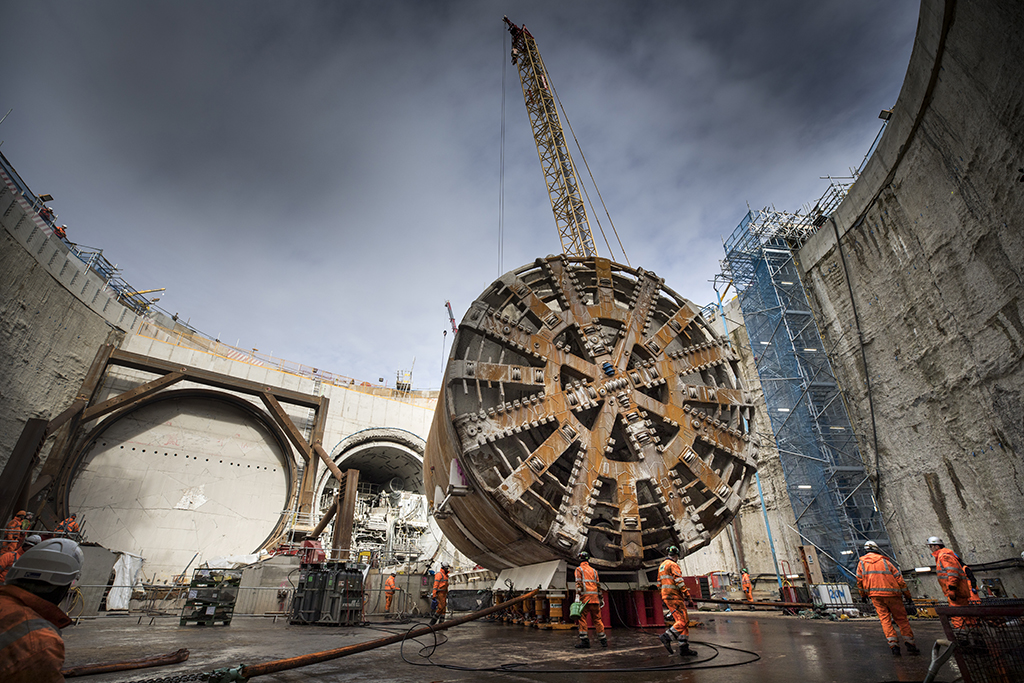
An 11.9-metre-diameter TBM, seen here mounted on its nitrogen skates, was needed to fit double-decker buses through the tunnel
Turning the TBM did present the team with challenges, however. The machine has an 11.9-metre diameter, making it wider than those used for HS2, Tideway and Crossrail. This is because, unlike those projects, the Silvertown Tunnel will contain multiple road lanes that must allow the passage of double-decker buses.
“We would probably need to hire all of the air compressors in the UK to make that [method] a success,” says Riverlinx project manager Ivor Thomas – a cost and supply obstacle not worth pursuing. Instead, the JV used a nitrogen skate system to help turn the TBM – needing only a “bottle bank of about 12 bottles of nitrogen”.
Nitrogen “is commonly available, it’s inert, it’s not poisonous, it’s lighter than air, and you get a lot of bang for your buck”, he adds. Client Transport for London is so happy with the outcome that a spokesperson says “there is no good reason” why nitrogen skates can’t be used again.
Thomas says the gas has been used to turn TBMs on only two other occasions, in Paris and Stuttgart – but the Silvertown TBM is bigger than the machines used there. Steel plates were installed on the base of the rotation chamber. The plates were then welded, ground smooth to allow even running (with grouting used to close off any underlying voids), and oiled to produce a slick surface.
The nitrogen is “all about breaking friction down” between the steel plate and the TBM and not actually lifting the machine, Thomas says. Decreasing the friction via the nitrogen and with a heavily oiled steel plate meant that the 1,400-tonne TBM could be pulled out and then turned in around eight hours by a pair of 25-tonne chain pulls operated by remote pendant control.

The TBM is wider than machines used to bore HS2 tunnels
The machine emerged in Greenwich from its journey under the Thames at a 4-degree angle. As it left the north-south bore, it was floated on top of a steel cradle using nitrogen skates that were placed underneath and bolted into position. The team levelled out the TBM using a hydraulic system, to ensure it was completely horizontal in preparation for the 180-degree turn.
The skates allowed the machine to almost hover, or “skate”, on the steel surface. The nitrogen skates themselves consist of “hydraulic feet” that work with compressed nitrogen.
The hydraulic system was then locked off and the nitrogen skates moved instead. The chain then pulled the TBM forward and sideways in two turns so that it was ready to bore the second tunnel. While the process was ongoing, the tunnel behind it was being fitted out with concrete for the road deck and low-point sumps to pump any water out of the tunnel.
UK firsts
“It is the first time I have been involved in a fit-out programme that has happened so quickly,” Thomas says. “It’s also the first time a machine of this size has been used in the UK, and the first time a machine of this size has been rotated using nitrogen skates.”
One of the key ambitions at the southern portal was to not disrupt a host of nearby assets, including the car park at the O2, which will be above part of the tunnel. “We’ve done all the design and professional work without affecting any third parties,” Trashorras says, which included Thames Water, UK Power Networks and National Grid Transco. “When you have a concert in the O2, you can imagine that car park is flooded with people.”
Meanwhile, all of the spoil – a full 600,000 tonnes – is being taken by barges down the Thames to the Ingrebourne Valley nature park, where it will be used to restore local areas into sustainable sites.
Savings on time, cost and materials have piqued the interest of clients keen to follow in Riverlinx’s footsteps, Trashorras adds: “Some clients are very keen to understand where this was a success and where else it can be showcased in the UK.”
Read More
Joshua Stein