

“The Breeders, Hole, Sonic Youth, The Smashing Pumpkins all had female bass players. That was definitely an inspiration”: When Melissa Auf Der Maur went solo
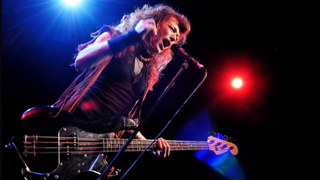
Montreal-born bassist Melissa Auf Der Maur was something of a four-string legend on the alternative rock and grunge scene throughout the early 1990s, with years of supporting roles in seminal bands such as Hole and The Smashing Pumpkins. In 2004, when this interview was conducted, she had just released her debut solo album, Auf Der Maur (opens in new tab). Guests on the album included Chris Goss (Masters Of Reality) Josh Homme and Nick Oliveri (Queens Of The Stone Age), Brandt Bjork (Kyuss), Erik Erlandson (Hole) and James Iha (Smashing Pumpkins). Having spent years backing up charismatic, limelight-stealing singers such as Courtney Love and Billy Corgan, preparing for a solo album was no small task…
Have you written the songs on your new album from a bass player’s point of view?
No, and I promise the world of bass players, and I promise my bass, and myself, that for the next record I will – because a big trouble is that the bass is really about sharing. You really need a drummer to play bass. You need a band – the bass player can’t really exist without a band. I wrote all these songs with power chords on an acoustic guitar alone in my room, so I didn’t have a relationship with a drummer to write from that perspective. I mean, I play the rhythm guitar like I would play a bass, they’re completely transposable, but I wrote it from a guitar place rather than a bass place.
How did you prepare for doing a solo album?
After five years in Hole and a year in The Smashing Pumpkins, I had to re-evaluate what music means to me. It was a very rigid structure in those bands, because the catalog was already accumulated and because there’s a cycle of touring and recording, with record companies and lawyers involved. And I basically needed to return to my love of music for my spirit and soul’s sake. So when I left the Pumpkins I wanted everything to start from scratch.
I realized when I did the album that what I had done in my five years in Hole as a bass player and backup singer is nurture other people’s spark and develop around them. You build melodies and arrangements around existing things. I adapted so well to that role that when it came to my record, I was playing that role to myself! I wrote the songs on guitar and then played the perfect bass player and backup singer to myself. It was like the old me supporting the new me, the songwriter.
Have the songs changed over the years?
No, not really. I believe people are born pretty much the way they are – I’m not too different than when I was 12. Of course I have a bigger vocabulary and a better bass-playing ability, but basically what I’m trying to relate in the music is always the same. But I did pick up a lot of melody ideas and riffs as the years went by.
Are you still playing Precisions?
Yes, I have a black one for this tour as well as the tobacco sunburst one I always use. I’ve only ever played Fender and there’s no reason as a bass player to play anything else. Maybe if you were playing jazz or funk, but for heavy rock riffs the Precision is the only one that’s round enough and has the attack. A Jazzmaster is good for walking around going dink-dink-dink, but when you want to hit that E string… I play almost everything on the E string. One of my trademarks is that I play everything on the E and slide up and down wherever possible. Everything is heavier on the E string and I tune down to D a lot. Also, if you avoid the A and D string and move up and down the neck it affects the actual feel of the riff.
Are you a five-string player?
No, but I do have a secret weapon in the studio which I might bring out live sometime. It’s a very heavy metal-looking eight-string from the 70s, a Greco. Unbelievable. I double every rhythm guitar with one of those. It has the biggest, fattest sound, and I also tune the high string in each pair not to an octave but to a fifth, which gives you these strange chords. The only songs I’ve ever written on the bass are ones I’ve written on the D and the G strings, with an open droning D. D is my favorite note.
What was your first bass?
A Squier Precision. Cheaper than a Fender, but it was a Japanese model from the 70s so it was really good. About five years ago Fender made me a whole bunch of custom-shop Precisions. The only specification I gave them was to make them exactly like my Squier! My Squier’s neck was worn down because it was an old bass, so they just shaved the necks down. It’s a flatter neck from behind. I couldn’t have used a Jazz because those necks are fatter but skinnier, the other way – I like wide necks, just not fat ones. I have very small hands but I still find them comfortable. Otherwise, I don’t have any custom modifications: I don’t use active pickups, that’s for sure.
Amps?
Ampeg only. I’m endorsed by them. I’ve done multiple Ampeg campaigns for them. As a bass player, I’m entirely convinced that there is nothing better than an Ampeg and a Precision. The amps are like an industrial machine – they’re not finicky. The old 60s and 70s ones a little wacky, but if you buy a new tube SVT Classic head, you’re fine.
Effects?
On the bass I don’t do much. I have a little Sansamp distortion for a couple of moments but I don’t like to distort the bass because you lose so much of the bottom-end definition. I’m addicted to phasers and flangers of all sorts – I write all my guitar parts on them, and I do use them on the bass but again, I don’t like losing the definition.
How do you write your bass parts?
I don’t like to go against my riffs too much but I will use my vocal harmonies when writing a bass part. That was my technique a lot when we were making the Celebrity Skin album (1999) with Hole. Every time I was singing a counter-melody and it was too busy for the backup vocals, I would make it my bass line. I think I use my voice and my bass very similarly, actually. Also, I evolve my bass parts throughout the song: in the first verse I start simple, then later on I come in a bit more, and then I play the most melodic part of the bass line right at the end of the song.
Who influenced you as a bass player?
Well, I’m a fan of various bass players, but to be quite honest I’ve been more influenced by bands than individual players. I was drawn to the bass at quite a young age at a gut-instinct level, because of the sub-frequencies that we don’t hear but we feel – not because I saw a bass player and thought, oh wow. I mean, in ‘91 and ‘92, the big inspiring years for me, I saw some amazing players at the beginnings of that incredible movement.
Grunge, the movement that dare not speak its name?
Ha! Yes, exactly. But I was so lucky to see all those bands before the explosion. In one summer I saw The Breeders, Hole, Sonic Youth, The Smashing Pumpkins. I saw Nirvana, Mudhoney and lots of others too, but those four all had female bass players. And subconsciously at least, I thought wow, that’s very accessible. Those girls were definitely an inspiration.
But from when I became a real bass player and started paying attention to the bass more, I’ll choose two players – bearing in mind that in rock bass playing you’re not supposed to be flashy. Being a lead bass player doesn’t fit in rock music. It does in jazz and funk, though.
What about Cliff Burton?
Actually, you’re right there. Anyway, these two players are tasteful rather than flashy: Eric Avery from Jane’s Addiction – their songs are clearly written from a bass player’s point of view – and Nick Oliveri from Queens Of The Stone Age, who plays on two songs on my album. He is one of the most moving bass players I’ve seen, and yet his work doesn’t intrude whatsoever.
On the whole, are you pleased with the new album?
Oh yeah. Recording the album was the best time I’ve ever had in my life. It was my world! Through and through. I worked and learned and did my education so that when I made my album it would be musically and emotionally exactly what I believe in. The songs have been building up for years – the oldest one dates back to 1993 before I was in Hole. That one in particular I began thinking of as a friend – I said to it, “I’ll be back for you, I promise. I’m not just abandoning you!”
This interview was originally published in Bass Player, 2004

Thank you for reading 5 articles this month*
Join now for unlimited access
US pricing $3.99 per month or $39.00 per year
UK pricing £2.99 per month or £29.00 per year
Europe pricing €3.49 per month or €34.00 per year
*Read 5 free articles per month without a subscription
Join now for unlimited access
Prices from £2.99/$3.99/€3.49
Read More
Margherita Redner