

A PRIMO view —
“PRIMO is a new approach to the difficult task of constructing images from EHT observations.”
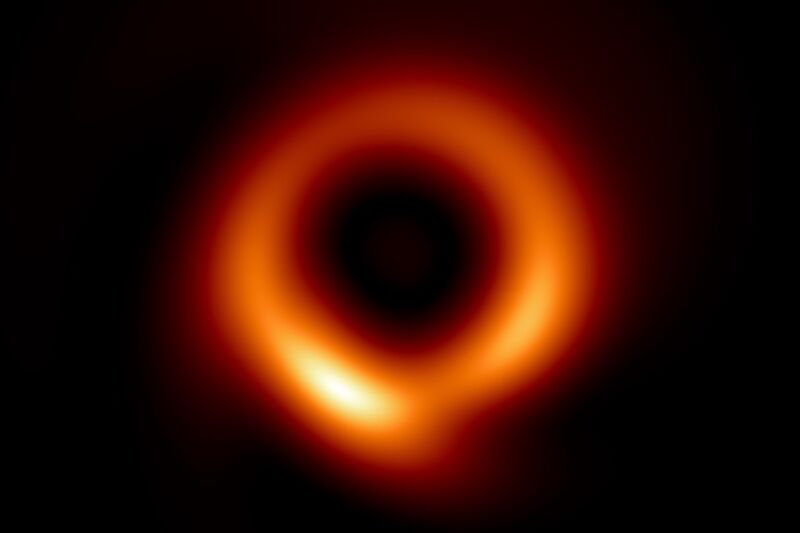
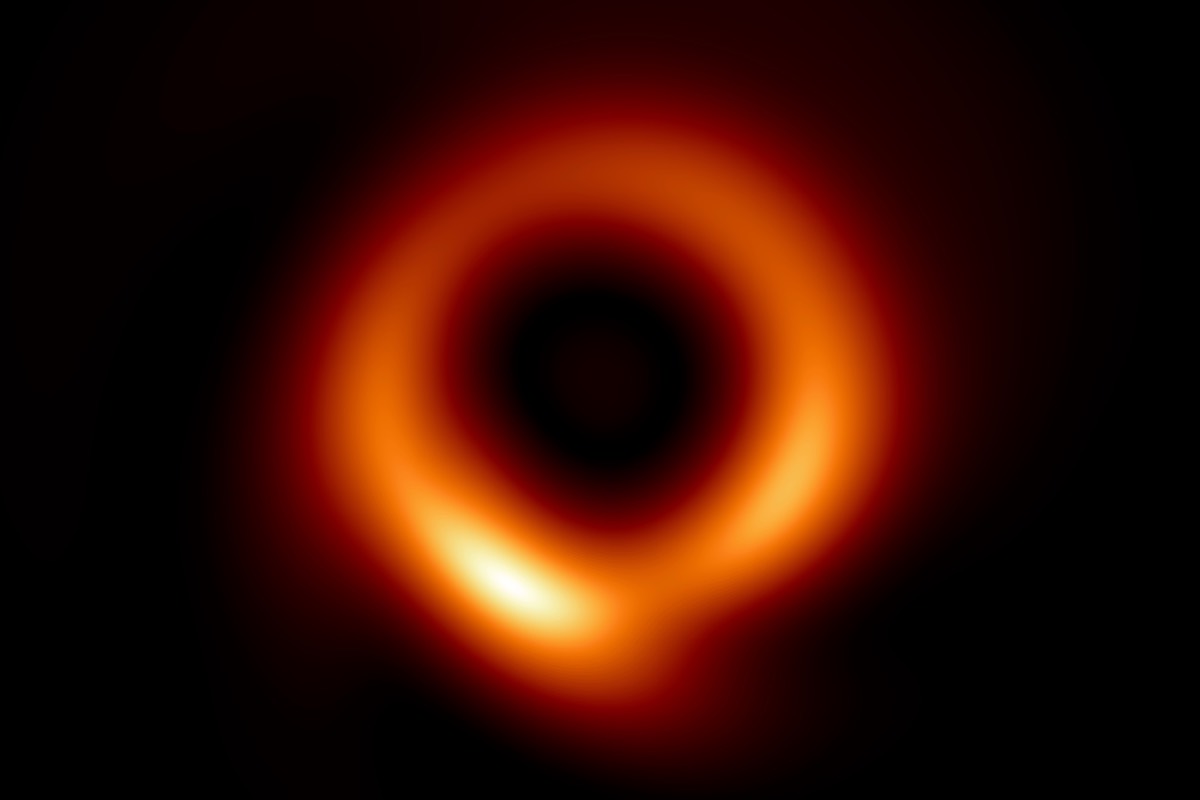
Enlarge / This new, sharper image of the M87 supermassive black hole was generated by the PRIMO algorithm using 2017 EHT data.
Medeiros et al. 2023
The iconic image of a supermassive black hole in the Messier 87 (M87) galaxy—described by astronomers as a “fuzzy orange donut”—was a stunning testament to the capabilities of the Event Horizon Telescope (EHT). But there were still gaps in the observational data, limiting the resolution the EHT was able to achieve. Now four members of the EHT collaboration have applied a new machine-learning technique dubbed PRIMO (principal-component interferometric modeling) to the original 2017 data, giving that famous image its first makeover. They described their achievement in a new paper published in The Astrophysical Journal Letters.
“PRIMO is a new approach to the difficult task of constructing images from EHT observations,” said co-author Tod Lauer (NOIRLab). “It provides a way to compensate for the missing information about the object being observed, which is required to generate the image that would have been seen using a single gigantic radio telescope the size of the Earth.”
As we’ve reported previously, the EHT isn’t a telescope in the traditional sense. Instead, it’s a collection of telescopes scattered around the globe, including hardware from Hawaii to Europe, and from the South Pole to Greenland, though not all of these were active during the initial observations. The telescope is created by a process called interferometry, which uses light captured at different locations to build an image with a resolution that is the equivalent of a giant telescope (a telescope so big, it’s as if it were as large as the distance between the most distant locations of the individual telescopes).
Back in 2019, the EHT made headlines with its announcement of the first direct image of a black hole, located in the constellation of Virgo, some 55 million light years away. It was a feat that would have been impossible a mere generation ago, made possible by technological breakthroughs, innovative new algorithms, and of course, connecting several of the world’s best radio observatories. Science magazine named the image its Breakthrough of the Year.
The EHT captured photons trapped in orbit around the black hole, swirling around at near the speed of light, creating a bright ring around it. From this, astronomers were able to deduce that the black hole is spinning clockwise. The imaging also revealed the shadow of the black hole, a dark central region within the ring. That shadow is as close as astronomers can get to taking a picture of the actual black hole, from which light cannot escape once it crosses the event horizon. And just as the size of the event horizon is proportional to the black hole’s mass, so, too, is the black hole’s shadow: the more massive the black hole, the larger the shadow. It was a stunning confirmation of the general theory of relativity, showing that those predictions hold up even in extreme gravitational environments.
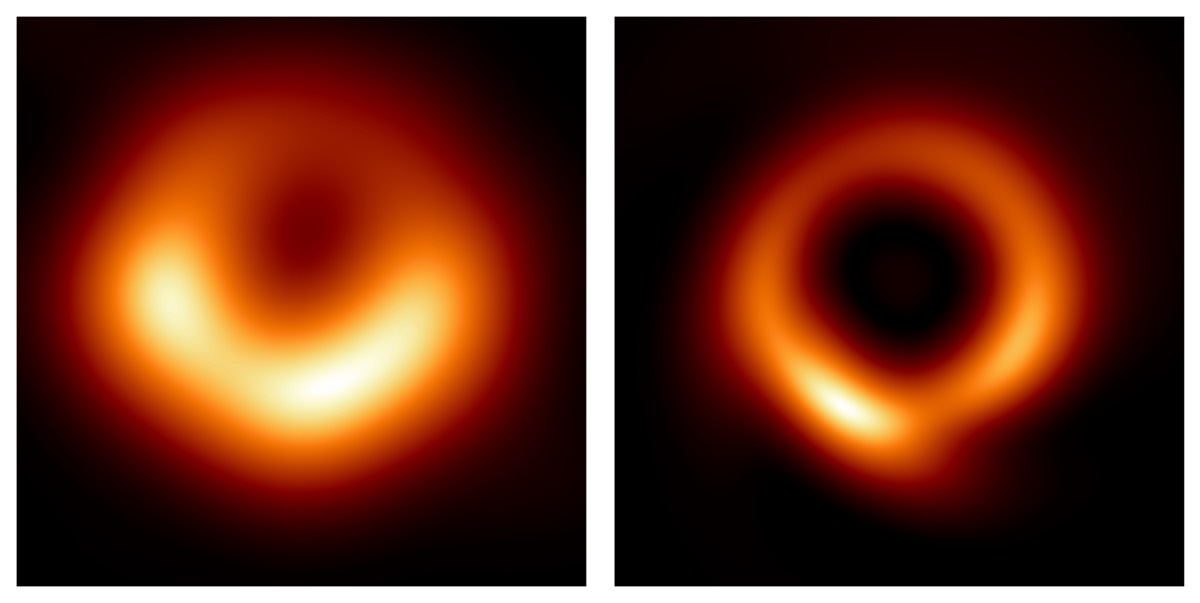
Enlarge / M87 supermassive black hole originally imaged by the EHT collaboration in 2019 (left); and new image generated by the PRIMO algorithm using the same data set (right).
Medeiros et al. 2023
Two years later, the EHT released a new image of the same black hole, this time showing how it looked in polarized light. The ability to measure that polarization for the first time—a signature of magnetic fields at the black hole’s edge—yielded fresh insight into how black holes gobble up matter and emit powerful jets from their cores. That polarization enabled astronomers to map the magnetic field lines at the inner edge and to study the interaction between matter flowing in and being blown outward.
And now PRIMO has given astronomers an even sharper look at M87’s supermassive black hole. “We are using physics to fill in regions of missing data in a way that has never been done before by using machine learning,” co-author Lia Medeiros of the Institute for Advanced Study said. “This could have important implications for interferometry, which plays a role in fields from exo-planets to medicine.”
PRIMO relies upon so-called dictionary learning, in which a computer learns to identify whether an unknown image is, for example, that of a banana, after being trained on large sets of different images of bananas. In the case of M87*, PRIMO analyzed over 30,000 simulated images of black holes accreting gas, taking into account many different models for how this accretion of matter occurs. Structural patterns were sorted by how frequently they showed up in the simulations, and PRIMO then blended them to produce a new, high-fidelity image of the black hole.
Overview of simulations generated for the training set of the PRIMO algorithm. Credit: Medeiros et al. 2023
The new image shows the central large dark region in greater detail, while the surrounding cloud of accreting gas is attenuated to reserve a “skinny donut.” Per the authors, the image is consistent with both the 2017 EHT data and with theoretical predictions, most notably the bright rings that result from hot gas falling into the black hole. The higher resolution will help astronomers more accurately peg the mass of the black hole, as well as tighten constraints on alternative models for the event horizon, and enable more robust tests of gravity.
“With our new machine-learning technique, PRIMO, we were able to achieve the maximum resolution of the current array,” Medeiros said. “Since we cannot study black holes up-close, the detail of an image plays a critical role in our ability to understand its behavior. The width of the ring in the image is now smaller by about a factor of two, which will be a powerful constraint for our theoretical models and tests of gravity.”
PRIMO should prove just as useful for other EHT observations, most notably the first image (released just last year) of the black hole (Sagittarius A*) at the center of our own Milky Way galaxy. While M87’s black hole was an easier, steadier target, with nearly all images looking the same, that was not the case for Sagittarius A*. The final image was an average of the different images from observational data that the team collected over the course of multiple days. It took five years, multiple supercomputer simulations, and the development of new computational imaging algorithms capable of making inferences to fill in the blanks in the data. PRIMO could improve the resolution even further.
“The 2019 image was just the beginning,” said Medeiros. “If a picture is worth a thousand words, the data underlying that image have many more stories to tell. PRIMO will continue to be a critical tool in extracting such insights.”
DOI: The Astrophysical Journal Letters, 2023. 10.3847/2041-8213/acc32d (About DOIs).
Read More
Jennifer Ouellette