

With millions of people affected and at least $1 trillion of economic value at stake, long COVID is our next national health emergency
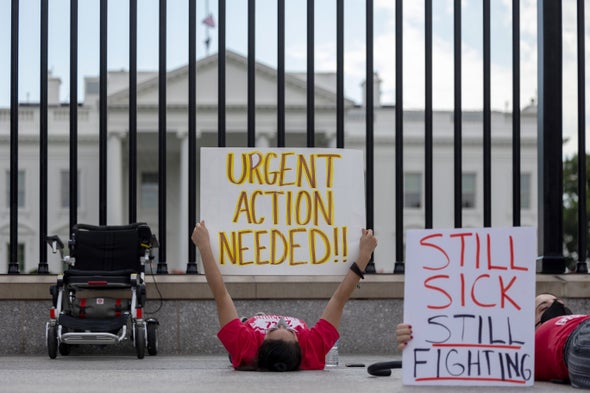
In August 2022, the Brookings Institution estimated that Long COVID is keeping the equivalent of two million to four million full-time workers out of the American labor force, resulting in about $170 billion of lost earnings per year. Economist David Cutler drew similar conclusions and, moreover, estimated the U.S. health costs of long COVID to be on the order of $100 billion per year. These combined estimates imply a real cost of more than $1 trillion over a five-year period, even before accounting for lost quality of life, increased disability costs and the burden on caregivers and the health care system. In our roles observing the health and economic toll of long COVID, these accumulating effects are breathtaking and extremely concerning.
And yet, unlike our earliest responses to acute COVID, there is no “Operation Warp Speed” for long COVID.
Because each new COVID infection carries with it the potential to lead to long COVID, the best way to avoid it is to avoid getting infected with COVID in the first place. However, we have largely abandoned societywide measures to prevent disease transmission, making infections difficult to avoid. This means we are forced to fall back on preventing and treating long COVID—but at this point, we can’t. Even as caseloads and the suffering of the people who care for those with long COVID continue to mount, science around this aspect of disease lacks transformative investment and activity.
The resources mustered by federal agencies, private companies and philanthropists to combat long COVID pale in comparison to those dedicated to the development of acute COVID vaccines, tests and treatments. To gain perspective, we searched the NIH’s research repository using the terms “Long COVID,” “Post-acute sequelae of SARS-CoV-2,” “PACS,” “Post-COVID syndrome,” or “Long haul” (access date March 23, 2023). We found $740.8 million of federal funding for long COVID studies across 218 projects, most of which ($509 million) was allocated in 2021. This reflects only 6% percent of the $11.6 billion in funding and only 2.7 percent of the 8,042 projects dedicated to COVID research overall. Compared to 2021, the percentage of funds devoted to studying long COVID in 2022 was cut by nearly half (from 11 percent to 6 percent)—representing an even bigger drop than it might seem because total COVID research funding decreased over that time period as well.
In March 2020, people began sharing their experiences with illness after acute infection with COVID, leading to the name “long COVID.” Yet, it was more than two years later before the Department of Health and Human Services (DHHS) released a “National Research Action Plan on Long COVID.” This plan announced an Office of Long COVID Research and Practice which has yet to launch. The RECOVER Initiative, aiming to better understand the long-term effects of the disease, has dedicated just $1.15 billion to long COVID research for the next four years. This amount is disproportionate to the scale of the problem. Moreover, scientists and patient advocates have criticized the distribution of these funds as inefficient and opaque. A report by the Rockefeller Foundation earlier this year noted the NIH had funded only eight of 200 active clinical trials on long COVID registered in clinicaltrials.gov and recommended a broad range of long COVID research improvements, including better data sharing, transparency, coordination, leadership, patient engagement and information dissemination.
“The world knows too little about long Covid, and this must change,” the Rockefeller report stated, calling upon the NIH to accelerate its ongoing long COVID research. The private sector response has been even more dismal. Biotech and pharma have largely “skirted” the issue of long COVID, entering the effort in a substantial way only in mid-2022.
No doubt, long COVID’s myriad symptoms present a challenge for developing therapeutics. Perhaps the potential return on investment is less clear for long COVID than with vaccines and treatments. But the continued narrative that COVID is no worse than a cold when it does not lead to hospitalizations and deaths utterly dismisses the significance of long COVID, which can occur even after mild infections. As a nation, we cannot accelerate and amply fund science around long COVID while failing to take it seriously.
The world’s extraordinary progress on COVID vaccines and therapeutics has shown what a coordinated effort across government and industry can accomplish in short order for the public good. A “Warp Speed” response to long COVID could lead to a better understanding of long COVID’s risk factors, whether and how much vaccines and acute treatments protect against long COVID and how such protection may vary depending on factors such as vaccine type and number, therapeutic treatment, COVID variant and viral load. We need to know much more about how to define, diagnose and classify long COVID to enable health care professionals to recognize it more consistently and provide the nation with a more accurate understanding of its incidence and prevalence. And health care providers and those living with long COVID urgently need more guidance to inform support, prognosis and care.
With momentum, political will and multisector funding, we could explore multiple potential pathways of disease at once, including autonomic nervous system damage, immune scarring, viral persistence and coagulation activation. And while further basic research may be required to fully understand some pathways, we do not need to wait on those results to begin to develop treatments for the chronic inflammation and coagulation disorders that we already know afflict long COVID sufferers.
We all wish the pandemic were behind us. But with an ever-growing number of people wrestling with a baffling disease, too little scientific understanding of its mechanism and management, and little effort to avoid its occurrence, we are sustaining the conditions for a long COVID crisis. The reality is that our failure to address long COVID guarantees the pandemic will continue, with dire implications for all of society.
This is an opinion and analysis article, and the views expressed by the author or authors are not necessarily those of Scientific American.
ABOUT THE AUTHOR(S)
Esther K. Choo is an emergency physician and professor in the Center for Policy and Research in Emergency Medicine in the Department of Emergency Medicine at Oregon Health & Science University. She holds an M.D. from Yale University and an M.P.H. from Oregon Health & Science University.
Scott Duke Kominers is a professor of business administration in the Entrepreneurial Management Unit at Harvard Business School; faculty affiliate in the Harvard Department of Economics and the Harvard Center of Mathematical Sciences and Applications and a research partner at a16z crypto. He holds a Ph.D. from Harvard University.
Read More
Esther K. Choo, Scott Duke Kominers