

Dive Brief:
- Overall construction and nonresidential input prices both jumped 0.4% in February compared to the previous month, according to an Associated Builders and Contractors analysis.
- Sharp declines in energy prices have pushed these overall numbers lower in recent months, but there remains “plentiful evidence of lingering materials price inflation and supply chain challenges,” said Anirban Basu, ABC chief economist, in a press release.
- “While the February construction materials price inflation data appear benign, a peek behind the headline numbers indicates that price pressures remain abundant,” said Basu. “With growing pressure on the global banking system and the Federal Reserve still wrestling with excess inflation, risks of recession continue to expand.”
Dive Insight:
Natural gas prices fell sharply in February, down 41.4%, while the price of unprocessed energy materials such as crude oil and coal tumbled 9.1% for the month, according to the report.
Still, natural gas prices remain up about 68.9% since February 2020, while unprocessed energy materials also remain up 76.3% during the same period.
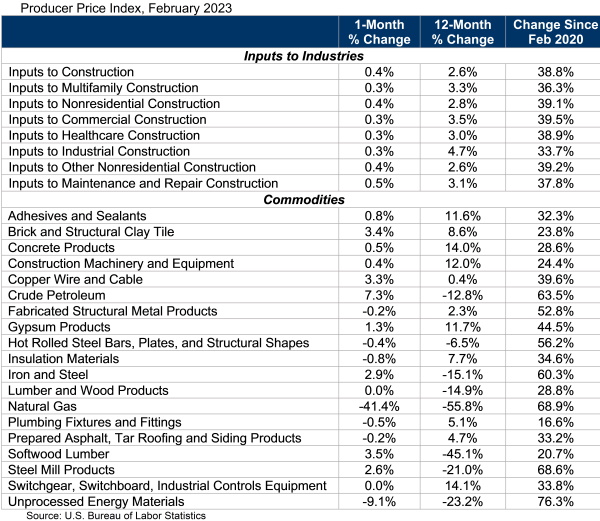
These massive price drops in energy mask widespread supply chain challenges and persistent materials price inflation, said Basu.
Overall construction input prices remained 2.6% higher than the year before, while nonresidential input prices ticked up 2.8% during that same span, according to the report. Since February 2020, overall construction and nonresidential input prices surged 38.8% and 39.1%, respectively.

That’s largely due to increases in commodities such as concrete materials, up 14% in the past year, and switchgear products, up 11.7% in the past year. Meanwhile, on a monthly basis, prices for brick and structural clay tile ticked up 3.4%, copper wire and cable moved up 3.3% and iron and steel prices jumped 2.9% in February, according to the report.
Nevertheless, Ken Simonson, chief economist for Associated General Contractors of America, said earlier this month the U.S. economy should fend off a recession this year. He added that manufacturing and infrastructure projects, boosted by the Infrastructure Investment and Jobs Act and CHIPS Act, remain the bright spot in terms of construction activity.
Still, Basu warns of a possible slowdown for contractors outside that scope of work.
“While contractors performing public construction and working on industrial megaprojects stand to fare well during the years ahead, the fortunes of many other contractors are increasingly threatened by elevated costs of capital, tightening financial conditions and the rising cost of delivering construction services,” said Basu. “Eventually, these factors could whittle away at backlog, which is currently elevated… creating greater challenges for contractors in 2024 or 2025.”
Read More
Sebastian Obando