

Digital technology: The backbone of a net-zero emissions future
Digital technologies will be key to the net-zero transition. They enable decarbonization with their ability to process more data more effectively, identify problems faster, and test solutions virtually. Energy-intensive systems will increasingly find efficiency gains from digital and Web3 technologies such as cloud and edge computing, artificial intelligence (AI) and machine learning (ML), internet of things (IoT) sensors, and blockchain technology.
Data is emerging on the impact of digital technologies on greenhouse gas (GHG) emissions, and their importance is clear. The World Economic Forum (WEF) and Accenture say digital technologies can help the energy, materials, and mobility industries reduce emissions by 4% to 10% by 2030.1 PwC calculates that AI alone can reduce global GHG emissions by 4% by 2030,2 while Capgemini reports that the climate potential of AI puts the figure at 16% across multiple sectors.3
Despite these technologies’ proven impacts, however, organizations have insufficient urgency around their adoption to accelerate decarbonization and emissions reduction goals. Across industry, many leaders leverage partners to support digital transformation, while energy transition remains a secondary objective. Digital and sustainability leaders are taking a surprisingly conservative approach to technology that fails to address current problems. As justification, they cite immaturity of existing solutions, a need for further study or customization, and challenges ranging from intermittent renewable energy supplies to lack of trust in existing carbon trading schemes.
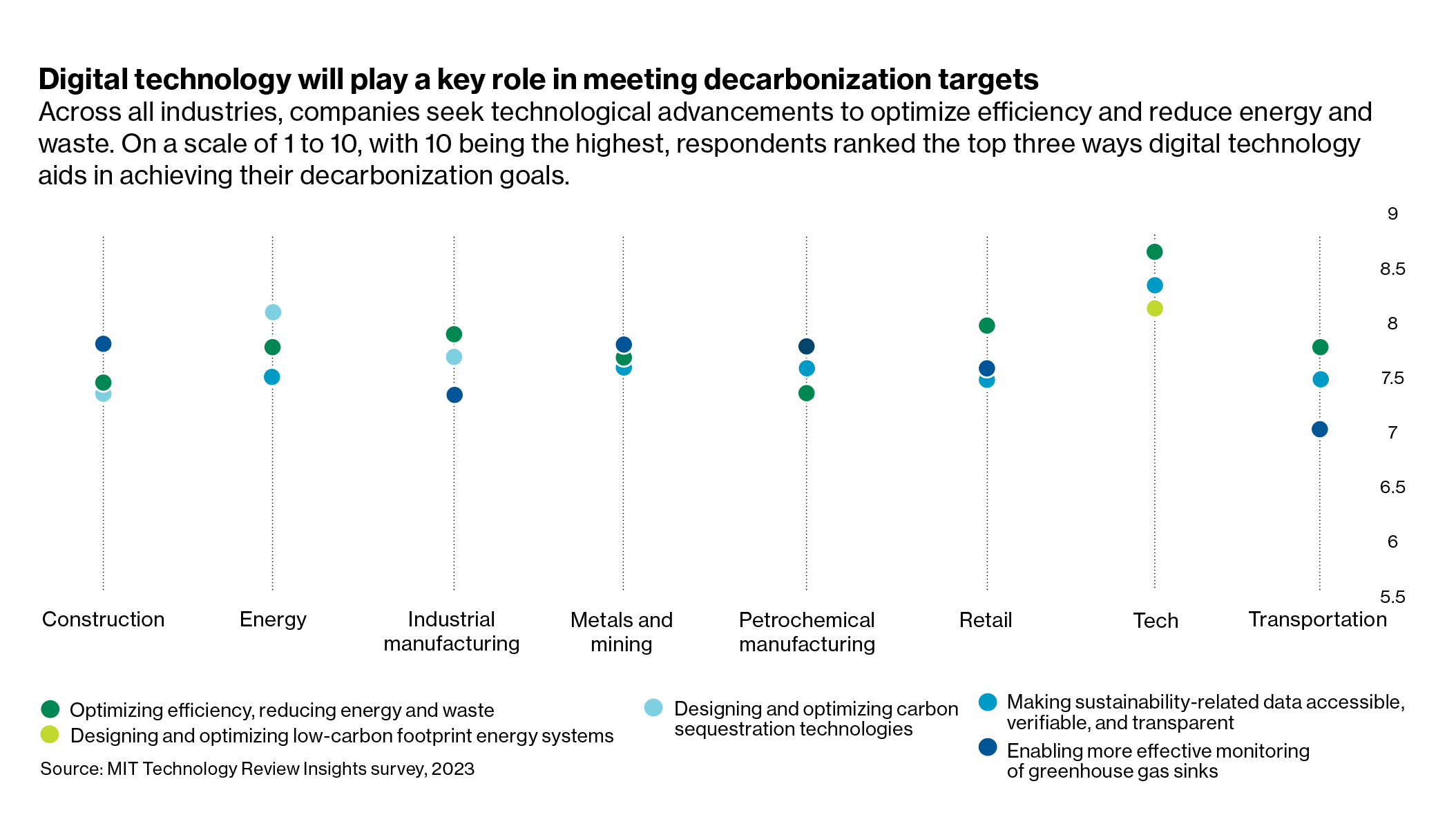
MIT Technology Review Insights conducted a global survey to examine industry leaders’ use of, plans for, and preparedness to adopt digital technologies to reach decarbonization targets. The survey addressed 350 C-level leaders at large global companies in eight major sectors, to gather their perceptions about these solutions. Insights were also gathered from in-depth discussions with nine subject matter experts.
The following are the key research findings:
Digitalization is the backbone that will support energy transition. Despite differences across industries (and across regions), digital technologies are considered important (rated from 1 to 10, where 10 is most important) for optimizing efficiency and reducing energy and waste (scoring 6.8 overall); designing and optimizing carbon sequestration technologies (6.7); making sustainability data accessible, verifiable, and transparent (6.2); monitoring GHG sinks (6.6); and designing and optimizing low carbon footprint energy systems (5.8).
For most industries, the main decarbonization lever is a circular economy. A majority (54%) of participants from all industries (except for petrochemical manufacturing) cite a circular economy4 as their dominant environmental sustainability goal. A circular economy minimizes waste with reduced consumption, increased efficiency, and resource and energy recapture. The second most highly rated sustainability goal is to improve access to clean energy (41%), and third, to improve energy efficiency (40%).
Partnership with technology experts is how industry innovates with digital solutions. The most cited approach to adopting new digital technology is through vendor partnerships (31%). Executives are less likely, however, to emphasize the importance of open standards and data sharing across the supply chain to accelerate digital technology deployment (especially in energy, metals and mining, construction, and petrochemical manufacturing), with only 16% identifying it as the top enabler. Yet, experts say an embrace of open standards and data sharing—essential to AI and ML’s ability to conquer complexity—to streamline the supply chain is “inevitable” to meeting decarbonization goals.

Attitudes toward tech adoption and innovation vary by sector and region. Although cybersecurity is considered the biggest external obstacle to digital transformation overall (58%), construction companies are much more apprehensive (76%), while metals and mining companies are less concerned (47%). Overall, 11% of respondents aim to experiment with digital technology early on, but some sectors are less enthused: only 4% in metals and mining, 5% in petrochemical manufacturing, and 6% in industrial manufacturing. Buy-in and a willingness to learn is essential for cooperation across departments and organizations.
A digital culture is needed to understand and address the challenges of decarbonization. The response to new technology solutions is embedded in culture, but the second most common way companies try new technologies is by simply waiting for them to mature (24%). Only one in four respondents want to adopt a digital innovation culture based on knowledge sharing and a learning mindset (25%). Technology roadmaps (19%) and senior leadership (17%) have similar, lesser influence. The success of adopting digital technology depends not just on the availability of data, but on systems and personnel. It falls to leadership to build digital coalitions of internal and external stakeholders, to encourage willingness to digitally transform, and explain the importance of integrating digital technologies.
This content was produced by Insights, the custom content arm of MIT Technology Review. It was not written by MIT Technology Review’s editorial staff.
Read More
MIT Technology Review Insights