

Forget about He Jiankui, the Chinese scientist who created gene-edited babies. Instead, when you think about gene editing you should think of Victoria Gray, the African-American woman who says she’s been cured of her sickle-cell disease symptoms.
This week in London, scientists are gathering for the Third International Summit on Human Genome Editing. It’s gene editing’s big event, where researchers get to awe the audience with their new ability to modify DNA—and ethicists get to worry about what it all means.
The event got underway Monday with a look back at what organizers called the technology’s “misuse” in China to create designer babies in 2018. That was certainly an ethical dumpster fire and raised profound questions about whether we should meddle in evolution.
But the designer-baby debate is a distraction from the real story of how gene editing is changing people’s lives, through treatments used on adults with serious diseases.
In fact, there are now more than 50 experimental studies underway that use gene editing in human volunteers to treat everything from cancer to HIV and blood diseases, according to a tally shared with MIT Technology Review by David Liu, a gene-editing specialist at Harvard University.
Most of these studies—about 40 of them—involve CRISPR, the most versatile of the gene-editing methods, which was developed only 10 years ago.
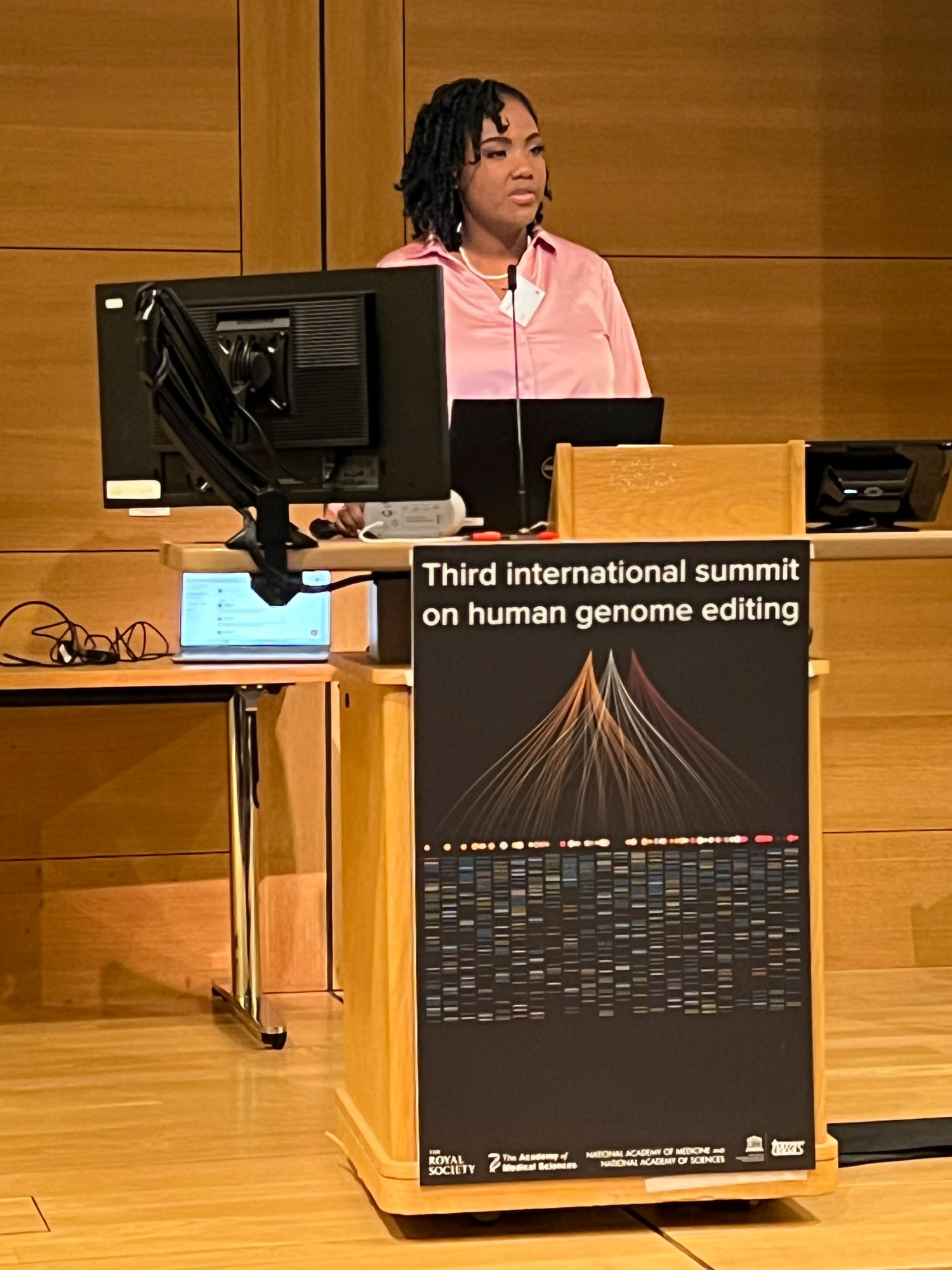
That is where Gray comes in. She was one of the first patients treated using a CRISPR procedure, in 2019, and when she addressed the group in London, her story left the room in tears.
“I stand here before you today as proof miracles still happen,” Gray said of her battle with the disease, in which misshapen blood cells that don’t carry enough oxygen can cause severe pain and anemia.
But Gray’s case also shows the obstacles facing the first generation of CRISPR treatments, sometimes referred to as “CRISPR 1.0.” They will be hugely expensive and tricky to implement, and they could be quickly superseded by a next generation of improved editing drugs.
The company developing Gray’s treatment, Vertex Pharmaceuticals, says it’s treated more than 75 people in its studies of sickle cell, and a related disease, beta-thalassemia, and that the therapy could be approved for sale in the US within a year. It is widely expected to be the first treatment using CRISPR to go on sale.
Vertex hasn’t said what it could cost, but you can expect a price tag in the millions.
A revelation
Researchers say the technique’s march forward to use in medicine has been remarkably fast. “I think CRISPR [has] outpaced every previous genomic therapy technology,” says Fyodor Urnov, a researcher at the University of California, Berkeley.
To scientists, CRISPR is a revelation because of how it can snip the genome at specific locations. It’s made up of a cutting protein paired with a short gene sequence that acts like GPS, zipping to a predetermined spot in a person’s chromosomes.
What’s more, it’s trivially easy to change that GPS sequence, says Jennifer Doudna, the Berkeley biochemist who shared a Nobel for inventing the method. “CRISPR is a technology that enables changes to DNA that are programmed,” she reminded the audience at the summit.
Along with Vertex, a wave of biotech companies, like Intellia, Beam Therapeutics, and Editas Medicine, are hoping they can use this technology to develop successful treatments. Many of them are running the trials on Liu’s list. But not all of these trials will be successful.
For instance, in January the San Francisco biotech Graphite Bio had to stop its own tests of a gene-editing treatment for sickle-cell after its first patient’s blood cell counts dropped dangerously. The problem was caused by the treatment itself. Graphite’s stock has plunged more than 90%, and now the firm’s future is in question.
The trick facing all these efforts remains getting CRISPR where it needs to go in the body. That’s not easy. In Gray’s case, doctors removed bone marrow cells and edited them in the lab. But before they were put back in her body, she underwent punishing chemotherapy to kill off her remaining bone marrow in order to make room for the new cells.
LLUIS MONTOLIU
In essence, the Vertex treatment requires a bone marrow transplant. That is an ordeal in itself, and not every patient will be ready for it. Vertex thinks the treatment will be suitable for “severe” cases, a market it estimates includes 32,000 people in Europe and the US.
Even then, patients won’t get the treatments if insurers and governments balk at paying. It’s a real risk. For instance, a different gene therapy for beta-thalassemia, developed by Bluebird Bio, was pulled out of the European market after governments there refused to pay the $1.8 million price.
CRISPR 2.0
The first generation of CRISPR treatments are also limited in another way. Most use the tool to damage DNA, essentially shutting off genes—a process famously described as “genome vandalism” by Harvard biologist George Church.
Treatments that attempt to break genes include one designed to try to zap HIV. Another is the one Gray got. By breaking a specific bit of DNA, her treatment unlocks a second version of the hemoglobin gene that people normally use only as babies. Since hemoglobin is the errant protein in sickle-cell, booting up another copy solves the problem.
According to Liu’s analysis, two-thirds of current studies aim at “disrupting” genes in this way.
Liu’s lab is working on next-generation gene-editing approaches. These tools also employ the CRISPR protein, but it’s engineered not to cut the DNA helix, but instead to deftly swap individual genetic letters or make larger edits. These are known as “base editors.”
According to Lluís Montoliu, a gene scientist at Spain’s National Center for Biotechnology, these new versions of CRISPR have “lower risk and better performance,” although delivering them “to the right target cell in the body” remains difficult.
At his lab, Montoliu is using base editors to cure mice of albinism, in some cases from birth. It’s a step, he says, toward a treatment newborn humans could receive, although not to change their skin color. Instead, he dreams of putting Liu’s molecules in their eyes to correct severe vision problems that albinism can cause.
So far, though, the albinism project is not a commercial venture. And that points to one of the biggest limits on CRISPR’s impact now and in the foreseeable future. Nearly all CRISPR trials underway aim at either cancer or sickle-cell disease, with multiple companies chasing the exact same problems.
According to Urnov, this means thousands of other inherited diseases that could be treated with CRISPR are just being ignored. “This is near-entirely due to the fact that most of them are too rare to be a viable commercial opportunity,” he says.
At the London meeting, however, Urnov will be presenting his ideas on how treatments could be tested even for ultra-rare diseases, including some genetic conditions so unusual they affect just one person.
That’s not a commercial opportunity, but because of how CRISPR can be programmed to go anywhere in the genome, it’s scientifically possible. Now that gene editing has had its first successes, Urnov says, there’s an “urgent need” to open a “path to the clinic for all.”
Read More
Antonio Regalado